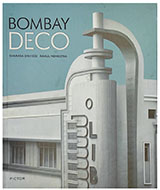
Bombay Deco by Sharada Dwivedi and Rahul Mehrotra. Published in 2024 by Pictor Publishing 152, Maharshi Karve Rd, Opp Oval Maidan, Bombay 400020; website: www.pictorpublishing.com; email: padmini1@pictorpublishing.com. Pp: 239. Price: Not mentioned.
With its large size, lavish illustrations and heavy art paper, Bombay Deco, authored by Sharada Dwivedi and Rahul Mehrotra, might have qualified as a coffee table book were it not for the quality and extent of its pertinent, engrossing and authentic text which lifts it above that genre.
Sharada Dwivedi (l) and Rahul Mehrotra
The first edition of the book was published in 2008, and was then the first detailed survey of the city’s Art Deco architecture between 1930 and 1947. It was sold out soon after its release. A significant event occurred between the two editions: In 2018, after years of studious effort by a dedicated group of enthusiasts, UNESCO (United Nations Educational, Scientific and Cultural Organization) granted World Heritage status to the Oval Maidan in South Bombay and the buildings surrounding it — 19th century Gothic public buildings to the east and Art Deco residential buildings to the west. Though this second edition carries many of the irreplaceable photographs from its predecessor, some have been replaced by fresh ones, and the text is significantly different. In spite of adding an entire new chapter of almost 30 pages by conservation architect Abhay Narain, explaining with detailed drawings the presentation that won the Oval its world heritage status, this edition is down to 239 pages from the first one’s 312.
Bombay’s Art Deco as a style of architecture, furniture, artefacts, signage, and even posters, was at the heart of India’s 20th century modernization, signifying a departure from the earlier Gothic and Victorian architecture that denoted imperial power. And though it, too, was imported, it was voluntarily and readily adopted by people rather than being imposed on them. It arrived in Bombay in the early 1930s, and ruled the roost until Le Corbusier introduced the austere Modernism in the 1950s. Fortuitously, Art Deco coincided with two other major shifts in lifestyle and building construction: the introduction of the "flat” system and the widespread use of reinforced cement concrete (RCC), factors that fed the boom in the building industry then, and incidentally spread the Art Deco style all over Bombay.
There was considerable difference of opinion among architects on the adoption of Art Deco, which was then something new and revolutionary. At the annual dinner of the Indian Institute of Architects (IIA) in 1934, this matter took center-stage. A photo of the august gathering shows a significant presence of at least eight Parsi architects — judging by their traditional attire — and includes a few women as well. An enthusiastic promoter of Art Deco was Claude Batley who created many landmarks in this style, including Cusrow Baug and its Agiary as well as the Breach Candy Hospital. Notable Parsi architects who readily adopted the new style were Sohrabji Bhedwar of Bhedwar and Bhedwar; Master, Sathe and Bhuta; Merwanji Bana and Company; Perin Mistri (India’s first woman architect); Shapoorji N. Chandabhoy and Company; Contractor, Kanga and Company; Taraporevala, Bharucha and Company; and Doctor and Vazifdar. Shapoorji Pallonji and Company constructed many of these buildings, and Bharat Tiles was a prominent supplier of Art Deco flooring for iconic cinemas and residential buildings.
The trailblazers of the Art Deco movement in Bombay were the cinemas, notable among being Regal, Eros, Metro and the highly decorative Liberty that adorns the cover of this book. Many among the 300 that were in operation by 1939 reflected that style in construction and their interiors. But the significance of Art Deco was emphasized by its collective expression in the buildings on the west of the Oval, and the row along Marine Drive. It is believed that the only other collection of Art Deco buildings to rival these is in Miami. Indeed, despite its title, the book also covers examples like the Umaid Bhavan Palace in Jodhpur, a hybrid between Art Deco and Indo-Saracenic, and Morvi Palace, a streamlined interpretation of the style built in 1942. The adaptability of Art Deco to local motifs is shown by the statue of Laxmi atop Laxmi Insurance Building on Sir Pherozeshah Mehta Road; the Bai Pirojbai Maneckji Vatcha Agiary on Dadabhai Naoroji Road which displays diverse, multi-colored materials to good effect; the angular sculpture in stone of the godha (winged bull) adorning the Seth Nassarwanji Maneckji Petit Fasli Atashkadeh at New Marine Lines; and the extensive bas relief on the façade of New India Assurance Building on Mahatma Gandhi Road.
The book, replete with rare photographs of old Bombay, and distinctive details of handrails, trellises, balcony railings, window grilles and signage, is a valuable repository of a significant aspect of Bombay and — to some extent — of India. P. B. J.