Helmsman of the government body to facilitate export of services, businessman Maneck Davar is bullish on trade opportunities
Farrokh Jijina
Businessman, publisher and chairman of the Services Export Promotion Council (SEPC) since November 2019 Maneck Davar stated that the country has the potential to grow export of services by seven to eight percent annually, despite the general economic slowdown. "The government has no option but to focus on services, given that export of services as against goods, is a net foreign exchange earner for India,” he stated in a meeting in his office in mid-December 2019. The union minister for commerce (and railways) Piyush Goyal "has asked SEPC for ideas on what the government should do to boost exports.” Davar believes that "India has an advantage over other countries…English speakers being the most significant of them… Plus there is our Indian native intelligence and ingenuity,” he smiled. Not overly worried about the perceived threat of China in the services export market,
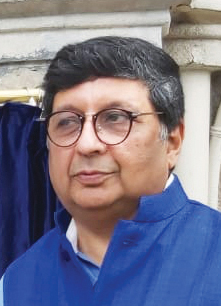
Davar stated that "China has its own ecosystem and a large population to worry about.”
Functioning under the ministry of commerce and industry, SEPC facilitates the exports of services from India in about 12 sectors that include telecommunications and information services, travel, insurance, construction and financial services, among others. As an advisory body, the Council "actively contributes to the formulation of policies” of the government, notes its website. Davar has been associated with the Council for the last seven years, including the last two as vice chairman.
Exporters of goods work on wafer-thin margins, he stated. Even developed markets for goods are "extra price sensitive… In services, if you prove value, exporters can be successful despite competitiveness… We are the only body that looks after the whole gamut of export of services,” he stated. "Others represent only segments… for instance NASSCOM (National Association of Software and Services Companies) caters only to the information technology sector.”
Exports of services from the country for the financial year (FY) ended March 2019 stood at USD 208 billion (Rs 14,83,508 crores), a growth of seven percent over the previous year, he noted. Telecommunication, computer and information services, at USD 86 billion (Rs 6,13,326 crores) accounted for 41%, Davar rattled off. According to statistics published on the SEPC’s website, the country earned net foreign exchange (income from service exports less imports) of USD 82 billion (Rs 5,84,799 crores) in FY 2019.
An exporter of services is eligible for government benefits and subsidies only if the company is registered with the SEPC. The Council has set itself a target to triple membership which currently stands at 3,000 in the next two years, stated Davar whose term will end in November 2021. Members, who pay about Rs 20,000 annually as fees, are eligible for networking opportunities and subsidized participation in national and international exhibitions. The 13 events organized by the Council in the current FY included delegations to China, USA, Burma, France and Australia. "We also subsidize (worthy) foreign delegates to participate in exhibitions here,” Davar mentioned.
Their three-day event "Global Exhibition of Services,” held in Bangalore from November 26 to 28 saw "over 500 participants,” Davar stated. "Apart from the exhibition, the knowledge sessions and the one-on-one business sessions were very positive and encouraging.” The Council prepared a services exports growth strategy for Karnataka which was unveiled on the occasion, he stated.
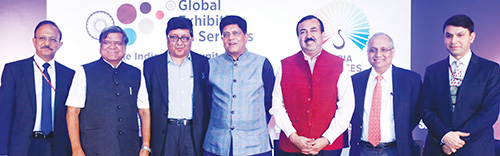
Top: Maneck Davar; above from l: Gaurav Gupta, Jagdish Shettar, M. Davar, Piyush Goyal, Sudhanshu Pandey,
Chandrajit Banerjee, and Darpan Jain at the Global Exhibition of Services in Bangalore
The vision of the Council ("to make India a service exports powerhouse”) and its mission ("to be an effective voice of the Indian services sector globally”) were prepared and adopted under his leadership. New office space has been identified in Delhi, the Council’s headquarters, with new regional offices planned in Bombay and Bangalore. Positions of directors of marketing and membership, finance, and research and policy are being filled, he said. The year 2020 will also see awards for star export achievers. The central governing council of SEPC meets four times a year. "Mini committees to look into administrative matters” have already been set up, he informed us. "Build the organization, build the membership” is his mantra, he stated.
There "must be quite a few” Parsi-owned companies that are SEPC members, Davar said. "It would be difficult to find out as companies are registered, not individuals.”
Davar is the chairman and managing director of Spenta Multimedia Private Limited, a large custom magazine publisher, and other companies in the digital media and publishing sectors. With over 38 years of experience in print journalism, he chairs the Kala Ghoda Association, which conducts the annual Kala Ghoda Arts Festival, and The Society for the Protection of Children in Western India, besides serving on the boards of other nongovernmental organizations. Honorary secretary of the 10th World Zoroastrian Congress, Davar had unsucessfully contested the Bombay Parsi Punchayet trusteeship elections in 2015.