Danseuse Dilshad Patel explains the multiple therapeutic benefits of dance and movement
Mehroo Kotval
"One does not need to impart training in dance therapy, but one gets therapeutic value by dancing,” claims petite danseuse Dilshad Patel of Bombay. The young artiste notes that in her classes, she does not choreograph her dances where the dancer has to follow or imitate the teacher. On the contrary, she mirrors the movements, moving to the dancer’s rhythm, maintaining dance decorum, poise and grace at the same time.
Dance therapy encourages the participant to express a state of mind and emotion through movements, explains Patel. Since movement comes from the participant, it is very different from a conventional dance class where choreographed movement is taught. Dance/movement therapy works from the premise that the mind and the body are inseparable, such that a change in one effects a change in the other. Movement therapy is a kind of psychotherapy based on the concept of using the body as a healing force for emotional distress.
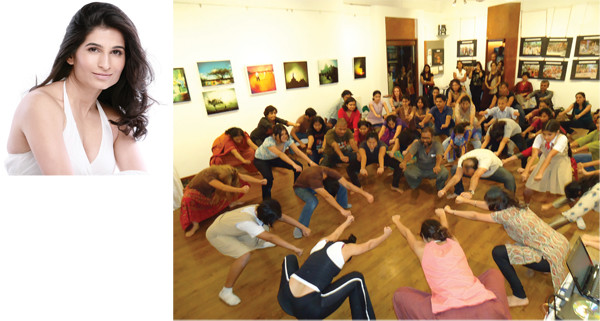
Patel’s workshops are attended by actors, prisoners, corporate personnel, patients, disabled persons — whether mental or physical — and of course anyone who wants to pursue wellness and fitness. If a participant is undergoing lack of self confidence, Patel immediately perceives the stoop, caved-in sternum or any other symptom that she is trained to notice. The bodily expression of such a participant while dancing reflects the emotional and mental being. Patel then typically starts movement for self expression, honing into the state of the participant.
Dance and movement therapy has multiple benefits, says Patel, creating an awareness of the potential one has for movement, as also spatial awareness about how we use space around us. "Have you seen how the Maoist Chinese walk? They have this march-like walk,” she points out. Dance and movement therapy also impacts how one relates to others… When asked how it helps in building relationships, she describes how a child adapts to the mother’s body when carried in a sling at the back as opposed to a harness in the front. There is no wrong lateral connect in a harness as compared to the hunched cling at the back. Simply put, the child curls up in the sling at the back but has an ‘open’ position when placed in a harness. The body reorganizes naturally to movement; in fact research shows that there is dance movement in the womb as well, Patel elucidates.
This therapy aids improvisation, risk taking, eye contact, expressing emotions, communicating and of course overcoming inhibitions, says Patel. By mirroring the participant’s movements and empathizing, it unlocks blockages in the neuromuscular system. It is akin to a psychotherapist who leads by empathic reflection (reflection on sharing in a nonjudg-mental, caring, empathetic manner). Dance therapy does the same thing, using the body… "A person opens up to me through body connection… It is a cathartic process. Not a diagnosis, it is a reflection.” Her write-up states: "A number of quantitative studies have reported change in psychological variables such as depression, anxiety, eroticized affection, self acceptance, integration of movement… through dance and authentic movement, people can identify and express their innermost emotions, therefore bringing those feeling to the surface.” She adds, "My program is the first of its kind in India. By strength training, we are wiring the brain in accordance to the (natural) neuromuscular system as opposed to an outward body movement. Move with the knowledge of the body, it is authentic and not directive.”
(Top): Dilshad Patel’s workshop at the Kala Ghoda festival; (left): Patel (above) leading her class on creative dance and movement therapy workshop
Though Patel performs Afro Caribbean, Bharat Natyam, contemporary, salsa, jazz and Bollywood numbers, she does not let one technique rule her classes. Her motto is "No specialization!” One understands this better as she goes on to explain: "It’s a feel-good class. There is also emotional release, especially stress. It gives time and space to you — each one comes up with what they are with.” This varies from children, relationships, and work stress to what you are reflective about at that time. All this is imparted from her classes held at Tardeo and Bandra. For more information one may look up her website: www.dilshadpatel.com As a by-the-way, she mentions being listed in the A list for the Best of Mumbai published by Mid-day. Her class is seen as something to register for in Bombay.
One experience that has stuck with her is teaching at the Byculla Ladies’ Prison. As always, she led the class with a lot of arbitrary movement, evolving into great bonding and cohesion. This is not surprising as Patel encourages individuals to use their bodies to expand, clarify and broaden their expressive movement potential. It becomes that much simpler for a shunned community to express themselves; as she points out, we deal with movement in our daily lives all the time — we brush our hair, tie our shoelaces, use dramatic effect — this is not much different from self expressive dance. Taking it from there, dance therapy helps in the artistic use of ground.
Patel has already run workshops for nongovernmental organizations (NGOs) such as Happy Home and School for the Blind, Manav Foundation for the mentally and emotionally disturbed, Aseema, The Royal Bombay Yacht Club, Infosys, World Network Systems, Ashok Piramal Group and the Aditya Birla Group — to mention a few. The latest feather in her cap is her participation in the Kala Ghoda festival where she conducted two successful workshops in February this year.
Patel has also conducted a research study in a workshop of 50 heart patients at the Asian Heart Institute. It is still too nascent a stage to talk of the details but her movement therapy workshop for prevention of heart related illnesses left participants asking for more. This was quite a change from the apprehension they felt at the outset. The workshop saw 30 to 70-year-olds coming together.
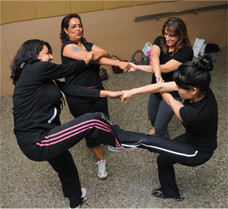
Left: Kids engrossed in learning how to use the body in dance therapy
Starting to learn Bharat Natyam at the age of five (she stood first in a national competition, she shares after much probing), after 12 years Patel switched to being a Shiamak Davar exponent and instructor for the next seven years. The dancing bug caught her and she decided to study dance therapy. Not surprising as her sister also teaches dance in Texas, USA. Dilshad left India on a scholarship, for the Harkness Dance Center, New York. Having left the comfort of her cottage in Bandra, Dilshad had no resting place in New York. She soon found a family, of which she talks glowingly, who put her up. Later, she got admission at the Garth Fagan Dance School, Rochester, New York. The Fagan technique was founded by a choreographer of the same name, who won the Tony Award for the Broadway musical Lion King. Quite a far cry for a girl with a double major in psychology and philosophy. Her father was an employee of Air India before retirement and her mother is a drama teacher. While her dance attire does not lend to wearing a sudreh-kusti, Patel is emphatic, "I will never marry a non-Parsi.” She also favors dakhmenashini as a mode of disposal for the dead.
The testimonial from her dance school director Natalie Rogers-Cropper reads: "The energy and clarity of her instruction in her dance classes are clear proof of her experience as both dancer and teacher… It is clear that Dilshad motivates and gives just the right dose of discipline, criticism, attention and praise to help students from any background improve their quality of life.”
The danseuse notes how important exercise and movement are to create a sense of self esteem, freedom of self expression and self confidence. To quote her: "…being a troubled teenager myself, I found dance was a powerful medium that helped me cope with personal issues. It was a simple dance class that had a positive life changing impact. We are born with an innate ability to move. All we need is a medium, an instrument like our bodies to express how we feel and act upon those feelings.”