An understanding of the prayers
helped in shaping a Zoroastrian consciousness
Aban Mukherji
In the mellow glow of the setting sun, the whitewashed walls of the agiary gleam through the aerial roots of the banyan tree. The stillness of its garden is enhanced by the plaintive call of the koel, drawing me back to my childhood. I feel the presence of my mother walking from room to room, censer in hand, spreading the fragrance of "frankincense and myrrh” throughout the house.
As night falls, Dadaji’s presence permeates the home as six-year-old me devoutly recites the kusti prayers clutching my kisse-kerfe, my pocket of good deeds, overflowing with kindly deeds or at least the good intentions of the day, to be offered up to Ahura Mazda!

To grow up in the inclusive atmosphere of a newly independent India — a land of many faiths as well as in a family that was "never too busy to lend a helping hand, and never too tired to pursue a new idea” — shaped my identity as a Parsi Zoroastrian. And the tale of "Sugar in the Milk” helped me hold on to my Iranian past while effortlessly identifying as an Indian.
Our home abounded in books on Zoroastrianism and Parsi history, and I was very fortunate to have been exposed to the writings of scholars at an early age which helped shape my Zoroastrian identity.
But as a child, confusion prevailed when I had to answer "I am a Parsi” to the question, "Who are you?”
"But why can’t I say I’m an Irani as I come from the land of Iran?” I would argue. "No you are not,” I would be told. "But Pars is a province of Iran,” I would shoot back "so I am definitely an Irani.” Indulgent adults would pat me on the head and tell me to run along and play.
So I would resolve this issue by singing my favorite patriotic song composed by Kavi Khabardar:
"Amé Hindi, Hindi, Hindi (We are Hindi, Hindi, Hindi),
Chhé Hind amāro désh! (Hind is our country)”
Iran was my fatherland in a distant, mythical past, but India was my Madarewatan (motherland), all-embracing and accepting! So I grew up comfortably accepting my Parsi Zoroastrian Indian identity.
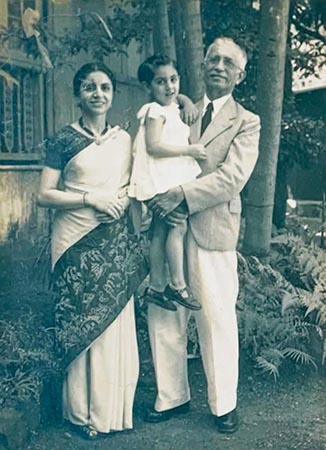
Top: Aban Mukherji; above: as a child with parents
Pareen and Dr Kaikhushru Lalkaka
But this identity was also shaped by the way I was viewed and judged by the wider non-Zoroastrian society in which I moved. Parsis were called kāgadākhāus (crow-eaters), loony, eccentric, harmless, good-natured, kind, honest, lovable and adaptable. Our truthfulness and philanthropy were extolled and the community was often showered with affectionate respect.
In school I found that the "Sugar in the Milk” story [the myth of Parsis adding sugar to a bowl full of milk sent to signify there was place for more people (migrants)] played a significant role in shaping the perception of non-Parsis towards us. Umashankar Joshi, a famous Gujarati writer and poet had composed a poem, Doodhma Sakar (Sugar in the Milk), which I loved reciting (see box).
My parents, wanting me to be fluent in Gujarati so that I would not be divorced from my Parsi Gujarati culture, enrolled me in a unique bilingual school where Gujarati played a significant role in my upbringing.
This decision brought me closer to my Zoroastrian roots. From an early age I could read the prayers fluently in Gujarati; as well as stories from the Shahnameh and the lives of prominent Parsis. I was drawn to the monajats composed in Gujarati as well as the Sarode Avesta — the Gujarati rendering of our prayers sung to Hindustani classical music.
But, paradoxically, the more fluent I became in standard Gujarati, the more distant I grew from the Parsi Gujarati dialect which still preserved many Persian words. It came as a surprise to me to learn that till 1925 Parsi families used to get together in the evenings to read the Shahnameh in Persian.
I often wonder what the bedrock of my faith was that gave me the self-confidence to proudly declare my Zoroastrian upbringing. What made me hold fast to the idea of Asha, the divine law, and find strength and solace in the concept of Vohu-Mano (the Good Mind) and Vohu-Kshathra (the Great power)?
It was, I feel, the importance given to Verse 3.2 of the Ahunavaiti Gatha (Yasna 30.2):
"Hear with your ears the highest truths I preach,
And with illumined minds weigh them with care,
Before you choose which of two paths to tread;—
Deciding man for man, each one for each;—
Before the great new age is ushered in
Wake up, alert to spread Ahura’s word.”
(Free English rendering by Dr I. J. S. Taraporewala)
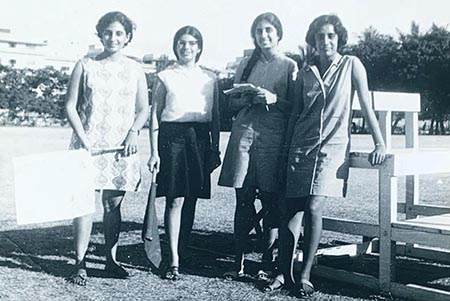
During college days, Aban (3rd from l)
Our prayers, it was emphasized, were never to be learnt by heart without understanding their meaning. This added immensely to my willingness to learn them. It was great fun reciting the Ahura Mazda Khodae, the Pazand translation of the Avestan Kem-na Mazda; for the language had a ruggedness and force that appealed to the dramatic in me. I would loudly belt out "Devan drujan jaduan darvandan, kikaan, karapan sastaraan gunehgaran ashmogan darvandan dush mana parian, zat shakaste bad (May the evil one, the wicked spirits, the false ones, the deluders, those who have left the right path, those willfully blind, those willfully deaf tyrants and doers of evil and distorters of the truth, the evil-minded who have strayed from the path of God, the fair seducers — may all these be frustrated and defeated” Translation by Irach Taraporewala) flourishing an imaginary whip to drive them all into the dark ice-bound regions of the North.
Sometimes it was the words of the original Avestan Kem-na Mazda that lingered in my mind and were made vividly familiar by my aunt, Zoroastrian scholar Piloo Nanavutty’s lyrical translation.
I often found myself effortlessly slipping from the language of the prayers to English — specially the passage in Ahura Mazda Khodae which declared:
"Glory unto Thee O God, who liveth forever. Grant that I relinquish dark doubts, black despair, and tortured reasonings, passing beyond the clutches of Angra-mainyu, the fearful stupor of my evil mind, to the crystal brightness of my spirit.” — translation by Piloo Nanavutty.
I could feel the brightness surround me, almost like a physical presence!
The significance of religious rites and customs had to be understood and even questioned when they seemed to contradict the basic tenets of the faith. Questions were never brushed aside and, if not answered satisfactorily, were encouraged to be mulled over at leisure.
Why do priests race through the prayers at breakneck speed when I am told to pronounce each word clearly and savor its flavor? And why do some of the priests mumble their prayers when Zarathushtra himself was so critical of the karapans, the mumbler-priests?
Why is the Ahunavaiti Gatha recited at funerals when its message is meant for the living?
Why are Parsi women discriminated against when the Prophet accords them equal status as hamkars?
And why were tomatoes and rotten eggs hurled at Dastur (Dr) Framroze Bode by a vicious mob of Parsis at The K. R. Cama Oriental Institute when he courageously held on to the true spirit of Zoroastrianism?
As a child I was witness to this shameful incident which left a deep impression on my absorbent mind, and made me determined to find out for myself what my religion taught.
Another troubling question related to the pallbearers. Why were they treated like outcastes? I remembered reading a passionate essay I had written on this subject in my college days and sent to Prof Rustom Choksey. I was all set to take on the Parsi Punchayet single-handedly, but after Choksey gave me a patient hearing, and the topic was discussed threadbare, better sense prevailed. And the fight was postponed for the future!
Many of my father’s generation, both Parsis and non-Parsis, had been familiar with the Persian language, which had, once upon a time, been the language of administration in many parts of India.
Today, I deeply regret not having learnt Persian, though living in a land that placed no barriers before me to learn and practice my ancestral religion and culture. As I grew older, I grew more and more distant from my Iranian past. And now I often find myself thinking: If only I had studied Persian, how much richer my life would have been! When I watch Iranian films I experience this chasm, this barrier of a language no longer shared by the two branches of the same family.
As an adult I have felt the need to connect with my Iranian brethren, to understand their lives, and the hardships they have faced in their own land. What if my ancestors had remained in Iran? The thought unnerves me. It draws me closer to my Indian identity. I realize that I have come to terms with both my identities. I will always be drawn to Iran to explore my roots, while cleaving to the motherland that has nourished and sustained me.
Looking back on my life as a Parsi Zoroastrian in India, rooted in its soil, it is hard for me to visualize myself as a descendant of migrants from Iran, or fathom the pain of losing one’s country, one’s identity; and the tremendous grit and courage it must have taken to forge a new life and a new identity in a distant land.
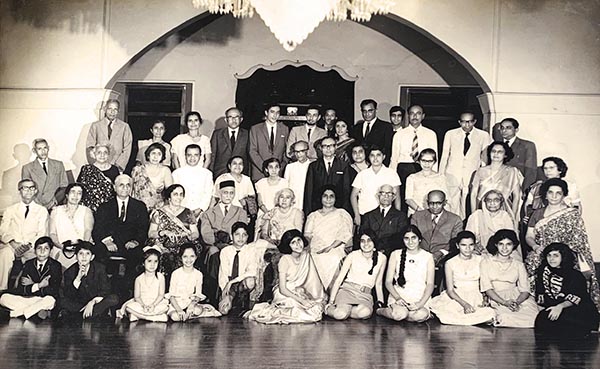
Extended Lalkaka family, Aban seated on the ground, 4th from r
Doodhma Sakar
Parsis, worshippers of fire,
Flee Iran, their religion to protect.
Traverse the seas, to the shores of Gujarat,
To Sanjan (they come), and consider it their home.
To the wise ruler of Sanjan
A messenger is sent with a request:
"Foreigners are we. Grant us refuge.
O King! Remove the sorrow of the pious.”
The King pondered.
Not an inch of land was there to spare.
No space for new settlements was there.
The messenger he dispatched with a bowl brimful of milk.
"Tell your Guru: Accept this milk from us.”
The bowl, overflowing, in the Guru’s hands was placed;
Who, quiet, still, lost in anxious thought,
After a moment, some sugar took
And poured a fistful into the bowl;
And sent it back to the king.
The Raja glanced at it and
Dipping a blade of grass in the milk
Tasted a drop of it.
"Why!” he exclaimed, "Sugar has been added to it!
Go messenger, inform your Guru,
Refuge I readily grant you.
Remain here forever, in harmony and brotherly love
Like sugar (dissolved) in milk.
Fair, resolute, considerate, brave are you.
You will be the jewel of our motherland.”
More than a thousand years have passed.
The Parsis remain lustrous diamonds
Of the Gurjar-land.
(My translation)