Architect Sharukh Mistry’s designs are inspired by his keen
observation of man’s interaction with nature
observation of man’s interaction with nature
Beyniaz Edulji
For three decades Sharukh Mistry, his wife Renu, founder partners of Mistry Architects (MA), along with their team have practiced "natural” architecture, constantly innovating to include every known sustainable means to strive towards an ever lighter carbon footprint. Known for his integrity and inspirational leadership, Sharukh’s tireless endeavor towards holistic architecture takes its inspiration from his keen observation of man’s interaction with nature. Sharukh likes to take his audience on a journey of creative exploration. "Innovating for Sustainability” was a case study done by the Harvard Business School on Mistry Architects in 2007.
Running a diverse practice, ranging from tsunami and earthquake rehabilitation in India and Nepal, SOS children’s villages to giant exhibition centers and campuses engaged in rural education, the Bangalore based firm’s interactions with their clients, the project managers and contractors, the earth on the site, the trees, and the laborers’ children make it unmistakably clear that Sharukh’s architecture definitely has a heart.
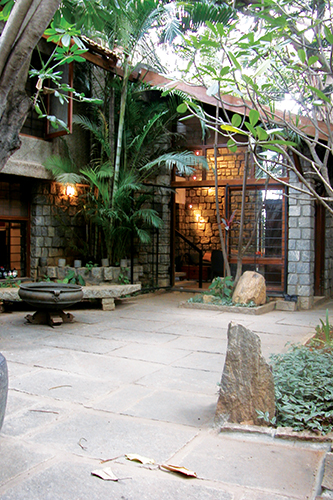
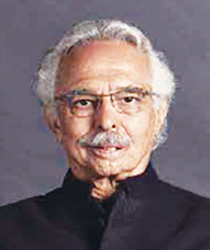
Architect Sharukh Mistry’s (right) house in Bangalore built in 1980
Structure designed by Mistry Architects
Top: Exterior of work done by Mistry Architects; above: interior of Mistry’s home
Kindergarten school in an SOS children’s village designed by Mistry
"For an architectural firm spanning 40 years, I would say that we are a design-centric practice,” he said. Some of their larger projects are The Wipro Corporate Campus in Bangalore and the Bangalore International Exhibition Centre. "We run a Robin Hood practice: a lot of architecture for the rich and famous at one end and socially responsible design for NGOs (nongovernmental organizations) and institutions at the other.” The SOS children’s villages of India and Nepal are very close to their hearts (SOS looks after destitute women and children in marginalized communities and disaster prone locations). The Agastya International Foundation is another organization that they work closely with. On their campus in Andhra Pradesh, MA are involved with creative rural education. Working on these projects "gives us all a high,” he stated.
Awards for their work are many. "Recognition from the fraternity is always appreciated,” says the architect. "It keeps us relevant and encourages us to push our boundaries and our own limitations. I believe that if one has achieved something, it is because a lot of people have helped one get there. Paying it forward is what I do now, with the next generation of youngsters.”
Evolutionary biology, the songs of trees and insects are my new interest and some of these species have been around long before humans. The seminal thought and idea of artificial intelligence and machine learning coming together with biological science inspires him. His personal experience of transplanting large 60-year-old banyan trees "changed my reading of this amazing information system that reveals itself only if one is a seeker and not just a believer. In being a seeker I am also a keen observer of things around me. Tangential thought interests me more than normal responses.”
His nine associates run the day-to-day practice. His main intervention is to engage in design and keep everybody’s happiness quotient high. "This I do by driving them up the wall. The people I work with are fabulous individuals. I realized early in my career that before one designs or builds anything, one has to build a team.” MA was founded in the early 1980s in Bangalore. Today, they have around 35 to 40 people working — a midsized design practice. "Our studio has developed a culture of sharing and caring, and our transparent working creates a sense of equanimity and lasting relationships,” he explains.
Asked what he plans after retirement, he says, "Retire? Never! I love this profession that has given me so much. It is the diversity of projects that we handle that continues to excite me. Yes, I do work long hours and love it. My family and friends tell me to slow down but honestly I do not know how to.”
Born on December 26, 1949 to Roshan and Eruchshaw at Parsi Colony, Dadar, Sharukh notes "Dad worked hard at Century Mills in Lalbaug. My mother cooked and sold food and at times I was the delivery boy. I enjoyed it thoroughly, as I made my first girlfriend on the job.” Their household was made up of his grandmother, mother, father and five other siblings: Dadi, Povru, Dinsoo, Ketu and Nalli Ketu.
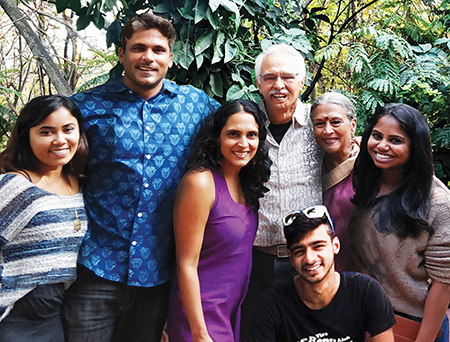
From l: Zia, Umeed, Arzu, Sharukh, Renu, Vira and (sitting) Zohan Mistry
His growing up years were filled with fun and learning, brought up with lots of stories from the Shahnameh by his grandmother. Sharukh played cricket and football, climbed fruit trees and broke window panes while trying to get mangos, visited Ervad Rustomji Panthaki at the (Dadar Athornan) Madressa, now Dadar Athornan Institute. The Parsi community was all he knew then.
Attending Don Bosco School exposed him to larger stories and narratives of people. "I was moving away from a single silo of one community to the big picture of an all-inclusive humanity.”
Regardless of the financial situation, the general happiness quotient of the family was high. "Simple things made us happy,” Sharukh recalled. "We did not need much to laugh and have a good time. It was tough going.” And if that were not enough, when he was 10 years old his mother decided to adopt her cousin’s daughter as they were more disadvantaged. His mother said, "We are five, how does it matter if we have one more? And so entered Nalli Ketu.”
Asked what made him decide to become an architect, Sharukh says, "My brother Dadi gave up his education so that he could work and fill the empty coffers of the family. I am an architect today because of his sacrifices. I will never forget his support and unconditional love that I continue to receive even today. Sharing the good and tough became part of our ethos…
"All of us were left to our own devices and since I believe that God loves idiots, he sent my way friends and elders to guide and influence this wayward lad. They pushed me to become the professional that I am today. They gave me books to read and go beyond my limitations.”
Initially he wanted to be an air force pilot. However, a friend’s grandmother who was an astrologer and fond of him, persuaded him to follow the path of design and art. His uncle Homi Shroff gave him books on architecture and introduced him to his architect nephew Rumy Shroff and his partner Noshir Talati. Sharukh interned with them through college. "They became my first mentors.”
As he could not afford a five-year degree course. Sharukh joined a diploma course of seven years at the Academy of Architecture (now Rachana Sansad). College would start at 6.30 a.m. and end at 10 a.m. A full day’s studio practice was followed by karate with Pervez Mistry. Then it was gallivanting around town and back to the office to prepare for the next day’s college submissions. "Mom used to say that I used the house as a dharamshala!”
While working with Noshir and Rumy, Renu, a cerebral South Indian topper from the Indian Institute of Technology, Kharagpur, walked into his life. Sharukh started to read Lebanese-American writer and poet Khalil Gibran to impress her. They married and the couple headed for Iran.
He has very "fond memories of Iran.” During conversations with his Iranian colleagues, he would pull their leg by saying that he was an original and they are all converts. "When that did not suit me I was out-and-out Indian. All of this in jest of course!”
With Renu, his mother Roshan, in-laws Indira and Pundarik, the family moved to Bangalore in 1980. With their five children Arzu, Umeed, Vira, Zia, Zohan, and dogs Khichidi and Flip, "there is never a dull moment. I learn a lot from my kids as their energy and enthusiasm are contagious. I have started working with them on some of the larger issues that find common ground between us.” Arzu has completed her masters in arts education at Harvard and teaches in Bangalore and the US. Umeed is a scuba instructor, underwater photographer, videographer, filmmaker and writes articles, gives talks and conducts workshops related to oceanography while Vira has completed her master’s in development studies in human rights from The International Institute of Social Sciences at the Hague and is currently starting a related entrepreneurial venture in the Hague. Zia is an artist and muralist and Zohan is a Professional Association of Diving instructor working in Goa. Renu is a professional in her own right and heads DWAR Ecodesign, a design built practice. "She is this giant banyan tree under whose shade we all grow.”
The community’s past contribution and philanthropy inspires him. "However, what has got us here will not take us to our next destination. When beliefs stop evolving and changing, dynamism is replaced by dogma. We then do not listen to other voices that are telling us to go beyond narrow religious constructs… It is inclusiveness that makes me realize the largeheartedness of this amazing country. It opened its doors and accepted us.This gift still stares me in the face and I do all I can to become part of this enriching web of life.”