In the late 70s, Indian Airlines was a monopoly carrier. Its standard snack was either chutney or cheese sandwiches. The boisterous, young Parsi architect on the Bombay-Bangalore flight, bearing a striking resemblance to the King of Spades, challenged his travel companion across the aisle to place a bet on which sandwiches will be served. "I say cheese. 5,000 rupees,” he said in a Parsi Gujarati accent with a slight lisp. "Chutney!” shouted the rotund textile magnate, accepting the bet. Chutney sandwiches were served and the Parsi, without wasting a moment, whisked out his wallet and handed over five Rs 1,000 notes to the friend, much to the amusement of the air hostess.
As the plane was about to land, the architect again swung into action. "Quickly!” he urged, "I say it will be a bumpy landing. Rs 10,000.” The textile fellow accepted the bet. The landing was smooth. The Parsi paid Rs 10,000 with a smile. "I will recover this before the weekend is over,” promised the architect. The weekend saw the Winter Derby in Bangalore. Those were the glorious days of horse racing. Maharajas and cine stars rubbed shoulders with textile magnates and barristers. Our friend, though from a middle class Parsi family of a practicing priest, was beginning to make an impact. When he entered the bookmakers’ ring, with the top buttons of his batik silk shirt open, and that carefree smile, even seasoned bookmakers became alert. He knew little about the form, handicap or record of a horse. His eyes just darted from one blackboard to another where the bookies wrote, rewrote and rubbed off the fluctuating odds, prior to the commencement of a race. In stock market parlance, he was not bothered about the fundamentals, only the technicals. This suited his impulsive, hyperactive mind which jumped like a monkey from one branch to another.
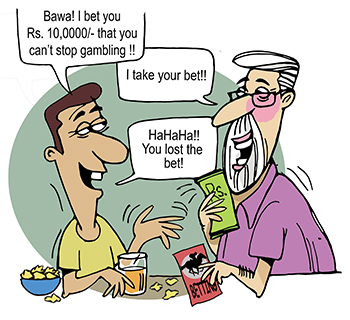
Illustration by Farzana Cooper
In his profession, where his stature was growing by leaps and bounds, his decision making was equally fast and instinctive. Without any doubt, he was a genius. Designs and dimensions, concepts of space and expanse, just floated into his restless mind. Lesser mortals were often aghast at his erratic instructions, and later astonished, when his plans materialized brilliantly. As if he was unconsciously attuned with the Cosmic Mind. He single-handedly introduced his brand of interior design to India. Iconic buildings in the city bore his unmistakable stamp.
He did not have even the slightest complex about his humble background, his Parsi Colony accent or his Gujarati- infested English. He strode with confidence into boardrooms and bedrooms of the rich and mighty. Once he was invited into the bedroom of an aging matriarch of foreign origin, to discuss the renovation of her bungalow. As he entered, with his trademark swagger, he was stunned to see his client as nude as a statue. Restoration was obviously not the only item on her agenda. Very happily married, he could compartmentalize love and sex with consummate ease.
His practice grew exponentially, and the elite sought his services at any price. A workhorse and a perfectionist, he was able to charge astronomical fees. The affable, easy-going architect was the toast of the town. Soon he was a brand countrywide. He loved steel and marble and bold designs. The minimalist, the subdued and the understated was not for him. Of course, his work was never gaudy or over the top. Maybe a trifle ostentatious. However, such were the tastes, 20 years ago.
When he was not dreamily doodling design, he negotiated, with great charm, real estate transactions. He was one of the pioneers in buying distressed assets or properties with a defective title or encumbrance or embroiled in a regulatory hurdle (lafraawali property). His hectic professional day was interspersed with betting on horses. If he lost too heavily, and most of the time he did (like all those who are foolish enough to gamble on horse racing in India), he hiked the fees for the next client that walked in.
In his younger days, gambling had caused him much distress. Whatever the situation, he always honored his bets. That’s why the bookies loved him and allowed him credit even in his bad times. Sometimes he lost so much that his innate optimism deserted him, and he turned suicidal. Within days, however, he would bounce back, with that half-roguish smile on his handsome face.
His venture into real estate yielded mixed results. Unfortunately, in Bombay real estate, his temperamental genius had no place. Often, his thriving practice had to subsidize his real estate commitments and, of course, his perennial gambling.
For his family and close friends, he was god. His table and heart were large and inviting, even when he was near bankrupt at times. The good life oozed out of him and his charming wife; they were invited to every happening social event in the city. Page 3 celebrities, they seldom ate dinner at home. Barring some pink champagne, he was almost a teetotaler. Every morning, like a Michelin chef, he would plan the menu for the day. Akoori and taja boomla (freshly fried Bombay ducks) were his favorites. His ample kitchen never ran out of food for a steady stream of uninvited guests.
It was difficult even for an enraged creditor to have an angry outburst. He disarmed them with that twinkle in his bright eyes. "Look, I have no money to pay you,” he told a business partner in some real estate venture gone wrong, "but here, take these keys of my Lexus.” He was more than fair to his partners, generous with his children, liberal with his servants. A failed deal never made him despondent. However, being garrulous sometimes landed him in trouble. He never turned a cynic. Anger seldom sat on his brow. His powers of persuasion were immense.
His legion of admirers counselled him to give up gambling. In his later years, bookies took undue advantage of his inability to keep a record of his betting. He lost crores. Betting from his bedroom, he listened to the racing commentary on the phone. In a strange way, he had attained equanimity. If his bet succeeded, he was not delirious with joy. If he lost, he showed not a flicker of emotion. Mechanically, like an addict, he dialed those vulture-like bookies and placed his next bet. When he consistently won, he felt bad for the bookies. It almost appeared as if losing gave him some sort of a high. Adrenaline flowed at the thought of the risk of losing.
He had plenty in life to be thrilled about. A doting spouse, loving children, warm friends, an army of admirers and a genius mind. Yet something within him compelled him to gamble. Perhaps a subconscious desire to lose. Winning always can be so boring. Chutney sandwiches, anyone?
Berjis M. Desai is a lawyer in private practice and a part-time writer. He considers himself an unsuccessful community activist.