"Suna, this is your labor of love and we are proud and thankful for the voice you have given the Parsis of Singapore.” Rustom Kanga lauded the efforts of his late wife at the launch of her book The Parsis of Singapore: History, Culture, Cuisine on April 19, 2017 under the auspices of the Institute of South Asian Studies (ISAS), National University of Singapore (NUS) by Grace Fu, minister of culture, communication and youth, Republic of Singapore.
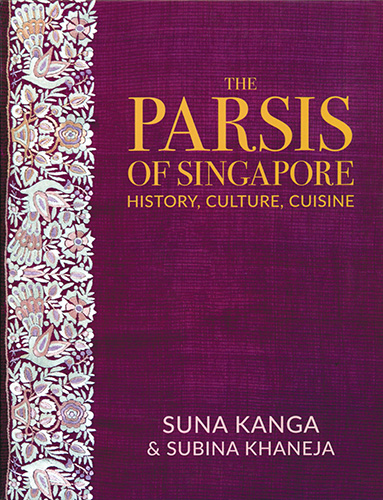
A journalist residing in Singapore, Suna who had done considerable research on Parsis over the years, worked in full steam once she received a grant from the National Heritage Board of Singapore in June 2014. She began by reaching out to the Parsi residents, interviewed the old prominent families who had contributed to the growth and development of the nation, and pored through archives to collect information and photos on the early settlers. Members of the community extended whole-hearted support to Suna, eagerly lending articles, ritual vessels, traditional clothes, and even recipes that are featured in a special section on Parsi cuisine.
Regrettably she could not complete the book due to an illness which took her away in February 2015. Spirited Suna had wished to live life to the full till her last breath, seeking no pity or sympathy from friends and relatives who became aware of her malignancy only after her passing away. Only her immediate family were privy to her secret.
Rustom and their two children, Nazneen and Cyrus, both professionals working in the USA, were determined that her efforts find fruition. A mutual friend introduced them to a freelance writer, Subina Aurora Khaneja, who did further research on her own and helped Rustom in completing the book.
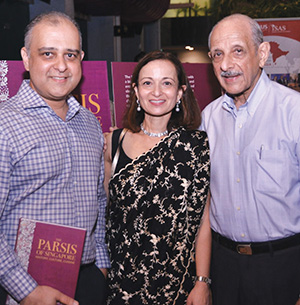
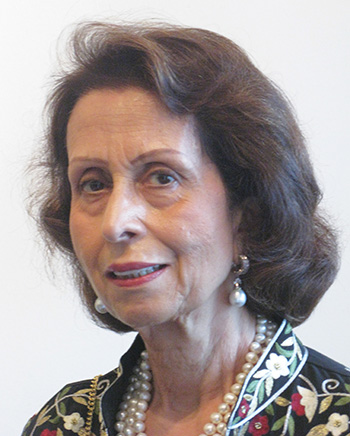
Cyrus, Nazneen, Rustom and Suna Kanga
Dignitaries at the book launch with Subina Khaneja and Grace Fu (3rd and 5th from left)
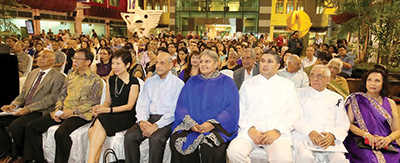
Rustom informed the audience numbering more than 350 that Suna felt the need to create awareness of this distinctive community and its culture and history, after endlessly having to explain who the Parsis were. When the manuscript was ready he finally approached Edmund Wee, of Eprigram Books, who had not heard of the Parsis. He inquired how large the community was in Singapore. When told that there were 350 persons, he asked incredulously "How many books can I sell?” He was impressed however when he learnt of the contribution of the Parsis to the growth and well-being of their adopted home and agreed to take on the job.
Khaneja spoke about her involvement with the project explaining that she undertook further research from where Suna had left off, and added the section on Parsi Craft, showcasing the gara and tanchoi tradition. She organized photo shoots for the textile chapter with the Parsi residents whom she met and interacted with. She was able to unearth hitherto unknown material regarding Parsi theater groups which visited Singapore and other South Asian destinations performing plays based on Indian, Mughal and Persian mythology. This features in a chapter entitled "Wayang Parsi.”
Prof Tan Tai Tong, ex-director of the ISAS, and vice president (academic affairs) at Yale-NUS College talked about an interesting project undertaken by the NUS when the President of Singapore S. R. Nathan cautioned that much of Singapore’s history and cosmopolitan social makeup would be lost if attention was not paid to the myriad communities who contributed to its growth. At his urging, the very first encyclopedia on the Indian diaspora was produced by the NUS in 2004, to be followed by one on the Sri Lankan diaspora. The late Nathan had wanted a similar study of the Parsis. Suna’s work, though independently done, could be a forerunner of an encyclopedia on the global Parsi diaspora, Rustom hoped.
Several donors who had contributed towards the publication were invited on stage and were presented copies of the book. Prof Subrata Mitra, director and visiting research fellow, ISAS, ended with a vote of thanks.
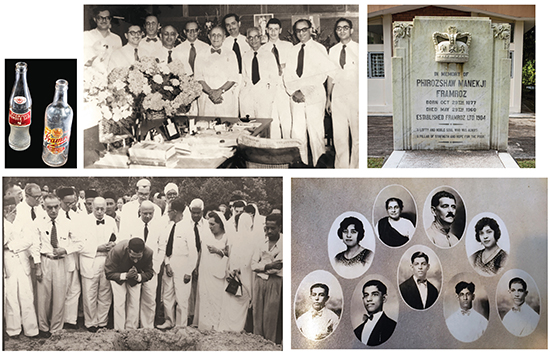
Framroz Aerated bottles; at the 50th anniversary of Framroz Limited; Phirozshaw Framroz’s
tombstone bearing his company logo, a crown; At Navroji Mistri’s funeral, 1953; Manecksha family
Giving back to Singapore
The Parsis of Singapore: History, Culture, Cuisine by Suna Kanga and Subina Khaneja. Published in 2017 by Epigram Books, 1008 Toa Payoh North #03-08, Singapore 318996; website:
www.epigrambooks.sg. Pp: 256. Price: SGD 60 + postage extra.
The island city of Singapore stands today as a brilliant example of innumerable ethnic communities co-existing and prospering peacefully. For centuries, ethnic Chinese, Indian, Arab, Malay and Jewish settlers have made the island, 31 miles long and 17 miles wide, their home where they each retain their identity while co-mingling with others. The Parsis, numbering around 350, form an integral part of this amalgam.
Department store John Little where Cursetjee Framjee was a partner in 1850s
Mistri family with bust of Navroji Mistri at Singapore General Hospital
Navroz celebration in 2016
Homiyar and Vidya Vasania with framed photo of Dara Vasania at Zoroastrian House (right)
Since little was known about this minuscule but vibrant community residing in Singapore, it was felt that the Parsi presence in Singapore needed to be recorded. Suna Kanga, a veteran journalist, undertook this project with a great deal of enthusiasm. A grant from the National Heritage Board of Singapore kick-started research for her book. Initially it was suggested that she bring out a book on Parsi cuisine but Kanga decided on a more worthwhile exercise of documenting the history, culture and cuisine of the Parsis of Singapore. It was her way of giving back to Singapore all the joy and prosperity this city state had offered her and the Parsis of Singapore.
When Suna and her husband Capt Rustom Kanga, a pilot with Singapore Airlines settled in Singapore in 1974, Parsis numbered 40 in a population of 2.5 million. Former associate editor with the Onlooker magazine in Bombay, Suna continued her passion for journalism in her new home, contributing travel and lifestyle articles in Straits Times, The Tatler, The Peak, Wine and Dine and many foreign publications.
The Singapore Parsi story goes back to the early 19th century when adventurous Parsi traders from India started looking towards the east for trade with South East Asia and China and set forth in sailing ships laden with cotton, textiles and opium, and brought home spices, tea, silk, porcelain and many other products. Singapore was en route to the Far East and became a gateway for England’s trade with China in which Parsis played a prominent role. The well-known firm of Jamsetjee Jeejeebhoy and Sons, among other trading companies which had interest in Macao, Canton and Hong Kong, sent Parsi men to Singapore to work with the shipping and trading
companies.
The names of several Muncherjees, not all related we presume, appear in the pages of this early history of Parsis of Singapore. There was Framjee Muncherjee who was allotted a piece of land in 1820 by Sir Stamford Raffles. Then there is an interesting story of a convict named Muncherjee. The British colony of Bencoolen in Sumatra was the penal settlement for British prisoners. However the British ceded it to the Dutch by the Treaty of London in 1824. The ships bringing convicts now made their way to Singapore which had by then been made a British Crown colony in 1819 by Raffles. Later with the transfer of the Straits Settlements to direct colonial rule in 1867, Andaman and Nicobar islands became home for the British prisoners. Surprisingly archival records show several Parsis among the convicts. A set of 18 Parsis were accused for the murder of one Muncherjee Hormusjee. However only one among them, Burjorjee Jamsetjee, was sentenced to death.
Cursetjee Muncherjee Moosh, a merchant trader and shop owner, also shows up in the records of this period. This Muncherjee had severe reversal of fortune. He made profitable business of buying shipwrecks and their cargo. But in his business dealings he got embroiled in legal battles with the brokerage firm of Jeejeebhoy, Dadaboy and Sons in 1851 over non payment of mortgage to the firm. He was even named in a massacre plot in the aftermath of the Indian Rebellion of 1857.
When a serious illness took the life of one Muncherjee, an Armenian friend Aristarchus Sarkies persuaded the Parsi traders in China to buy land for a burial ground. As Parsi traders spread in Singapore, Macau, Canton and Shanghai, a trust was formed in 1822 in Macau for Parsi cemeteries in these areas. The infrastructure necessary for community living was slowly established. Predictably, soon some more land was bought in Singapore adjacent to the burial plot and a bungalow constructed which was known as the Parsi Lodge. Traders, only men in those days, travelling to Singapore to and from China used the Parsi Lodge.
As Singapore developed, these early landmarks of Parsi history have disappeared, however remnants of the burial site with a few graves on Mount Palmer Hill stood till 2016 when the Singapore Metro acquired the land for a new MRT station. Unfortunately no picture of
the Parsi Lodge remains; those were not the times when instant clicks from smart phones recorded events and institutions pictorially.
Another successful businessman, Framurzee Cursetjee, a prominent freemason and philanthropist owned vast stretches of property and lived in a bungalow adjoining the Parsi Lodge. Moving in the society of wealthy and important Europeans, it is a mystery how at the end of his life he became bankrupt and had all his assets taken away by his creditors. However, as the burial ground and Lodge had been set up as a trust by the Parsis of Canton, these properties escaped being attached when he became insolvent. An interesting footnote to Cursetjee’s life followed. He had married an English woman, Maryanne Scott, and had three children Sorab, Rustom and Isabella. After Maryanne’s death the children were brought up by their maternal grand parents in Liverpool, England. Decades later, in the 1990s, Isabella’s granddaughter, Mary Clemmey, came searching for her Parsi roots and discovered her Parsi heritage in Singapore. It is such nuggets that add interest to Kanga’s narrative.
To have a Parsi Road in a prime financial district in the 19th century with such few Parsis in Singapore would be considered unusual and perhaps an indicator of the influence exerted by some of these early Parsi residents in the life of the colony.
This 19th century period of British colonial history was consciously blocked out by English historians because of the stigma attached to the illegal opium trade with China. In that respect, Kanga’s archival work, unearthing stories of the early Parsis in South East Asia, of which Singapore was a significant part, fills in some further gaps found missing in the colonial history of
the time. Novelist Amitav Ghosh’s Ibis trilogy deals with this period. As Parsis were majorly involved in this trade, members of the community featured prominently in Ghosh’s novels.
Once these Parsi businessmen established themselves in Singapore and acquired wealth, they displayed philanthropic and charitable inclinations. Even today descendants of those philanthropists carry forward the charitable work started by their forefathers.
Byramji Hormusjee Cama and Company, established as merchants and general agents in 1849, had endowed a college in India, initiated scholarship schemes in London and Singapore, and started the Cama free school in Singapore in 1864 which was free for all locals and run at his expense for many years. When due to lack of adequate infrastructure and space the Tan Tock Seng Hospital reeled under high mortality rates, Cama stepped forward with a donation of $ 1,000, a large amount those days, to help the Hospital.
By the mid 19th century, Parsi settlers had established themselves as merchants, commercial agents, insurance agents and gained prominence in the economic activities of Singapore. Behramjee Pestonjee was a member of the Singapore Chamber of Commerce, while Dhunjibhoy Hormusji was a member of a Grand Jury in 1854. The 20th century saw doctors, lawyers and more recently information technology, finance, media and advertising professionals settling in Singapore.
In the section, "People With Heart” the authors continue the story of Parsis during the 20th and 21st centuries, describing their trials and tribulations during the Japanese occupation in World War II and showcasing their success in business and industry through sheer hard work. They grasped opportunities that came their way and contributed to the development of the island nation. Navroji Mistri, a self-made businessman and bachelor started the Phoenix Aerated Water Factory in 1925. This Factory had the most hygienic aerated water equipment in the Far East and supplied soft drinks to the British and Indian armed forces. Mistri was conferred the title of officer of the prestigious Order of the British Empire (OBE) in 1947. Once when Navroji was being treated at the Singapore General Hospital the plight of children lying in the corridor of the Hospital prompted him to make a donation of $ 9,50,000 that helped create the Children’s Wing named after Mistri in 1956, related his nephew Noshir. Three generations of Mistris have resided for 100 years in Singapore.
Another bachelor Pesi Daver, a cousin of Navroji, is well known to almost every educational institute in Singapore as a benefactor of scholarships and bursaries for the advancement of needy Singaporeans. From his estate of four to five million dollars managed by HSBC bank, donations of $ 1,50,000 to 2,00,000 have been made every year since 1980.
The Maneckshas were early pioneers in Malaysia. They acquired rubber estates and also imported leather goods, glass, stationery, etc from the UK. Three generations of the Maneckshas, many of whom are lawyers, have been based in Malaysia and Singapore. The Japanese occupation of Singapore during World War II compelled many Parsi families to escape and hide in remote places. There is the story of the Maneckshas hiding in their rubber plantation. When peace was restored they found their belongings looted. A member of the Manecksha family, Nelly Doctor recalls that her father and uncle had been married on the same date with their wives wearing identical white saris with pure silver zari borders. One day walking along a street, her uncle saw a vegetable seller wearing a similar sari. On enquiring, he found that she had got it from a Japanese. He pleaded with her to sell it to him which she did. So the sari returned to the family! Doctor transferred the silver border to a red, satin sari which she wore for both her daughters’ weddings. A photo of Doctor in the red sari features in the book. Such fascinating material sourced from archives and diligent interviews with present residents makes the book engrossing.
Among the Parsis prominent in the field of medicine and health are Drs Pesi and Piloo Chacha. An eminent orthopedic surgeon specializing in reconstructive micro-surgery, reattaching severed limbs and fingers, Pesi is well known as a teacher, researcher and trainer. His love for academia has earned him the French award Ordre des Palmes Academiques in 1976, the prestigious Arris and Gale Memorial Lectureship of the Royal College of Surgeons, England, and others.
A young mechanical engineer from the Indian Institute of Technology in Bombay and the Institute of Management in Ahmedabad, Homiyar Vasania, accompanied by his wife Vidya, came to Singapore as an investment banker in 1990. When his father Dara Vasania died unexpectedly en route to his son, the support given by the Parsis persuaded him to perform the last rites in Singapore instead of taking the body to Bombay. Overwhelmed by the community support and the realization that the Parsis in Singapore did not have a place for gatherings and religious ceremonies, the Vasanias bought a shop house property in town and rented it to the Zoroastrian Association for one dollar a month in memory of their father. Named Zoroastrian House (see "Success in Singapore,” Parsiana, February 7, 2013) this has become the office of the Association and venue for all gatherings including the annual gahanbar that is observed each year on the anniversary of the Zoroastrian House inauguration. The 2017 gahanbar took place a couple of days after the book launch when some overseas visitors got to interact with the young and vibrant Singapore Parsis. Food was prepared by volunteers, led by Freddy Bavaadam whose passion is cooking.
Among the other well-known individuals of Singapore are social workers Keki and Nargis Medora, Soli and Behroze Setna, Phiroze Medora, an authority on insurance, Dr Jimmy Daruwalla who came to Singapore to work with Dr Chacha and ended by establishing The Dyslexia Association of Singapore, Rusi Ghadiali who devotes his time to interfaith organizations amongst many others.
As with many books on Parsis, the book under review also starts with the background of the Parsi arrival in India, their religion, customs and traditions. When Subina Khaneja joined the project, she researched more material, organized photo shoots and added a section on Parsi art and Wayang Parsi (Parsi drama). Early Parsi theater companies toured Malaya from the 1870s performing plays based on Indian, Persian and Mughal mythology. These groups performed in Gujarati, Urdu and Hindi. Later Malay was added as their song, dance, drama and comedy routines gained much popularity and inspired local companies to start creating their own "tiruan Wayang Parsi” (Parsi imitation theater). The Victoria Parsi Theatre Company was highly popular in Singapore and its famous play Inder Sabha became an all time favorite for many years. The coming of the cinema slowly ended the era of the theater.
The concluding section on Parsi cuisine includes recipes for savory and sweet dishes contributed by some Parsi ladies of Singapore.
If Kanga-Khaneja’s efforts could inspire Parsi communities spread around the globe to initiate similar projects of recording local history, it would be truly worthy. AVA KHULLAR