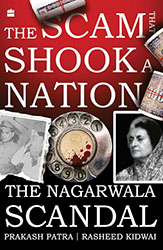
The Scam that Shook a Nation: The Nagarwala Scandal by Prakash Patra and Rasheed Kidwai. Published in 2024 by HarperCollins Publishers, Tower A, Building No. 10, DLF Phase II, Gurgaon, 122002. Pp: 272. Price: Rs 260.
On May 24, 1971 Ved Prakash Malhotra, chief cashier of the State Bank of India (SBI), Parliament Street branch, received a purported call from then Prime Minister (PM) Indira Gandhi, and Parmeshwar Narayan Haksar, secretary to the PM, to deliver Rs 60 lakh for a secret mission in Bangladesh. He was asked to hand over the money to the courier at the place indicated by Haksar and was given some code words to identify himself and to recognize the so-called courier. After delivering the cash he was told to visit the PM’s house to get a receipt. After Malhotra had paid the money, he approached the PM’s office for a receipt. He was told that neither Haksar nor the PM had given any such instructions or sent anyone. It was then that Malhotra realized he had been duped.
By the end of the day, the Delhi police had managed to recover most of the cash and arrest the man responsible for the heist, a retired captain of the army, Rustom Sohrab Nagarwala who had mimicked the voices of both Haksar and the PM. After the cash had been handed over to Nagarwala, he transferred it to a rexine suitcase and a bag in a waiting taxi.
Nagarwala was arrested from the Parsi Mengusi Dharamshala in New Delhi, at that time being managed by the priest-cum-manager Ervad Darius Bagli, who was assisted by his wife, Dhun. (The authors have made a mess of the Parsi names: Dhun becomes "Dhur” and Nagarwala’s roommate at the Dharamshala, Dinyar Kolaji becomes "Dinwar.” There are problems with some other names as well.) The details made interesting reading, particularly for this reviewer, since he later became acquainted with some of those who had a ringside view of events, or who played an unwitting role in this somewhat strange drama.
Nagarwala was arrested from the Dharamshala on the evening of the same day. When Darius asked the police officers if they had a search warrant, he was told that in certain cases a warrant was not required. Worried, he telephoned Shiavax Nargolwala, president of the Delhi Parsi Anjuman and an ICS (Indian Civil Service, now Indian Administrative Service) officer then serving with the central government. Nargolwala spoke to P. A. Rosha, the deputy inspector general of police, and accused the police of high-handedness. Rosha stuck to his guns and told him that the police had acted in accordance with the law.
Almost all the money, except Rs 5,700, was recovered late in the evening from an apartment in Defence Colony where Nagarwala’s friend, Noshir Captain and his wife Nergish, resided. Nagarwala had given Captain two large rexine suitcases containing the cash for safekeeping. Noshir, of course, knew nothing about their contents. The police asked Nagarwala to mimic the voices of Haksar and Gandhi and recorded the imitation. They seemed satisfied that Nagarwala could indeed have pulled off the heist in this manner. However, the Pingle Jaganmohan Reddy Commission, which was set up by the Janata government to probe the Nagarwala case, concluded that Nagarwala could not mimic anyone. A few others, too, thought that his mimicry was hardly convincing. More than half a century later, the Nagarwala case can hardly be said to have been solved. Lingering doubts remain on many important aspects, and the case continues to puzzle. There were many questions but few answers.
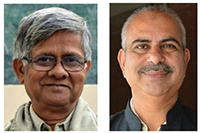
Prakash Patra (l) and Rasheed Kidwai: politically neutral
Nagarwala claimed that his act was not a premediated one but that he got the idea when he visited the bank to get change for a hundred rupee note. In his confessional statement Nagarwala said, "Suddenly, on the spur of the moment my thoughts started churning and my blood ran hot with the excitement of adventure.” In the same statement he said that the driver of the taxi kept watching the road when he saw him transferring big bundles of currency notes into the suitcase and bag. "I wanted him to see all this and feel uneasy, which he did… Along the way, the driver was getting nervous and started asking questions about the money. I offered him Rs 500 in cash and told him not to mention it to anybody, only so that in case the police came to him, he could tell. I was sure at the time that this driver would safely lead the police to the Parsi Dharamshala. And this is exactly what happened.” Later he told the police that he had intentionally left several clues that would help the police to track him down. The all-important question that arises is: why did Nagarwala want to get caught?
Nagarwala was tried in super-quick time. Two days later, on May 26, the additional chief judicial magistrate sentenced him to two years’ rigorous imprisonment and a fine of Rs 2,000. Nagarwala seemed shocked as he had naively believed that since the money had been recovered with his cooperation, he would be set free. But Nagarwala was never a reliable source, and had different versions for different people. He told his friend from Poona, Nusli Pudumjee, that he had done this to help the people of Bangladesh and that it was "a long story.” However, he told a fellow prisoner in Tihar Jail where he was lodged that he had been working on secret jobs for the PM in the past. He said that ultimately the money was to reach Gandhi’s younger son, Sanjay.
This well-researched book makes interesting reading, as it revisits a long-forgotten scandal. It is based on extensive research, police records, press reports, interviews, the 820-page report of the Reddy Commission and files from the National Archives. Dividing the narrative into 23 different chapters, Prakash Patra and Rasheed Kidwai try to present the facts as they occurred, and succeed in being politically neutral. However, the excessive details become tiresome at times. It could have been more tightly edited. There are also a few spelling mistakes and proofing errors.
The book includes in-depth profiles of both Nagarwala and Malhotra, which trace their lives before the hoax. Nagarwala, whose maternal uncle was the redoubtable Sir Ardeshir Dalal, civil servant and later businessman with the Tata Group, grew up in Poona. He lost his father early and mother Goolbai first moved to her brother’s house in Bombay and later to Poona. Nagarwala joined the army and was commissioned as an officer in 1944. But he was dogged by misfortune from the start as his mother once admitted. A series of motorcycle accidents ended his career in the army on medical grounds. Always short of money he drifted from place to place. Nagarwala was fluent in languages and had a pleasing personality. Malhotra, who had relocated to India after Partition, had risen from the ranks in the SBI. An acolyte of Indira, he had always dreamt of doing something for the nation. So, when he received the phone call from Nagarwala, he was not only overawed but also considered it a golden opportunity. His error of judgment would cost him very dearly: he was dismissed from service and ended up losing all his retirement benefits. He was also arrested but released soon after.
The case had many twists and turns. On November 20, 1971, six months after discovering the hoax, Devinder Kumar Kashyap, 31, the chief investigator, died in a road accident near Mathura. The belief was that Kashyap, a 1967-batch Indian Police Service officer, who had just got married, knew too much and had been got rid of. However, the authors’ research has shown that it could indeed have been an accident. Following that tragedy, there was another twist. On March 2, 1972, Nagarwala died of a heart attack at the G. B. Pant Hospital in New Delhi on his 50th birthday. Again, suspicions were raised, although an autopsy revealed no foul play.
Did the Nagarwala episode embarrass the PM? Indira told the Reddy Commission that she had nothing to do with any of the doings. She said, "Certainly not, since I had nothing to do with it. I did not know any of the persons concerned.” The book revisits the rash of conspiracy theories: Whose voice was it? Did the SBI keep Indira’s unaccounted-for money? Was the money meant for Sanjay? Was Nagarwala forced to make the confession to save Indira? And many other questions.
In Justice Reddy’s view, there wasn’t enough evidence to conclude that the money belonged to Indira. The case was officially closed on January 15, 1981. The authors’ note states: "The Commission set up to probe the scam reached its conclusions, but its assumptions are debatable.” While there was an admission of guilt, many questions remained unanswered. The investigation process was too speedy to allay doubts. It will not be surprising if The Scam that Shook a Nation, an interesting narration of a forgotten scandal, becomes a limited series on an OTT (over the top) channel. There’s no doubt that this cause celebre of the early 1970s would make interesting viewing.
BAKHTIAR K. DADABHOY
Dadabhoy is a Secunderabad based author.