The four World Zarathushti Chamber of Commerce awardees stressed the importance of Zoroastrian values in business, professional and personal life
It is a rare honor when the awardees are felicitated twice for the same award. Though all the recipients of the World Zarathushti Chamber of Commerce (WZCC) annual awards were present at the Marina Mandarin Hotel in Singapore on January 4, 2013 the awards could not be presented to them. The courier company claimed that since the trophies were gold plated, they could not be exported from India. A second function was held at the West End Hotel in Bombay on February 24, 2013 (see next issue of Parsiana).
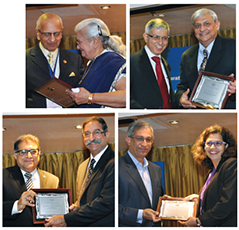
The four candidates selected for outstanding achievements were Homai Engineer of Industrial Boilers, Capt Percy Master of the Master Group of Companies, Bomi Bhote of Ruby Hall Clinic and Dr Zuleika Homavazir, an educationist.
Engineer’s citation as Outstanding Zarathushti Entrepreneur published in the WZCC AGM (annual general meeting) 2012 souvenir speaks of her "rare entrepreneurial zeal and pioneering efforts in being the first company in the private sector to offer steam boilers and micro steam turbines” under one roof with a guarantee for both products "at one point” without any excuse.
Her co-awardee in the same category, Master won the award "for displaying rare business entrepreneurial qualities in diverse fields and being recognized a leading player in the maritime and logistics sector.”
Bhote’s award for Outstanding Zarathusthti Professional was in "recognition of his remarkable professionalism and high commitment towards proving superior quality and innovative medical solutions.”
Homavazir’s award for Young Zarathushti Professional/Entrepreneur was "for achieving excellence in higher education and for various exemplary social initiatives, in the field of innovative human resource development.”
Behroze Daruwalla, WZCC global corporate secretary welcomed the guests at the function while WZCC global president and honorary member Minoo Shroff stated the delegates were "stumped with the glories of Singapore.” The island state in the South China Sea encouraged entrepreneurship while adopting a zero tolerance policy toward corruption. Shroff narrated incidents of ministers being handcuffed and awarded only partial bail. In one case a bribe of $ 25,000 resulted in a $ 1,00,000 fine being imposed. Corruption is a global phenomenon (as the late Prime Minister of India Indira Gandhi once famously commented when criticized for her lackadaisical approach towards the rampant practice in her government — editors). Citing Singapore’s example Shroff observed, "You have to know how to tackle it.”
Former president of the Parsi Zoroastrian Association of Singapore (PZAS) Rustom Ghadiali gave an audiovisual presentation on the history of the community in the former British colony (see "Success in Singapore,” Parsiana, February 7, 2013) detailing the contributions made by various individuals. With a current Zoroastrian population of around 300, the country has a Parsi Street and a Mistri Street, the latter named in honor of philanthropist Navroji Mistri. The community has an aramgah and two-and-a-half years ago acquired a community center thanks to the munificence of the current PZAS president Homiyar Vasania. Non-Parsi spouses can be members of the Association.
"The perfect life…”
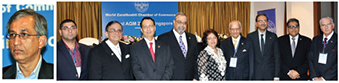
The keynote speaker for the evening was former investment banker Sanjiv Misra who runs a boutique consultancy and principal investment firm named Phoenix Advisors Private Limited and is also chairman of the Asia Pacific Advisory Board with Apollo Management, a global equity and alternate management firm. A 12-year resident of Singapore the tieless, jacket wearing wealth management practitioner apologized for his casual attire, explaining that he was once told that in Singapore people either wore a tie or a jacket. "If you wear both people assume you’re from out of town!”
Referring to the WZCC deliberations earlier in the day comparing the pros and cons of doing business in Singapore versus Hong Kong, the former Citibank banker who lived and worked in Hong Kong for eight years remarked, "the perfect life would be to live in Singapore and work in Hong Kong…few places have the buzz that Hong Kong has. Their attitude and approach to business is second to none.”
He related an incident from his early days in Hong Kong when he worked with Goldman Sachs and Company in the Citibank Plaza building to demonstrate the Chinese obsession with gambling. As office-goers waited for the elevators at around 9.10 a.m., two delivery men were standing to a side observing the lifts, waging bets on which lift would go up or down first. "Money was changing hands” while people were waiting for the lift, said Misra.
Observing that the WZCC motto was industry and integrity, Misra said these values were the "hallmark of Singapore.” In 1965 when Singapore was expelled from the Malaysian Federation, the island city with a then population of three million was smaller than the "constituency of East Delhi. Yet see where it has come.” Today with a population of over five million, the 63-island country has become the "hub” of commerce for South East Asia. Companies were moving to Singapore and from there doing business in the region. "The Tatas have a huge presence here,” he observed.
He spoke of the "stability, safety, (ease of) transportation, the (high) level of hygiene…solid intellectual infrastructure” that made "people more comfortable…Singapore is everyone’s favorite second city…It’s easy to come in and do business here…to raise capital…establish a presence.” People wanted to "invest money here… for safe keeping.” He believed that Singapore would "soon become the wealth capital of the world, more so than Zurich or London.”
He noted the WZCC had elected Singapore to host its global annual general meeting east of Bombay. In a turbulent political and financial world, the 10 countries comprising the Association of SouthEast Asian Nations (ASEAN) was "a relatively tranquil oasis.” Though the countries were grouped geographically some of them, such as "Singapore and Cambodia or Vietnam have very little in common.” Yet the bloc of 600 million people with a Gross Domestic Product (GDP) of US $ 1.8 trillion (almost equal to India’s GDP) comprised "the 10th largest economic unit in the world.”
Misra termed Singapore’s first Prime Minister and prime architect of its success, Lee Kuan Yew, "truly brilliant. He was better read than anyone I know.” Once when comparing India to China, Yew had commented that "China operates more like one country, India like a federation of states.” The day the fiery and mercurial chief minister of Bengal Mamata Banerjee could become chief minister of say, Kerala, "India would be on the way to national integration,” Misra quoted Yew as saying. The Chinese Communist party leaders worked and trained in different provinces and were equally at home in one geographical unit as another. This was not the case with India.
As to whether Singapore was a truly democratic country or not, (Freedom House ranks Singapore as "partly free” while The Economist terms it a "hybrid regime” — editors), Misra felt the debate "was not relevant” today. "Social media (Facebook, Twitter, etc) was taking care of that” as people can freely express their point of view. Instead of rallies and speeches, the internet offered "different dynamics.”
Though Singapore faced challenges such as a slowing growth rate, increasing inflation, less cost effective productivity, a declining fertility rate, resentment against foreigners, the pluses such as a well-educated and highly compensated economic and political leadership, a corruption free administration (Transparency International rates Singapore one of the least corrupt countries in the world — editors) would see the city-state "prevail in the final round. I bet my money on Singapore,” affirmed Misra.
The wealth manager also had a mantra for the delegates when investing in a business. "Manage opportunity with a risk management strategy... Firstly, don’t risk a lot for a little. Secondly don’t risk more than you can afford (to lose) and thirdly consider the odds.” And if you take on a partner, make sure that he, like you, "takes out more than what he puts in.”
"They make us proud”
"The global awards are meant to recognize the excellent work done by Zarthoshti members,” explained Daruwalla beginning the award presentation session. "They make us proud to be alive.” The judges were from five different continents and had to select awardees on the basis of several criteria including global presence, involvement with WZCC and trade and commerce associations, commitment, and track records of "proven success.” Any WZCC member can nominate a candidate.
She termed the first awardee Engineer as "humble but a lady of substance” with "vision and ability.” Engineer received the award but requested her son Rohinton to address the gathering. He explained his mother suffered from "stage fright.” She was a heart patient who had open heart surgery when Rohinton was only eight years old and she had four pacemakers inserted over the years. But she was still the company’s "guiding spirit.” Though she had received numerous awards, this was "a special one” as it came from her community. She was "proud and honored” to receive it.
The firm followed the principles of good thoughts, good words and good deeds. "Businesses that follow these guiding principles will never fail,” Rohinton concluded.
Among Master’s group of companies Master Marine Services was "the number one (marine) survey company in India.” The Master Group of Companies represented 120 shipping companies, with 45 offices all over India and 3,000 professionals, said Daruwalla. Yet Master still devoted time and money for community causes. He helped finance the renovation/refurbishment/upkeep of the Iranshah Atash Behram in Udvada, the Dadysett and Thoothi agiaries in Bombay and the Cowasjee Dinshaw Daremeher in Lonavla.
Born in humble circumstances in Porbunder, Gujarat, Master graduated from the Dufferin merchant navy institute and joined Scindia Steamship Company. After 20 years he started "a small survey company,” said Daruwalla.
Master told the gathering that he started his business in 1983 "with one table space” with his wife Arin serving as secretary-cum-accountant. In 30 years the enterprise had grown into five companies with an all-India presence. He urged the audience to "remember the roots from where we came and how we can contribute to the community…Young entrepreneurs need our help to come up.” His company’s logo stated "good thoughts, good words and good deeds and that is the motto on which we have progressed.” Zoroastrians are liked because they not only see to the welfare of their business but also the society at large, said the captain.
Commenting on the day’s deliberations that highlighted the advantages of doing business in Singapore and Hong Kong, Master said while he admired these countries’ achievements, "let us not forget a lot of entrepreneurship comes from India. India gave (the Parsis) the opportunity to progress. Grab it.
"Even in a corrupt India the Tatas have progressed, the Godrejs have progressed. They have conducted their business in the right way. It all depends on the individual. If you are good, if you are straightforward, nobody can stop you.”
Noting that the WZCC was not only about entrepreneurship, Daruwalla introduced the next awardee who was a professional. Bhote had assisted the late Dr Hector (Keki) Grant turn the 150-bed Ruby Hall Clinic into a 550-bed nationally recognized medical center offering all facilities under one roof. Patients are not asked to pay a deposit on admission, she observed. The hospital is "India’s largest critical care unit set up with 130 beds,” said Daruwalla. They were also the first hospital to offer an air ambulance service.
A mechanical engineer, Bhote started his career as a management trainee with TELCO (now Tata Motors) and after 14 distinguished years joined General Electric as a vice president, developing exports from India for the multinational giant. He then changed gears and took up patient care at Ruby Hall.
He termed the award "one I will cherish forever… It means a lot to me — I have come all the way from Poona to Singapore to receive it — it is from our community which I honor and the principles of this community are what I run our hospital on. We do about two million dollars (Rs 11 crores) worth of free treatment every single year.” He also ensures that nobody in the hospital knows who is availing of the free treatment. This ensures "that every patient gets the same level of medical care a human being deserves… Do charity the way charity is to be done.” No Parsis had ever gone without medical care at Ruby Hall for want of finance, he noted.
Homavazir’s "passion to teach and do good” made her give up lucrative human resource jobs in the pharmaceutical industry. Having worked in Pfizer, Novartis and Holcim, she joined Wilson College as a lecturer in the department of management studies and was promoted to the head of the department. Subsequently she earned her doctorate in management. Under the guidance of this "iron lady,” Wilson College gained the top ranks of academia, said Daruwalla.
Her "brainchild,” HOPE — Help Our People Elevate — and other initiatives indicate her commitment to social causes. Homavazir’s three mantras are determination, discipline and dedication, said Daruwalla.
Stating that "this incredible recognition honors my integrity and efforts in academics…a field which not only enculturates feeble minds but also creates successful human beings,” Homavazir said she wished to share the award with "all teaching professionals” as well as "all responsible parents who instill positive self-esteem in their children so that they can pursue their dreams.” Learning, she stated, was a continuous process whether one was a primary teacher or a college professor.
Her will to teach is especially reinforced when past students become entrepreneurs and "express their appreciation as well as negations” of what they learned. She said that teachers should live up to the appreciation voiced by others. "We make a living by what we get. We make a life by what we give,” she concluded.