Dastur (Dr) Firoze Kotwal convened two
meetings for priests to emphasize the
important of correctly following rituals
Text: Farrokh Jijina Photos: Sarosh Daruwalla
The correct recitation of prayers and performing of rituals were discussed by Dastur (Dr) Firoze Kotwal in meetings held in June and July. Parsiana was present for one and relied on an attendee for the report on the other.
The questions ranged from the practical to the esoteric and came fast and furious with many hanging around after the formal close of the meeting to derive maximum benefit. On a rainy Sunday, July 21, 2024, Dastur (Dr) Firoze Kotwal convened a meeting in the hall of the H. B. Wadia Atash Behram to answer questions from about 30 boiwallas, panthakies and mobeds. Coordinated by Ervad Hormuz Dadachanji, panthaky of Vachaghandhy Agiary, the objective was to benefit from the High Priest’s inputs on rituals in view of the forthcoming muktads, a refresher session of sorts. "Mobed o ni thori thori practice differ thaayech (Mobeds have differing practices for rituals)” due to the dependence on oral traditions, Dadachanji told Parsiana as an aside at the event. Inviting participation, the octogenarian Kotwal kicked off the meeting by stating that what he was going to speak about was not his interpretation of rituals, but an understanding derived after reading what had been written down by the senior priests of all five mobed tolas (groups). (Traditionally, priests were divided into five tolas or sects, depending on their geographic locations.) "I will put it all before you… you can convince yourselves… Baddhu poochhi né karvanu…puchhva thi pandit thaay (If you do not know, ask… asking makes you wiser),” stated Kotwal.
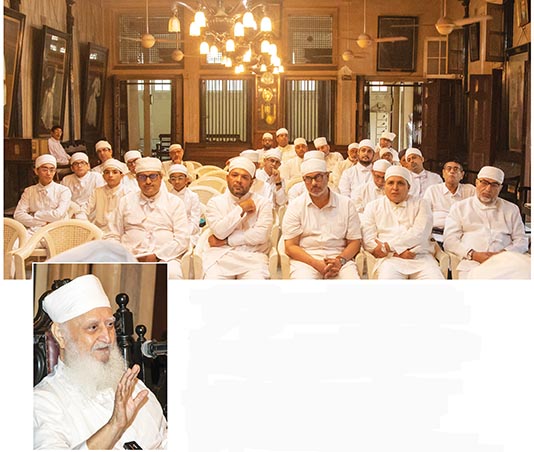
Top: Attentive audience at a meeting called by Dastur (Dr) Firoze Kotwal (inset)
The term muktad was coined in the 12th century by Nariyosang Dhaval. Of Sanskrit origin, the word means released souls, he stated. The High Priest is personally of the opinion that muktads should be observed for 18 days, as was done traditionally. For how many years after a death should family members offer muktad prayers? was a query from the floor. "As long as it gives satisfaction to the family members…At least for the first year,” was the High Priest’s answer. To continue after that, would depend on the financial strength of the behdin. Once stopped, muktads can be re-started even after a break of some years, Kotwal stated.
Explaining funerary rituals, the High Priest stated that the first part of the geh sarna is directed to the gehan (bier) that is to carry the body to the dakhma. It is important that the gehan should be positioned such that the mobeds have their eyes on it. He advised the mobeds not to read or recite the geh sarna prayers from a book. In days of yore, priests with impaired vision were barred from performing funerary prayers. The High Priest stated that the sachkar (ritual bath) must be done "as soon as possible after death, preferably in the same gah” (the day is divided into five gahs) as the one in which the death had occurred and the funeral as early as possible. "It is wrong to wait,” he stated.
Regarding the practice of bhoi nu bhantar (prayers recited near the corpse), Kotwal stated that if a mobed is not available, a family member should pray near the body. "It is necessary that Avesta prayers must be on… The Ravan ni papet (prayer for the corpse) is a must,” he stated.
Can a jashan be performed on water, say on a ship? asked one mobed. The High Priest replied in the negative. Water on which ships sail is polluted with human excreta. Until the 1920s, when mobeds returned from Aden, they were barred from performing any pav mahel kriya (higher liturgical ceremonies). However, the practice changed later to allow priests to do the pav mahel kriya after a nahan. On the other hand, kusti prayers while on a ship is a farajyat (bare minimum) to be performed.
"Aapri kom ma Pope ghana oobha thayi gyaach (Many Popes have arisen in our community),” stated a slightly annoyed Kotwal when an agiary manager asked him whether, before agreeing to perform a wedding, it was mandatory to examine whether the grandparents of the bride and groom were both Parsi. "Jeevta o ni sagvad maaté ferfaar nai karvo (For the convenience of the living, one should make no changes (in rituals)],” stated the High Priest, indicating that such an examination was necessary.
A gahanbar is celebrated to remember the six creations of Ahura Mazda, namely, sky, water, earth, flora, fauna and humankind. The High Priest opined that priests should use the gahanbar or jashan gathering to impart religious knowledge to their behdins. Vendidads (an expensive ritual) are for the peace and happiness of the departed. If possible, it must be done within three days of the death occurring, he stated.
What happens when in an adarian, for some reason, one boi is missed? Does it become a dadgah? Can a behdin pasban offer boi in such a case? Yes, was Kotwal’s answer. "Do not let the fire die.” The adaran will remain an adaran, but certain religious rituals have to be performed in the sanctum sanctorum.
Other questions raised by mobeds pertained to prayers, including the details of the positioning of the Yatha Ahu Vairyo and Ashem Vohu recital within certain prayers, the number of times these have to be repeated, mandatory prayers on the first five days of the Gathas, and so on.
Seated from l: Dasturs Tehemton Mirza, Khurshed Dastoor, Kotwal, Keki Ravji Meherjirana,
Cyrus Dastur and other priests at the meeting
Laity at the meetings, from l: Dr Kerman Daruwalla,
Cashmira Bengalli, Firoza Punthakey-Mistree, Khojeste Mistree
"Gentleness and humor”
A month earlier, on June 20, Kotwal had called a meeting of yaozdathragar priests at Neville House where about 25 priests and four high priests — Dasturs Khurshed Dastoor and Tehemton Mirza of Udvada, Cyrus Dastur of Surat and Keki Ravji Meherjirana of Navsari — were present. Art historian and author Firoza Punthakey-Mistree who also manages Kotwal’s office sent Parsiana a report on the meeting. Technical issues that are pertinent only to priests are not included in this article. The meeting was "an example of (Kotwal’s) quiet spoken word reaching the hearts of the priests… There was an amalgam of gentleness, moments of dry priestly humor and the need to reestablish religious order, underlined by the kind of restrained authority barely exhibited but felt by all,” noted Punthakey-Mistree.
Kotwal stated that 200 years ago there was near complete uniformity in the rituals and the recital of prayers. He reminded the priests that for more than 1,000 years in India Parsis had preserved the memory of Iran by remembering the divinities, sages, kings, warriors, mountains, rivers, lakes and coinage of Iran in all the religious rituals, by constantly blessing the country and preserving its memory every day.
While many Parsis would be under the impression that the phrase pasandeh kardam in a marriage ashirwad pertains to ascertaining the acceptance of the bride and groom of each other, Kotwal reminded the priests that it is really an oath that the couple take "to affirm their loyalty to Ahura Mazda, Zarathushtra, the seven Amesha Spentas and, in effect, to swear loyalty to the Zoroastrian religion… If either of the couple is a non-Zoroastrian, it is religiously and spiritually inappropriate to recite the ashirwad for them,” he stated.
The High Priest emphasized that boi must be offered when the gah begins. Reportedly, there were no questions on what must be done where a lone priest serves multiple fire temples as is the case in some cities in South Gujarat and even in Bombay. In fact, Parsiana was informed that there were no questions at all! "There is no month attached to the Gatha days… When praying during the Gatha days, the name of a month cannot be recited.”
Regarding long lists of family members provided to priests by family members for the farmayashni (requestors of prayers), Kotwal advised that "Only the name of the person who has commissioned the ceremony and other elderly members of the family” should be mentioned. "It is a wrong practice for community members to give the names of children in the farmayashni.”
Other matters Kotwal referred to included the correct details of prayers to be recited during a navjote and their sequence.
Enjoining a love of rituals in the priests present, Kotwal stated that rituals should never be abandoned. "Jétlu thaay tétlu karvanu (Do whatever is possible),” he stated.