Long serving Parsi faculty members recall their association
with St Xavier’s College at the institution’s sesquicentennial celebrations
Parinaz Gandhi
If you have not signed the attendance sheet it will be assumed you are not present,” jested Dr Ruby Pavri, head of the department (HOD) of psychology and master of ceremonies for the evening, using a line familiar to most faculty members demanding attendance from their students. She was addressing erstwhile professors of the noted Jesuit institution in Bombay, St Xavier’s College, who were invited to the valedictory function that brought the sesquicentennial celebrations of this institution to a close on December 7, 2019.
When calling out the name of Dr Manek Mistry from the botany department, she asked of him, "Did you come in late?” As he later confided to Parsiana, his reputation for keeping students waiting had earned this jibe from Pavri but that day he had been genuinely preoccupied on the College premises since morning.
The faculty members of Xavier’s "leave their mark or rather marks. Here teachers don’t cover the syllabus, they uncover it,” believing "I touch the future, I teach,” added Pavri.
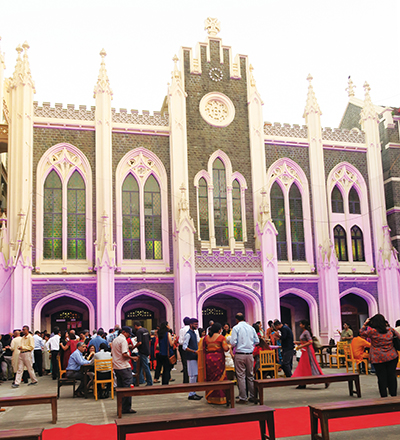
St Xavier’s College top at the 150th celebrations
Priests at the valedictory mass (from l) Fathers Frazer Mascarenhas, Keith D’Souza,
Bishop John Rodrigues, Fathers Roy Pereira, John Misquitta, Gordon Daniells
"Xavier’s helped me grow and is now my way of life,” commented Dr Jehangir Mistry, erstwhile vice principal and HOD of physics who is currently the dean of the Xavier Institute of Communications. When he joined the faculty, his starting salary was Rs 149, recalled Jehangir, appreciating that interactions with "the dynamic student body has helped to keep me young.” He was happy to report that his wife Firdaus (née Tata) is also a Xavierite. His parents, father Burjor, a lawyer in the Supreme Court specializing in criminal law, and mother Jer (née Presswala) too were both Xavierites as were his in-laws, he informed the gathering.
At Xavier’s, "teachers don’t retire; they just fade away,” remarked Prof Nandini Sardesai, former head of sociology, who played an integral role for the 150th celebration, roping in her ex-student Sabbas Joseph, co-founder of noted event management company Wizcraft to mastermind some events. Recalling her student days at Xavier’s, she mentioned that she got married when she was in junior college and graduated in the same year her son was born. She gave credit to the College for providing an environment for "growth and self-actualization” and alluded to her one-time student Dr Sam Taraporewala later becoming HOD of sociology despite his visual handicap.
"We have been blessed by the contribution of the Parsi community, not only by the financial help of the Tatas and Godrej and other Parsi industrial groups, but also through the presence of good Parsi faculty. In recent times there have been about eight HODs who are Parsis,” acknowledged Dr Fr Roy Pereira, vice principal (academics), director, Xavier’s Development Programme, and coordinator for the 150th anniversary. Among the current HODs are Dr Pearl Pastakia (English), and Prof Marazban Kotwal (chemistry) who also serves as controller of examinations. All the current heads are alumni of Xavier’s and have contributed to raising the bar of educational excellence for which this institution is known.
Pereira further recalled the tenures of those who had served devotedly: "Dr Hoshang Master, former head of chemistry and controller of exams continues to serve the College even though he has officially retired 12 years back. Dr Freddy Havaldar retired as head of chemistry two years back and is the only professor to have an international and national patent in his name.” Prof Kaizeen Mistry was acting head of the history department. Dr Sam Sethna was HOD of geology and was followed by his wife Bakhtavar. Prof Cavas Shroff from the mathematics department was instrumental in setting up a separate statistics department and was its first HOD. "I have been taught by Profs Bakhtavar, Hoshang, Jehangir and P. H. Lentin, and I have taught Prof Marazban in my very first year in this College as a lecturer in 1993. He later became my colleague,” Pereira shared his reminiscences with Parsiana.
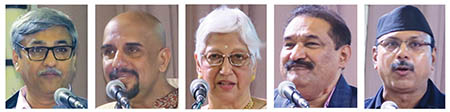
From l: Dr Rajendra Shinde, Pereira, Prof Nandini Sardesai, Sabbas Joseph, Josy Paul
Clockwise from top left: Dr Freddy Havaldar in the chemistry laboratory,
Dr Nariman Irani explaining Nataraj pose at Elephanta Caves; Dr Aban Daruwalla and Prof Cavas Shroff
Above (from l): Profs (Drs) Hoshang Master, Jehangir Mistry, Manek Mistry, Sam Tareporewala,
Prof Marazban Kotwal, Drs Pearl Pastakia and Ruby Pavri
At the press conference launching Xavier’s 150th (top row, from l): D’ Souza with alumni
Dr Swati Piramal, Ashish Bhasin, Anu Aga; (2nd row): Amrita Raichand, Farokh Khodaiji,
Shaina N. C., Aditya Thackeray
Once a bastion of Parsi students, barely a dozen pupils from the community now pursue degree courses at the reputed institute. "It is a telling comment on the decline of the Parsi population that the number of Parsi students in Xavier’s today is often less than the number of staff members!” remarked Manek Mistry. The high cut-offs for admission to junior college is one of the reasons the number of Parsi students has declined, felt Master.
Sesquicentennial special
"A jubilee is a time to look back with gratitude while refocusing, revitalizing and reenergizing ourselves to face the challenges of the future,” remarked Bishop John Rodrigues when leading the mass at the valedictory function. "Members of the Society of Jesus are like leaders of an expedition entering fields unknown and unfamiliar… ready to swim against the tide,” he reminded the gathering, most of whom had been associated with Xavier’s for decades.
"Do we wait for something special to celebrate or do we celebrate each day as special?” enquired principal Dr Rajendra Shinde. Lauding the combined efforts of staff, students and alumni that resulted in the sesquicentennial series of events through the year he appreciated, "Within the tapestry of this institution there is commitment, compassion,” adding, "There is a spirit of discourse encouraged by Xavier’s... I am amazed how the staff and students curate extracurricular activities.”
The alumni who consider "Xavier’s a special ingredient…the X factor” that binds them together were able to resonate with the theme selected for the 150th celebrations "Made of Xavier’s.” One of them, Josy Paul, co-founder and chairman of the reputed advertising agency BBDO India conveyed that "the arches spoke to me, enquiring ‘what have you given us?’ I said, ‘Maybe I can give you a font.’” Thus emerged the Xavier’s font, specially created for the occasion as "an ode to the iconic architecture of the College…”
From the time the logo and theme were unveiled at the start of the sesquicentennial celebrations until the final closing ceremony on December 7, 2019 the year long celebrations included Lingua, a theater festival in English, Hindi, Marathi; Volantus, junior college cultural events; alumni dinner; international science conference; Janfest 150 – Indian and western classical music; social sciences forum; the leadership conclave that brought together speakers like Adi Godrej and Narayan Murthy; Malhar 150; social outreach; heritage hunt; and Jesuit interactive programs.
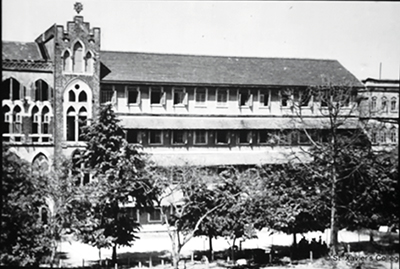
St Xavier’s College: iconic architecture
Titan teachers
When the College celebrated its centenary landmark in 1969, this institution was still the first choice for Parsi boys who had passed out from St Xavier’s School to continue education at the College that was conveniently located around the corner. From these students emerged some academicians who have been unable to sever ties with their alma mater even after 50 years. They returned to the College as lecturers, then heads of department, and even after retirement continue to lend their expertise, having enjoyed uninterrupted service as compared to the Jesuit priests who run the College but are rotated among different educational institutions.
With his paternal grandfather too having studied at this institution, Master has had enduring ties with Xavier’s. An undergraduate when the institution was celebrating its centenary in 1969, he remembered the main function at the open air Rang Bhavan auditorium down the road graced by the President of India with the popular Nelly Batlivala entertaining the gathering on her accordion. An avid stamp collector, he has in his possession the stamp released on the 125th anniversary of the College.
Within 20 days of his BSc graduation with chemistry from Xavier’s in 1970, Master joined the chemistry department as demonstrator, working in the laboratory. In those days, the prevailing hierarchy included the ranks of junior lecturer, senior lecturer and ultimately professor (post 1976 when the 10+2+3 system of education was introduced for 10 years of schooling, followed by two years of junior college and three years of senior college, all were deemed lecturers). After earning his master’s and doctorate he could mentor students. The popular head of chemistry department served as thesis guide to 24 students only one of whom was a Parsi. He retired from the chemistry department in 2007 but within two years when the College was granted autonomy he was appointed controller of examinations, a responsibility he still continues to shoulder.
"After building so many schools in Bombay why did Parsis not build a college?” enquired Master. Unable to elicit a response from the Parsiana representative,, he proceeded to answer his own query, "because St Xavier’s was considered aapri (our) College.” The scenario is quite different in the College’s sesquicentennial year. "There are no takers now for the specially constituted prize for the ‘Most deserving Parsi boy in Third Year Science’” as "there are very few Parsi students, maybe one boy and two or three girls per year in senior college.” On the Ex Students Association, Nilufer Marolia served as president for several years while Master was treasurer. The body has now been disbanded with new banking regulations, he states. A keen hiker until his knees weakened, Master was known among the students for the hikes he organized.
"Today Xavier’s is better known as an arts than science college,” pointed out Jehangir Mistry who would have liked to pursue humanities but was dissuaded by those around him who sneered, "ghéllo chhè (you are out of your mind).” Among the faculty members who had most influenced him was Prof Sam Khambatta who was researching the Raman effect (a change of wavelength exhibited by some of the radiation scattered in a medium). With his eyesight failing, Khambatta came to depend more on young Jehangir. Khambatta was past president of The Photographic Society of India and a theater artiste. Khambatta’s wife Soona too was a Xavierite and Jehangir remembered her telling him that she was not allowed to commute alone to college and a domestic help would drop and pick her up. Parsi professors of yore would come dressed in a duglo and pheto, Jehangir learnt.
Zoroastrian alumni of Xavier’s who went on to win national and international laurels in different fields were listed by Jehangir: Ratanji Tata, Adi Godrej, Jehangir Boman Petit, Anu Aga (business); Zubin Mehta (music); Nani Palkhivala, Soli Sorabjee, Fali Nariman (law); Dr Armaity Desai, Shaheen Mistri (education); Farokh Khodaiji and his wife Katy (née Chargeman, table tennis); Khatau brothers Percy and Sam (boxing); Dara Doomasia and his wife Sheroo (née Khan, athletics); Polly Umrigar and Nari Contractor (cricket); Adi Marzban (theater); Jehangir’s elder brother, Nariman (physics and astronomy).
As reminded Jehangir, for students pursuing higher studies in Avesta and Pahlavi, the only option in Bombay was Xavier’s that continued with this facility despite the total number of students opting for these subjects being limited.
Xavier’s houses the largest private herbarium in western India — the Blatter Herbarium. Fr H. Santapau was mentoring several Parsi botanists on the faculty of Xavier’s, recalled Manek Mistry: Dr Aban Daruwalla (née Randeria) worked on the flora of Borivli National Park. For her doctoral work, she wrote "a monograph of the genus ‘Blumea’ at the University of Michigan, the only staff member till date to have undertaken and completed a monograph. Dr Nariman Irani worked on the flora of Matheran for his PhD. Shinde has fond memories of both these seniors who taught him botany. Irani was an official tour guide for the Government of India and had accompanied Queen Elizabeth during her visit to India. An authority on the Elephanta Caves, he would explain the sculptures with poses. Dr Zarir Kapadia worked on the orchids of Bombay while Manek Mistry studied the flora of Ratnagiri district.
The branch of geology at Xavier’s was given a strong foundation by several Parsi HODs: the first Parsi to head the department was Dr A. S. Kalapesi who retired in 1954. He was succeeded by Dr Ratan Sukeswala, Dr Sam Sethna, Dr Rohinton Avasia, and Dr Bakhtawar Sethna who was the only lady HOD of this department.
"I will stop formal teaching but I will continue in a full-fledged capacity at the Resource Centre,” stated Taraporewala who ceases to be HOD beginning 2020. He takes pride in the accomplishments of the Xavier’s Resource Centre for the Visually Challenged that he initiated in 2003 and is today regarded as a strong force to provide support and sensitization to visually challenged students as also those suffering from hearing impairment, autism, learning disabilities and orthopedic problems to enjoy holistic living. Giving "full marks to Fr Frazer Mascarenhas” for guiding him on this endeavor, Taraporewala remembered the then principal’s words, "Let it not be just a cyber café.” He was equally appreciative of erstwhile principal Fr John Misquitta’s "bold decision” to include him among the teaching staff.
Conceptualization and strategy are the key factors to success in "today’s world of virtual work,” noted Taraporewala who has not permitted his visual impairment to limit his functioning. Unperturbed by students who might have tried to take advantage of his handicap, he maintained that he was "focused on his teaching.” In earlier days, students seeking shortcuts would resort to photocopying, today it is "copy, cut and paste,” he draws an analogy.
"If there is no vacant position, they will make one for me,” Pavri remembers her own supreme confidence. After five years of studying at Xavier’s from 1985-90, she was determined to return as a teacher, and she did in 1992, teaching for three years in junior college and then in senior college, taking over as HOD in 2015. Active during her student days with the Social Service League and other programs, "all of which helped develop different facets,” she played a key role in the 150th celebrations.
Pavri who has opted to retain her maiden name after her marriage to a South Indian describes herself as "a multicultural person” but feels the Parsi culture "fits in very well at Xavier’s. The freedom and confidence to be ourselves rather than feel restricted” for being a girl has helped her bring a joie de vivre to the College with her "love for people, love for the place and love for the job.” Quoting the lines from the musical Mary Poppins to impress on us how every task should be undertaken, she asserts, "In every job that must be done, there is an element of fun…”