French scholar Anquetil du Perron narrates the hardships he faced in his quest to study Zoroastrianism in Surat in 1758
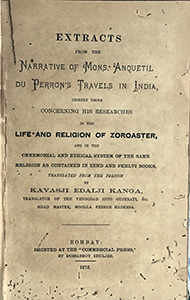
"It may not be unknown to the reader that Mons (Abraham Hyacinthe) Anquetil du Perron was the first European scholar to come to India with the two-fold object of learning the religion of Zoroaster from the followers of the prophet themselves, and of acquainting the learned men of Europe in general, and those of his own country in particular, with the result of his studies,” writes Kavasji Edalji Kanga, headmaster of the Moolla Feeroz Madressa in the preface to his translation from French to English of Narrative of Mons Anquetil Du Perron’s Travels in India, chiefly those concerning his researches in the Life and Religion of Zoroaster, and in the ceremonial and ethical system of the same religion as contained in Zend and Pehlvi Books.
In 1754, Du Perron had seen in Paris four Zend leaves copied from the Vendidad Sade (a variant of a Yasna text into which sections of the Visperad and Vendidad are interleaved — Wikipedia). "Immediately I resolved to enrich my mother country with this singular work. I ventured to entertain the idea of translating it, and of going with that view to Gujarat or Kirman to learn the ancient Persian,” the French scholar wrote in his book. His quest met with many obstacles and hardships.
Kanga observed, "Thanks, then, to his almost inspired devotion to the cause of Zoroastrian literature, his indefatigable exertions, his anxiety and foresight to preserve to posterity the fruits of his labors, reaped under perils and struggles which might have appalled any but a great enthusiast, his successors in the same path have availed themselves of his manuscripts, and illumined to a great extent the obscurity in which Zoroastrian lore was shrouded by lapse of ages.” Parsiana carries unedited extracts from the book whose publication in 1762 made Du Perron "an instant celebrity.”
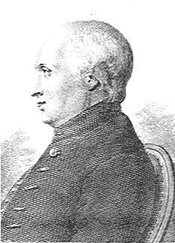
Anquetil du Perron: pioneering scholar Photo: Wikipedia
I saw the Parsi Dustoors, for whom I had made the voyage to Surat, and from whom I had to learn the religion of Zoroaster. They were Dustoors Darab and Kaous, High priests of one of the two sections in to which the Parsis of Surat are divided. In the first instance, there was the difficulty about the manuscript which, they asserted, had been received from their Legislator. They engaged to copy it out for me for Rs 100: this involved some time and being desirous to make up for the years which I thought I had lost, I commenced without delay the study of their ancient languages.
I despaired of (the dasturs’) tardiness. After a stay of three months in Surat, I received the promised manuscript. This was the Vendidad, 20th work of their Legislator, a quarto volume, written in Zend and Pehlvi. I did not discover till some time after that it was mutilated and incorrect, and after having paid them its price, I thought to begin immediately the study of this work. But the Dustoors, fearing to see me quick at my studies, wished that I should commence the alphabet. I wrote down what they dictated to me. This enabled me to decipher the characters in which the Vendidad was written.
These first steps did not please my Dustoors, who believed I was nearly escaping from their hands, their answers to my questions were more reserved. They affected a mysterious tone, believing it gave importance to their lectures. Long absence, under the pretext of the dangers they were exposed to by coming to my place, intervened between their visits. Once they talked to me of the offer of a considerable sum of money which Fraser had made to them for obtaining some Pehlvi manuscripts, and of the remuneration which was reserved in England for any one, who could translate their sacred books.
[James Fraser (1713-1754), had lived in Surat for over 16 years. He had "returned to Britain with some 200 Sanskrit and Avestan manuscripts, which he intended to translate, but he died prematurely on January 21, 1754,” notes Wikipedia]
Towards the commencement of February, seeing my business languish, I told Dustoor Kaous that his manuscript differed from the other Vendidads (that is, other copies of the Vendidad) of Gujerat, and showed him immediately the one belonging to Mancherji. He grew pale at the opening of the book, and at first feigned not to know this work adding that it was some other book: he wished afterwards to maintain the authenticity of his copy (for he knew not that I had the patience to compare the two manuscripts, word by word), and went away in a very bad humor. The next day, Darab, his father who was more clever and more sincere, and who saw besides that I could no longer be deceived, brought me a copy perfectly to that of Mancherji, assuring me, that all the copies of the Vendidad resembled that which he had presented to me; and that the copy, which he had given me at first was corrected in the Pehlvi translation, but that in the one in Zend, there were only a few transpositions and changes of letters of little importance. He promised, at that same time, to bring me a copy similar to that of Mancherji and also an entirely Zend copy without the Pehlvi translation. These advances were accompanied by a Pehlvi and Persian vocabulary, of which I have already spoken above, and some other manuscripts, some in modern Persian and some in ancient Persian (Zend and Pehlvi); and a small history in verse of the emigration of the Persians to India.
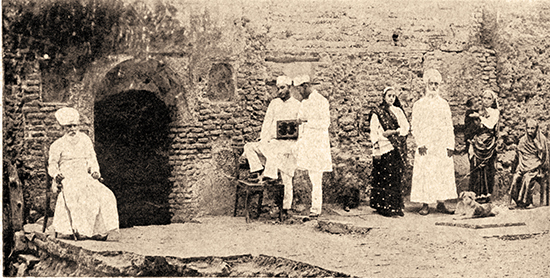
A group photograph of the family of Dastur Darab Sohrab Kumana, the leader of the Kadimi sect at Surat,
at the start of the sect. The photo was taken by the orientalist Ms Menant in 1901. Anquetil du Perron
"was a pupil of Dastur Darab Kumana, a fact he acknowledged openly." Caption and photo: Parsi Lustre on Indian Soil
Seth Pestonji Kalabhai Vakil (Kadmi) Atash Behram constructed in 1823
Dakhma at Surat Doongerwadi
Pioneer Parsee Zend and Avestic scholars. Seated from left: Ervads Tehmurus Anklesaria,
Sheriarji Bharucha, Khurshedji Kama, Kavasji Kanga, Edulji Antia;
standing from left: Ervads Jamsetji Nadirshaw, Khurshedji Kateli
Caption and photo: Parsi Lustre on Indian Soil
The reading of the liturgical books had made me familiar with some minor ceremonies of the Zoroastrian religion; I had bought some copper instruments used in their sacred rites by the Parsis, some Koshtis, a Sudra and a Padan, but my curiosity was not satisfied. I wished to enter their Fire-temple and to attend their service. Being aware of the strict severity of their religion, I believed the thing impossible: my presence, according to the Zend books, would defile the temple and tend to nullify the efficacy of their prayers. Besides, no foreigner had ever entered the Deremehers of the Parsis, except the Mogul Emperor, Akbar. However, a small present and the promise to take a short excursion through the town in my palanquin, induced Darab to satisfy my curiosity. He took for this purpose a rainy day, the 20th June 1760. I was dressed as a Parsi, accompanied by only one peon, who was made to stand at a short distance from the gate of the Deremeher, and who guided me from a sufficient distance for fear I should be recognized – the environs of the Fire-temple being inhabited by a number of Parsis. The water was knee-deep in several places; it was all dark, and as I was not sufficiently acquainted with all the streets of Surat, I was on the point of losing my way and of being nearly drowned.
When I arrived at the Deremeher, there were very few people in it. Darab came to receive me, and led me to the fire-altar where his son officiated: it was half past six in the evening, in the Aivicruthrem Geh.
Old Darab notwithstanding the objections which I had sometimes raised against what I had found to be unreasonable in his religion, had seen me study his books with so much care, and occupy myself so seriously with the smallest minutae, instead of despising them, as is generally the case with foreigners, that he believed me almost a proselyte, wanting only the ceremonies of initiation; and I think that this idea consoled his conscience a little. Several times he had persuaded me to give up smoking my Hookka, saying that I had read in the Parsi books that what came out from the body, as saliva, breath, defiled the fire. Instead of contradicting him boldly — which would have displeased him — I contented myself with the reply that I was a Christian. When I was in presence of the sacred fire, which I saw like all lay Parsis across the rails, which enclosed the chapel on the north side, Darab asked me if I would make some offering to it. I said I could not, as a Christian, comply with his request. Darab retorted, but with an embarrassed air which had something sinister about it, that some Musulmans, without having had the privilege of seeing the sacred fire, had made some presents to the Deremeher. The position was delicate: I was alone, without any arms except my sabre and a pocket-pistol; and if the devotees, who performed their prayers in the Deremeher, had suspected me who I was, I should have fallen a victim to the zeal of the worshippers of the Fire-temple. Without appearing in any way moved, I answered Darab in a loud voice, that I was come to see the Deremeher and nothing more. My firmness shut up his mouth; he requested me to speak in a lower tone; he feared more than myself that the people of the Deremeher might recognize me. He explained to me afterwards, in a whisper, the use made of the different parts of the Deremeher. I examined everything minutely. I entered everywhere; and I imprinted very clearly in my mind all that I saw, in order to be able to prepare on my return the plan and the description.
After having attentively inspected the divisions of the Deremeher, I approached, with a view to satisfy my curiosity, the place reserved for the recital of the Izeshne (Yacna). Darab made some difficulty to allow me to enter it, protesting that he would afterwards be obliged to purify the place; but I went further on and found in a corner of the Izeshne-gah his Zend, Pehlvi and Persian books, and among others, some Mss, which he had told me he had not with him. I knew that his library was in the Deremeher, and this was one of the reasons which had induced me to enter this temple with the view to an inquiry in reference thereto.
Satisfied with my visit which lasted nearly an hour, I rejoined my peon, who was waiting for me within gunshot from the Deremeher. Darab, deceived in his expectations, had no occasion to be equally satisfied. He had calculated on extracting from me something as an offering to the sacred fire; and the discovery which I had made put him to the necessity, if he did not wish to fall out with me, to sell the books which he had up to then denied me, or refused to make copies for me.
Some time after I went out of Surat to see the Dakhmas (towers of silence). These are a species of round towers whose walls are built of square stones, and which are about ninety feet in diameter. While I walked around these towers, whose walls were assailed by an army of vultures, ravens and other carnivorous birds, several Parsis, who saw me from a distance, grumbled at my curiosity. In the mean time a funeral procession arrived, which obliged me to remain at a distance. From the place where I stood, I saw the Nasasalars perform the Sagdid (that is to say, the ceremony of presenting the dog to the dead), and carry the dead body into the Dakhma. Afterwards the procession, which stood at more than eighty paces from the spot, returned, praying two by two, each holding the other by his sleeve, as they had done while going. On my return their murmurs increased: in the streets of Surat many Parsis loudly clamoured that I had profaned their towers of silence; but these complaints had no other consequences.