Like many Parsis young Homi Bhabha learnt
to master and manage two cultures
Bakhtiar Dadabhoy
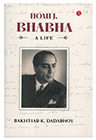
This extract from Homi J. Bhabha: A life by Bakhtiar K. Dadabhoy (Rupa Publications, 2023) has been reprinted in Parsiana with permission from the author and the publishers.
Homi Bhabha attended the Cathedral and John Connon Boys’ School in Bombay. Esplanade House, Jamsetji Tata’s grand home, was a stone’s throw away from the School, and he used to go there for lunch, apart from spending many fruitful hours in its well-stocked library. Thus, in addition to the many books at home, Sir Dorabji Tata’s rich library was also available to him. His aunt Meherbai, Dorabji’s wife, being childless, lavished affection on the Bhabha brothers, Homi and Jamshed. Homi, a voracious reader, was fascinated by science. He also read widely on other subjects, laying the foundation for his multifaceted interests and achievements. That he was an avid reader is evident from an early photograph in which an adolescent Homi, dressed in a dark suit and tie, is reclining in a formal pose in an armchair with a book on El Greco on his lap.
Meherbai was a lady of remarkable talents and the perfect foil for Dorabji. A champion tennis player, she won many tournaments. She played clad in a sari, which drew much comment from spectators. She represented India at the Paris Olympics in 1924 and was a familiar face at Wimbledon. A good horse rider, she also drove a motor car and harbored hopes of being the first Indian woman to fly. Musically inclined, she played the piano well enough to be in demand for public concerts in Mysore. She was also the owner of the famous Jubilee diamond, a gift from her husband. At 245.35 carats, it is the sixth largest diamond in the world. Meherbai played an active part in raising contributions during World War I and was an active member of the Indian Red Cross Society. She was made a Commander of the British Empire by King George V in recognition of her services.
Dr Homi Bhabha discussing design of Apsara reactor with colleagues in 1955
Concerned about the condition of women, she was actively involved in the enactment of the Child Marriage Restraint Act, 1929, popularly known as the Sarda Act. She was not only consulted on this Act but also campaigned for it in India and abroad. Her advocacy of the Act was only one aspect of her vast contribution to women’s emancipation in India. She was committed to women’s suffrage, girls’ education and the removal of the purdah system. She championed these causes on global platforms. Unfortunately, Meherbai died of leukemia in Wales in 1931 and is buried at the Brookwood cemetery in Surrey.
While Homi was fortunate in being born into a family that recognized his talents and had the wherewithal to nurture them, he was doubly lucky to be so closely associated with the Tatas. He witnessed the emerging world of Indian industry and saw and heard the nationalist politicians of the day. Mahatma Gandhi, Vallabhbhai Patel, Motilal Nehru and his son Jawaharlal all used to visit the Tata home when in Bombay. Gandhi stayed with the Tatas during the launch of the first civil disobedience movement.
British physicist, Sir John Cockcroft, observed: "Homi Bhabha’s family on both sides was strongly nationalist and, as a young boy, Homi used to listen to the conversations of Mahatma Gandhi when he visited his aunt at the time of the launching of India’s first civil disobedience movement. Friendly ties also existed between the Nehru family and the families of Tata and Bhabha. Dorabji’s younger brother, Ratan, had come to Gandhi’s aid in 1909 with a donation of Rs 25,000 (USD 2,007) to be used for his struggle in South Africa. Ratan spent a great deal of time on the Continent and in England — he had a grand home in Twickenham — but was very interested in Indian politics. He was a good friend of the Indian liberal politician and social reformer Gopal Krishna Gokhale and contributed Rs 6,000 (USD 72) a year to his Servants of India Society.
Notwithstanding the thesis of the marginal man, many Parsis learnt to master and manage two cultures and were not simply stuck between the two. By the time he went abroad at the age of 18, Homi understood a way of life that allowed his community to prosper in a tumultuous political world. As American author Robert S. Anderson has observed, "In a colonial situation, where collaboration with foreign firms was necessary for industry’s survival, Bhabha met foreign leaders along with famous nationalist politicians as houseguests and learned that nationalists too were adaptive and strategic in their relationships.”
According to Cockcroft, being privy to discussions on national issues, particularly regarding economic development and the setting up of industries with India’s top leaders, was a very important influence on the young Homi. This exposure resulted in not only a broad vision but also brought home the importance of having the ability to plan and organize within national and international contexts. Such exposure is uncommon among scientists who tend to be ivory tower academics or researchers with a very limited focus.
From l: Homi Bhabha with Jawaharlal Nehru at Trombay;
Niels Bohr being introduced to J. R. D. Tata while Homi (center) and Jamshed Bhabha look on
By the time he appeared for his Senior Cambridge examinations, Homi had read Albert Einstein’s Special Theory of Relativity and gained some understanding of it. Such precocity was in itself remarkable given the fact that Einstein’s theory was understood by very few people at the time and certainly not by boys of Homi’s age. Given his ability to think in abstract terms, he was aware of the limitations of observing the natural world through ordinary sense perceptions. In a speech many years later, he said that science expands the mental horizon "by demonstrating the limitations of commonsense ideas based upon the world immediately perceived by our senses… since … our senses perceive only a very small fraction of the phenomena of nature around us.”
Homi passed the Cambridge Local Examination (Juniors) in 1924 with honors. He was awarded the Headmaster’s Prize for
English essay and the Hudson Prize for mathematics. After he became a national and international figure, his old headmaster, C. H. Hammond, wrote to him congratulating him "for the eminent position you have reached in the world,” saying that he was proud to have had some role, however small, in his education. Homi responded warmly, acknowledging the part played by the school in his success. Whatever the relative contributions of upbringing, schooling and Bombay society, in Homi’s case everything aligned propitiously to produce not only a scientific mind of rare ability but also the sensibilities of a true aesthete.
He was only 15 when he finished school and since universities abroad had a minimum age restriction of 18, Homi had to wait before going to Cambridge. He spent the academic year 1925-1926 at the Elphinstone College, studying Arts, and 1926-1927 at the Royal Institute of Science in the first year of the BSc class. Many years later, Bhabha reminisced about his time at the Royal Institute of Science and the time he first heard of cosmic rays from a physicist, Arthur Holly Compton, a subject that later became his special field of study. He said that the year he spent studying at the Royal Institute of Science before he left for Cambridge was a happy one.
The next year, in 1927, Compton won the Nobel Prize in physics for the 1923 discovery of the effect named after him — the Compton Effect — which demonstrated the particle nature of electromagnetic radiation. It was a sensational discovery at the time: the wave nature of light had been well demonstrated, but the idea that light had both wave and particle properties had not been demonstrated conclusively. In the same year, Homi set sail for Cambridge for his Mechanical Sciences Tripos from Gonville and Caius College. This was to be the start of a fascinating journey, beginning with mechanical engineering and leading to mathematics, theoretical physics and much else.
To be continued