Teaching and the piano were
Cyrus Panthaky’s passions
Hoshang Dastoor
Many, many years ago, I taught myself to play Ludwig van Beethoven’s Waldstein piano sonata, one of the twin towering peaks of the piano music of his middle period — not very well, but always with much enthusiasm and a strong sense of the unfoldment of great events. In those days, we Dastoors used to live on then-named Kohinoor Road, which leads to the Dadar Central Railway station. People alighting from trains there would walk on the footpath past our ground floor flat and could look through our open front door into our hall on their way home.
One evening, at about eight o’clock, I was struggling with the superb and tricky development section of the Waldstein’s first movement when, out of the corner of my right eye, I saw someone on the footpath. He was not passing by, but had stopped, was looking through the garden fence in my direction and seemed to be listening intently to the music. I tried to ignore this, and soldiered on, only to be startled to find the guy standing on the verandah a few seconds later, right at the front door. I abruptly stopped, walked towards him, and enquired what he wanted. I could see that he was interested well beyond the need to satisfy a casual curiosity.
Cyrus Panthaky playing the piano at the Taj Mahal Hotel
This was my introduction to Cyrus Panthaky, Fellow of Trinity College of Music, London (FTCL), the middle-aged, bald, somewhat portly, dignified and soft-spoken Parsi piano teacher of Dadar Parsi Colony. He was intrigued, if not necessarily impressed, by my playing, and asked me a few questions about myself, particularly regarding European classical piano music. I told him that my mother played the piano and that I had taught myself several works, mainly of Beethoven, Johann Sebastian Bach and the Polish composer Frederic Chopin, and tried to render them as best I could. In turn, he told me that he was a piano teacher who lived and worked from his residence in the Colony, and we soon became good friends, despite his being my senior by as much as about 11 years.
I never really took piano lessons from anybody for an extended period but nevertheless became his pupil in the early 1980s and continued with him for about two years during which he taught me easier sonatas by Beethoven and Wolfgang Amadeus Mozart, and a number of pieces by Chopin and a few other composers.
It was an insightful and pleasant experience learning under him, and his relaxed yet alert approach reminded me of what I once read about Chopin as a teacher. Like Chopin, Panthaky seemed to prefer the adoption of natural keyboard fingering to the rigid pedagogic rules of often awkward fingering followed by many other teachers at the time. I noted this early during our interaction because he always sat on a chair about 10 ft away from his piano while I was playing, watching me closely and only coming near to guide me when I occasionally "ran out” of fingers.
Once, Panthaky saw me looking fixedly, and only at the score, while playing a particular piece, during which I was making quite a few mistakes. He made me get up from the stool, sat down and brilliantly mimicked my actions, his mouth open with concentration and confusion in equal measure, and a simulated dumb expression on his face — a rather decent portrayal of a sincere and utterly confused moron! The message was clear — "Look down at what your fingers are doing on the keyboard!” — conveyed with the words: "Em tau koi uppar joiné piano vagaarto hosé su (Does anyone look up and play the piano)?” in classic, impeccable Parsi Gujarati and with the warm and taunting bluntness one reserves for a good friend. This was a valuable lesson and I thoroughly enjoyed it, never mind that I was at the receiving end of that serious and pleasantly delivered criticism. Note the choice of "and” over "but” here, as both aspects of the feedback peacefully coexisted.
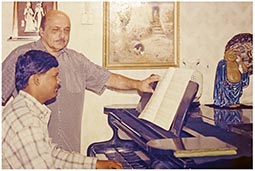
Panthaky teaching his star pupil Manikanand
Like Chopin again, he permitted a certain degree of freedom of expression and yet was particular about the judicious use of the pedal, control over dynamics and phrasing. When he demonstrated a passage it sounded utterly natural — there was certainly individuality in his playing, but it was always sincere and simple. He would surely have made a great corporate manager, with his innate balance between the bird’s-eye and worm’s-eye views of operations.
His simplicity was transparent, being manifested in his choice of works to teach his students. He taught me an early Beethoven sonata which I liked and enjoyed playing; however, when I once asked him what he thought of the last five Beethoven sonatas, which I simply worship, he frankly replied that he never ventured in that "metaphysical” space, as he put it, referring to the sublime and mysterious aspects of the late sonatas, meaning that that "space” was not for him.
A regular highlight of his professional career was the series of annual concerts he gave in which his pupils (I was not one of them) performed at the Sohrab Palamkote Hall in Dadar Parsi Colony. He invited my wife Veera and me to at least one such event. I remember how Panthaky really glowed with happiness and pride at witnessing his students performing various pieces with diverse levels of difficulty; their playing certainly justified his feeling of achievement. The audience — the pupils’ parents and other invitees — used to highly appreciate and enjoy these events.
His family hailed from Bangalore and were devout followers of the Church of Christ, Scientist, better known as Christian Science. It was calming to observe the seamless and happy blend of Panthaky’s peaceful demeanor, presumably influenced by his Christian faith, and his unmistakably very Parsi personality. I see no internal contradiction whatsoever in terming and regarding him quite respectfully as a Parsi Christian, for that is what he undoubtedly was. An unforgettable instance of his and his family’s firm adherence to a tenet of their faith was their calmness and refusal to seek conventional medical help to treat the cancer that ultimately claimed his dear mother, a truly gracious lady.
His elder sister, Gool, also lived with Cyrus. Both siblings were unmarried. To me, Gool really stood out for her tolerance of the nearly continuous sound of the piano classes Cyrus held for the better part of the day. Imagine her in her room while the pupils, and occasionally Cyrus himself during demonstrations, played on his acoustic piano in the living room. Gentle Gool quietly provided her dear brother with invaluable support and hopefully even enjoyed herself sometimes.
He was happily proud of the fact that he used to play at the Taj Mahal Hotel. This was a just recognition of his professional talent and competence. The European and American guests at the Hotel, appreciating and enjoying his music, began to reward him with substantial tips. He initially felt that accepting these gratuities was demeaning, and refused them politely. The guests, feeling rebuffed, complained to his "boss,” one of the Hotel’s general managers, who advised Cyrus to accept the amounts. So he followed the advice and the ruffled feathers on both sides were smoothened.
One day a middle-aged lady entered the room where he was playing, walked towards the piano and stopped to listen intently. Cyrus, looking up, recognized her instantly, and his cup of joy was full, for the lady was none other than the reputed playback singer Lata Mangeshkar, widely known as the "Nightingale of India.” After all, beautiful music is universal, notwithstanding the widest cultural diversities.
Panthaky and Manikanand, (2nd and 3rd from l) with other students
Cyrus, a well-known senior piano teacher and musician, was a regular visitor to Furtados, the music shop at Dhobi Talao. He was fascinated with the Yamaha electronic pianos that had recently been imported and, being a serious music professional, was truly impressed with the quality of their sound as compared with those of the old, reliable acoustic instruments.
So he bought a Yamaha upright piano from Furtados and invited Veera and me home to see and hear it. Apart from the joyous excitement at the invite, I wondered how he could have placed it in his modestly sized hall, which already housed the piano he used for his lessons. But when we arrived at his home, he led us to his still smaller bedroom and, lo and behold, the newcomer was installed there in one corner. That was a judicious example of space management!
Being a pianist-in-residence, a gracious, effusive host and an ingenuous friend, he was raring to demonstrate his formidable new toy. Veera and I sat on the bed to listen, and I — not to put too fine a point on it — was animated with excitement and anticipation.
Cyrus played for a full hour. He performed Beethoven’s Thirty-two Variations, some Chopin waltzes and preludes, a Mozart sonata movement and more. He was modest, not once looking at his tiny audience as if to say: "Joyoon ké, mè kéhvu vagaryu (How well I played that)!” Incidentally, this was perhaps when I started listening at concerts with my eyes closed!
The sound of Cyrus’s electronic piano was a revelation. It was very close to that of his acoustic instrument, without, however, sounding the same. We strongly praised his acquisition and did not fail to congratulate him on his performance, either.
If the trusty acoustic, boudoir, grand piano in the hall was his faithful accomplice and collaborator, then the Yamaha was his pride and joy. None but he could use it and revel in its aural, electronic fidelity.
I was saddened to learn about the passing of a good friend, a spirited teacher and musician, and a genuine human being after a brief illness. He plays his Thirty-two Variations in heaven, and Pak Dadar Ahura Mazda, the universal spirit, listens and says: "This is for real!”