Conceived as a cultural hub for aspiring artists, in the
last 50 years Cymroza Art Gallery has made a pivotal contribution
Parinaz Gandhi
Artists are known to transform space. One visionary young artist, Pheroza Shroff, sought to create space. She launched Cymroza Art Gallery (CAG) in 1971 for aspiring artists to exhibit their works. Over 50 years, the gallerist-turned-collector, connoisseur, art historian and researcher, Dr Pheroza Godrej has gained new perspectives. The precincts that started as a vibrant "multi-arts forum for youth culture” has continued to host upcoming artists in the domain of painting, sculpture, textiles, ceramics, photography and printmaking. Cymroza has hosted over two lakh visitors to their 700-plus exhibitions and promoted more than a thousand artists, as notes their specially created website cymroza50.com
To mark the golden jubilee of this art institution, three concurrent exhibitions at three venues in Bombay were inaugurated on September 1, 2021. "The Cymroza Chronicles” documented the progress of the Gallery and its founder at CAG on Bhulabhai Desai Road. "Mapping the Lost Spectrum” showcased 100 varied exhibits from the rare collection of Jamshyd and Pheroza Godrej and their son Navroze at the second gallery, Pundole’s at Ballard Estate. "The Unpaved, Crusty, Earthy Road,” a retrospective of the little-known fiber artist Nelly Sethna who was patronized by Pheroza, was on view at the third gallery, Chatterjee & Lal at Colaba. "Having three galleries allowed us to make this celebration an expansive and participatory festival,” noted Ranjit Hoskote who had curated the first two exhibitions while his wife Nancy Adajania curated the one on Sethna.
Originally Pheroza had envisaged nine consecutive thematic exhibitions for Cymroza’s golden jubilee year. However once the curators expressed their vision of "a typology of exhibitions — archival, selective and research-based” she gave them a free hand. "Please don’t ask me what to do. Treat me as a fly on the wall,” she impressed on the collegium that worked on the three complementary exhibitions. Preferring that "a collector should not do the critical thinking of a curator,” she encouraged them to proceed independently.
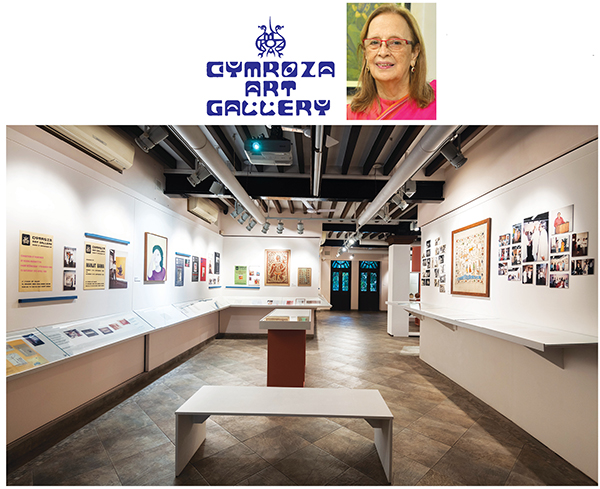
Top: Dr Pheroza Godrej; above: "The Cymroza Chronicles" exhibition
Working on this constellation of exhibitions since March 2020, the team or collegium as they referred to themselves, were initially anxious whether their plans for physical exhibitions would be marred by the pandemic. Fortunately for them the restrictions for physical assembly at art galleries were lifted so they went ahead although some of the preparatory processes were marginally slowed down when specialists and artisans returned to their villages or could not travel. Even though Dadiba and Khorshed Pundole as also Mortimer Chatterjee and Tara Lal offered their premises free of cost, the non-curatorial expenses almost doubled because of the lockdown. "Budgets and I don’t go hand-in-hand,” confessed Pheroza, alluding to similar experiences in the past of co-curating exhibitions at the National Gallery of Modern Art (NGMA) mounted during the 10th World Zoroastrian Congress in Bombay in 2013 and a decade earlier her coffee table book, A Zoroastrian Tapestry that she had co-edited with Firoza Punthakey Mistree. The safety of visitors however was the prime concern of Pheroza and her team. Ironically, one of the exhibits at Cymroza showed an oil painting by the founder titled Woman with Masks.
Besides carrying visuals of the exhibitions, cymroza50.com features seven stories where Pheroza relates the early days of the Gallery and her inspiration from and contribution to the cultural scene of India. From these stories, visits to the exhibitions and subsequent interviews with the gallerist and the curators, Parsiana was able to weave its own narrative.
Gleanings from the gallerist
"It was just an immense desire and passion to start this Gallery,” mentioned Pheroza who had held her first exhibition at the age of 20 years at Chetana Art Gallery at Kala Ghoda after being politely turned away by other galleries. To establish themselves upcoming artists need their "sketchbook, paintings, portfolio… but none of this carries as much weight as that one first solo exhibition. Where do young artists go to exhibit?” was her prime concern when setting up her own Gallery in a godown on her parents’ property on Bhulabhai Desai Road. The name Cymroza, derived from a synthesis of the four Shroff family members, was coined by her mother Mitha: ‘Cy’ from younger son Cyrus, ‘m’ from Mitha, ‘roz’ from father Phiroze and ‘a’ from Phiroza.
"You have to get a good logo and a good letterhead. For a contemporary art gallery, why do you want to use old English typeface?” Pheroza recalled the initial feedback of senior sculptor Pilloo Pochkhanawala on seeing the invite brought by the young artist. Convinced that the Gallery opening originally scheduled for August 15, 1971 needed to be deferred by a couple of months, Pheroza returned to the drawing board. The new logo and specially created font for Cymroza have remained their distinctive features over the years.
Identifying herself more with the artist fraternity than a gallerist, Pheroza had chivalrously announced in the early days, "‘I don’t need a commission.’ I am an artist. They were artists. How can you take somebody’s bread and butter away?” she asked rhetorically.
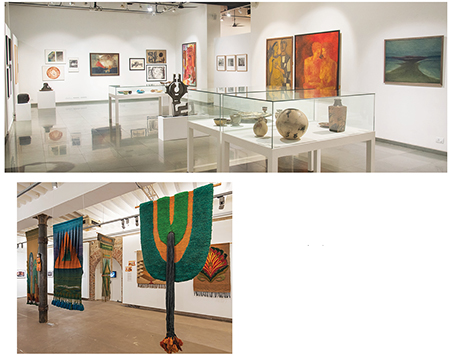
Top: Mapping the Lost Spectrum" at Pundole’s;
Above: "The Unpaved, Crusty, Earthy Road" at Chatterjee & Lal
Nelly Sethna on wheelchair with husband Homi (behind) and Roshan Mullan
"We’re not a 100% commercial gallery and I’ve never made a lot of money,” declared Pheroza, happy though that she had "parents who supported me; not indulged me.” If she went out for coffee at the Willingdon Club, her mother would reprimand, "Ghér ma coffee nathi malti ké baar peeva jaich (Do you not get coffee at home that you need to go out)?” Immersed as she was with the Gallery, her parents were concerned that she was deferring matrimony but if the pretty belle was invited out to a meal by questionable suitors, whether an artist or patron, her mother would be seen shaking her head, prompting her to do likewise. "There were parameters and brakes put on me. I still have parameters and brakes put on me. If you cut your coat according to the cloth you have, you won’t go wrong. Don’t overextend yourself. It only spells doom,” she has learnt. Her only regrets are that her mother made her prioritize her piano lessons as also Indian dance with Shirin Vajifdar rather than permit her to learn conversational French at Alliance Francaise or shorthand and typing at Davar’s College that could have eased her current writing burden.
Through the ’70s it was a struggle to sustain the Gallery from season to season, each one lasting for approximately five months from November to March. In the evenings, CAG was the favorite venue for concerts, literary pursuits, film screenings and theater, with the support of the British Council, Max Mueller, Alliance Francaise and other organizations. By the time the Gallery became an established name in the ’80s, each exhibition would be accompanied by a catalog with an annual catalog printed at the end of the year for the convenience of art patrons.
"From contemporary art, going backwards, my taste and interest started widening from the mid-80s. This took me to a second career that was very rewarding. I discovered I’m a research person at heart,” stated Pheroza who enjoys immersing herself in books at a library. At a much later stage in life she decided to complete her second Master’s degree from the Bombay University on "Caves Architecture of Western India.” This was followed by a PhD on "Temple Architecture from the eighth to 12th century” that gave her an opportunity to travel around India and reach the sites in remote areas, usually accompanied by an escort to ensure her safety.
Her parallel career in art administration saw her chair the advisory committee at the NGMA and its Mumbai chapter. "If you follow the rules, your work is very well cut out and you receive a lot of cooperation,” even from bureaucratic heads, she learnt. As a matter of principle, she would however insist on recusing herself from the NGMA Purchase Committee lest a decision concern one of the artists whom she had nurtured in earlier years.
Her approach to her work and her collection inspires confidence. When unable to make headway on a project she convinces herself and others, "There must be another way.” If overwhelmed by the enormity of some task at hand, she recommends, "Break down the issues into smaller tasks and then prioritize the components to see if they are doable… I really believe, whatever you do, you have to put your whole heart into that.” When adding a new painting to her collection, she ensures "it really touches a chord in the heart and intellectually. If it is tribal or naïve art it should arouse joie de vivre… Collecting works by craftspeople has been very integral to my growth. We have to support crafts. If we don’t, who will?”
Impressed by the commitment of her seniors like Roshan and Ebrahim Alkazi from whom she learnt about art heritage, Pheroza now serves as a role model for others interested in art history. With her curators too she shares a special rapport although they are younger than her. Both Hoskote and she were English literature students at the Bombay University before they pursued their respective careers in art.
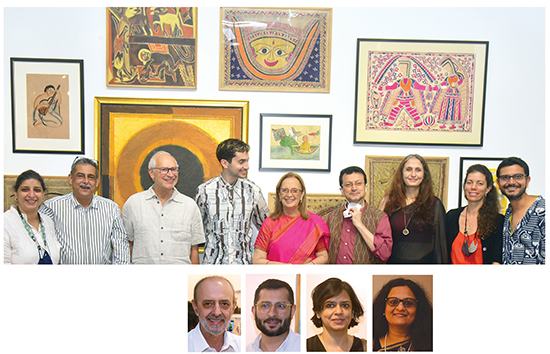
At the inauguration of Cymroza at 50 (from l): Khorshed and Dadiba Pundole,
Jamshyd, Navroze and Pheroza Godrej; Ranjit Hoskote, Nancy Adajania, Eve Lemesle,
Parvesh Java; below: Cyrus Shroff, Mortimer Chatterjee, Tara Lal, Vrunda Pathare
All exhibition photos: Godrej Archives
Connect with the curators
"The response to all three shows has been absolutely extraordinary! The openings were fantastically well attended” and the curatorial walkthroughs had an average attendance of around 60 people. "The footfalls have more than justified the effort involved… A whole new audience and a new generation have become aware of this rich history of collecting and exhibiting, of artistic and gallery practice in Bombay,” noted Hoskote in an email interview with Parsiana.
At the Cymroza walkthrough he mentioned, "The tenor of this initiative was founded in deeply moving experiences.” The photos, correspondence, invitation cards, announcements, visitors’ books and catalogs on display, he viewed as "an intense exercise in reaching collective memory.” CAG was more than just a gallery. Cymroza took forward the Bhulabhai Memorial Institute’s mandate of being open to all the arts which is why during its first decade it presented itself as "a Gallery for young people. It was a cultural hub… for Hindustani and Carnatic concerts, folk and rock music concerts, poetry and play readings, screenings, theater, lectures and civic participation.”
The Jamshyd and Pheroza Godrej Collection has been "especially hospitable to historically under-regarded artistic practices rather than being fixated on a masterpiece oriented approach… Its scope ranges from works by established modernists to lesser known artists of rural heritage, embracing a range of media including painting, sculpture, drawing, printmaking, ceramics, fiber art and photography.” Particularly fascinating for the curator was the ceramics collection, delighting in "how many generations and lineages of ceramic artists were represented here.”
"People have been most moved by the Nelly Sethna retrospective because here is an artist who has unjustly been consigned to oblivion,” added Hoskote. The Sethna retrospective was possible only because of Pheroza’s "inclusive vision,” confirmed Adajania, appreciating her "foresight to collect Nelly’s works at a time when fiber art was seen as a poor cousin to the dominant medium of the day, namely painting. I have divided the exhibition scenography into two parts: on the one hand the viewer is free to meander through a field of Nelly’s tapestries which are highly textured and even sculptural, and on the other, the viewer is presented with a wall of my research notes which contextualize Sethna’s work.” Believing that nature was the perennial guide to design, Sethna is known to have preferred "the unpaved, crusty, earthy road” over one paved by custom and habit.
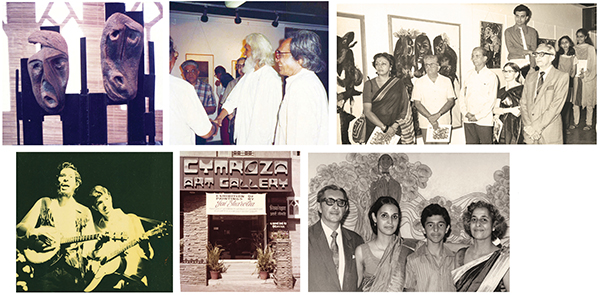
Glimpses from Cymroza's past: (top row, from l) Pilloo Pochkhanawala's sculpture, 1988;
Akbar Padamsee greets M. F. Husain as Tyeb Mehta looks on, 1992; Sumitra Kumar Srinivasan,
D. G. Nadkarni, Nissim and Daisy Ezekiel, Kersi Dubash (behind) and
Phiroze Shroff, 1985; 2nd row: Rohinton Mistry’s performance; Gallery entrance;
Phiroze, Pheroza, Cyrus and Mitha Shroff at the inauguration of the Gallery, 1971
Collaboration with the collegium
Besides Pheroza and the two curators, the collegium involved in the golden jubilee celebrations included Chatterjee who was regarded as the resourceful convenor, Lal who contributed conceptual and practical advice, Eve Lemesle who handled the production infrastructure and Vrunda Pathare who offered vital archival support. Colleagues from Godrej who facilitated their efforts were Rumi Majoo, Sharokh Marolia and Sneha Chandorkar.
"We have the utmost respect for the history of Cymroza Gallery and for Pheroza’s journey with art,” noted Chatterjee and Lal, adding, "As such, we are thrilled to be a part of the Cymroza at 50 celebrations. Our gallery has a long-standing interest in research based exhibitions and so it was exciting to work with Nancy on the Sethna retrospective.”
"It is always a pleasure to join in the celebrations of a fellow gallery that has survived 50 years,” stated Pundoles. "Having the Jamshyd and Pheroza Godrej collection on our walls was a real treat not only for our viewers but also for us,” they added.
"I take time to build a team. I like to work with consensus,” stressed Pheroza who has realized that people who are not "confident of themselves tend to become petty and start nitpicking.” Delighted to see her collection "interpreted in a new light, in a new way,” she is convinced, "Diversity in culture makes civilization interesting. How are we going forward? How do we learn from critical theories? … We need to change our thinking – change with a purpose… for the ultimate good.”
Like all collectors, Pheroza is "worried about storage and conservation. Bombay’s climate is not very kind to works of art. Maintaining a collection in a pristine condition can be very painful.” She is relieved that Godrej Archives under its chief archivist Pathare could be entrusted the responsibility. Restoration efforts started five years ago under a professional restorer. Fortunately the historical segment and the sculptures don’t need restoration. Simultaneously the collection is being documented under different heads: artist, subject, material, condition.
Being new to this collection, at the Cymroza walkthrough Pathare admitted feeling "overwhelmed for the last two to three months” and how she needed to depend on Excel to document the items. "This is not just the founder’s story but of all who’ve made this possible. Every gallery must have its own archives. Archivists need to come out of their comfort zones and create knowledge instead of merely recording it… Archives are not closed walls. Galleries are more about conversations. You have to make the audience participate.”
While the exhibition at Pundole’s ended on September 15, the ones at Cymroza and Chatterjee & Lal will continue till October 30, 2021.