The progress of the Congresses, Iranshah and mobed amelioration were some of the issues deliberated by the Global Working Group
Parinaz Gandhi
"This is a fragile organization that needs a lot of nurturing. There is a thin thread that holds us together,” reminded Rohinton Rivetna of Chicago when addressing the Zoroastrian leaders from USA, Canada, UK, Dubai, India, Hong Kong and Australia at the Global Working Group (GWG) meet hosted by the Bombay Parsi Punchayet (BPP) trustees and convened at the Banaji Atash Behram Hall on December 20, 2017.
The meeting witnessed several firsts with the "informal” world body appointing its premier non executive chairman and permitting the Parsi Press to be present, albeit at the last moment. Whilst the appointment of Neville Shroff, president of the Zoroastrian Charity Funds of Hongkong, Canton and Macao, as administrator at the last GWG meet in Hong Kong in December 2016 was welcomed by all leaders, this year, the initial suggestion to give him the designation of president or chair "befitting his personality and stature” was met with misgivings. The objection was not against Shroff but the creation of an official post in an organization that was meant to be informally structured.
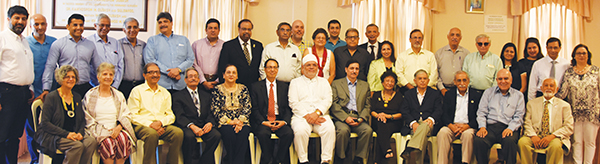
Representatives from four continents at the Global Working Group meet in Bombay
From left (top row): Neville Shroff, Yazdi Desai, Homi Gandhi, Dastur Khurshed Dastoor, Rohinton Rivetna, Malcolm Deboo,
Meher Bhesania, Firoz Pestonji; (2nd row) Astad Clubwala, Adil Minocherhomjee, Kobad Zarolia, Dinshaw Tamboly,
Sam Balsara, Kersy Bhesania, Noshir Dadrawala, Kersi Randeria; (3rd row) Arzan Wadia, Bomi Patel, Javid Canteenwala
Since the formation of the GWG eight years prior, this was the first meeting attended by a section of the Parsi Press. Earlier, during the days of the GWG’s predecessor, the Coming Together Roundtable (CTR), the Press used to be invited. The confirmation that Parsiana could attend the 2017 meeting was received a little before midnight on December 19, following an intense debate between the BPP chairman Yazdi Desai and his five co-trustees. Desai opposed the presence of the Press stating in an email to Parsiana, "The GWG is an informal structure whose representatives from various regions of the world express thoughts without the fear of being misquoted or their opinions being distorted by the Press… After the meeting the GWG will release a Press statement. The Press has never been a part of the GWG meetings and we wish to continue this comfortable tradition.”
Kobad Zarolia, former president of the North American Mobeds Council, informed the gathering of the efforts of Byram Avari, chairman of the Karachi Parsi Anjuman Trust Fund, to facilitate the migration to Canada of Parsis from Pakistan under 45 years of age. "Presently 48 persons will be given the facility of being permanent residents in Canada for a few years till they are given citizenship. These people fit into one of the 2,000 categories which are available for immigrants. The Karachi Anjuman is paying for two years’ free accommodation, free food and cost for further educational qualification if required for these immigrants to get a job,” Avari clarified in an email to Parsiana. Additionally, the Zoroastrian Society of Ontario has signed an agreement with the Government of Canada promising help to any migrant from Iran, "anytime, anywhere,” added Zarolia.
One hundred and sixty-six delegates have registered for the 11th World Zoroastrian Congress (WZC) in Perth from June 1 to 4, 2018. "We need a lot of support from all of you,” stated Congress chair Firoz Pestonji. "We want to see results coming out of the Congress. Don’t dwell on the past; come with solutions. We want to help associations move forward. If we don’t do the right thing today, there may never be a tomorrow,” cautioned Pestonji. His audiovisual presentation that described the venue of the Congress and the tourist attractions, also alluded to "a digital hall of fame” as being the legacy of the Congress. The Congress website,
www.11wzcperth.com.au, features some individuals well-known in the community in the "hall of fame.” He further referred to the formation of the Australian Zoroastrian Federation and stated that with New Zealand wanting to join, they may have to change the name.
The deadline for nominations for the Awards Program at the Perth Congress was October 31, 2017. There were 50 contenders for six categories, reported Meher Bhesania of Dubai. The applications have been sent to the judges who will decide the winners by April. Pestonji was informed that he would have to prepare the Awards trophies and ensure that the winners are present, failing which the award would go to the next person on the list.
The Zoroastrian Association of Greater New York (ZAGNY) has bagged the right to host the 12th WZC in 2022. No other association bid to host the meet. In his audiovisual presentation, ZAGNY president Astad Clubwala stated the Congress plans to bridge regions on cultural and religious grounds, educate people on the practice of religion over time, obtain representation from emerging Zoroastrian groups, support Zarathushti seniors, organize elementary and advanced knowledge sessions, develop a separate youth track with different networking opportunities, identify every Zoroastrian pocket in the world. They hope to induce each region in the world to take ownership of certain session/event in the Congress program.
The Seventh World Zoroastrian Youth Congress will be held from June 30 to July 3, 2019 at the California Zoroastrian Center, as reported Adil Minocherhomjee, vice chair of the meet. Through the Congress they aspire to build new friendships and respect for people from different environments. The program will include a jashan, movie night, outings to the beach and a tour of Los Angeles. They expected to raise revenue of $ 430,000 (Rs 2,74,66,250) from institutions, $ 220,000 (Rs 1,40,52,500) from individuals and $1,400 (Rs 89,425) from sale of tickets.
Malcolm Deboo, president of the Zoroastrian Trust Funds of Europe, enquired whether a brilliant presentation is a prerequisite for bidding for a congress. (A GWG committee decides on who will be assigned the Congress meant to be held once every four years.) Responded Clubwala, "Organizing a WZC requires tremendous amount of coordination. If that organization can’t come up with a decent presentation, will it be able to hold a congress?” ZAGNY has hosted three of the 17 biennial North American Zarathushti Congresses.
"To make Udvada the global center for showcasing our Zoroastrian heritage, culture and way of life” is the mission of the Global Initiative, announced at the GWG and officially launched at the Iranshah Udvada Utsav on December 24 (see "Faith, fun and food,” pg 44). Inspired by Dastur Khurshed Dastoor of Udvada, and supported by Meher Amalsad of California, Noshir Dadrawala, Bombay Parsi Punchayet (BPP) trustee, and Homi Gandhi, president of the Federation of Zoroastrian Associations of North America (FEZANA), the nascent organization will endeavor to perpetuate the legacy of Iranshah through "education, inspiration and donation.” The "five-star purpose” as delineated by them aims to preserve the sanctity of Iranshah; create a monetary incentive for the mobeds; keep the flame alive by providing kathi; maintain the Iranshah edifice; provide round the clock security. In addition they are seeking volunteers to keep the premises clean and presentable. FEZANA vice president Arzan Wadia announced that FEZANA has already created a portal fezana.org.udvada through which donations can be routed.
A subcommittee comprising Dastoor, Dinshaw Tamboly, chairman of the World Zoroastrian Organisation Trust (WZOT) and Sam Balsara, chairman of Madison World, was constituted to look into possible solutions to the vexing problem of maintaining a surfeit of agiaries and supporting priests who are in short supply. It was recommended that a white paper be prepared detailing the number of agiaries and devotees with a master plan to provide for them 10 years hence.
Parameters for GWG
The GWG proceedings started with a benediction by Dastoor who on roz Khordad, mah Amardad sought blessings from the presiding angel who bestows men with integrity and prosperity.
In his opening remarks, Shroff maintained that the GWG, since its inception has been endeavoring "to preserve all aspects of religion, culture and property… whilst alleviating poverty and stress for the betterment of the community… We would like to work together in unison… showing respect for the global majority… with no single organization dominating… It’s a working group where decisions should be approved with a 75% majority… not a committee where decisions are approved and later disapproved… The global community would not accept infighting and tarnishing of its image. Let us be proactive… Let us as leaders think of others, be honorable Parsis and work with integrity, tolerance and respect worldwide.”
The formation of a world body, mooted at the First World Zoroastrian Congress held in 1960 in Tehran has been a contentious issue. The Federation of the Parsi Zoroastrian Anjumans of India had wanted to form a representative world body. In 1993 the World Council of Zarathushti Federations (WCZF) was conceived. The World Alliance of Parsi Irani Zarthoshtis was formed around 2005 to oppose any move to create a global institution that included associations with non-Parsis as members. This meant the North American associations would be barred from participating. The CTR functioned for some years before evolving as the GWG at the 9th WZC in Dubai in 2009.
Rivetna ran through the salient features of the Code of Civil Conduct, developed by Ervad (Dr) Ramiyar Karanjia. The Code specified that progress is possible only if there is peace, and peace can be attained if there is respect, tolerance and obedience. Rivetna added, "In the eyes of the world, we have little relevance… The chances of survival of each region are slow. Our goal should be to assist each other to grow and prosper whilst being mindful of the others’ sensibilities.” The word hamazor means "united in spiritual energy,” he noted, encouraging the representatives to share the hamazor hand clasp with the person sitting to their left and right so that the fraternity would be "together in strength and together in righteousness.”
Desai observed that at GWG meetings, "there is no voting. Everything is by consensus… It is completely informal… No religion” is discussed. "If we have to push initiatives, we have committees and an administrator… We should keep this in mind.”
"Religion is the basis on which we are here together,” stated Gandhi who had come to Bombay after attending an interfaith meet in Jaipur where he spoke on the Zarathushti principles of peace and non-violence. Clarified Desai, "Different continents have different opinions on who can be a Zoroastrian… Controversial decisions will not bog down the GWG.” Former FEZANA president Bomi Patel mentioned that at the very first GWG meeting in Dubai it was specified that no federation will interfere in the internal working of another. It was also minuted how regions would be represented, permitting any number to attend but only two from each region to vote. With six of the BPP trustees in attendance at the GWG meet in Bombay, if it were to be restricted to two, "it would be me and Viraf (Mehta),” jested Desai. (Mehta is a traditionalist like Desai.) "We don’t want too many heads,” maintained Bhesania who was in favor of a closed door meeting.
"The reason for an informal group instead of a superstructure is to have autonomy,” stressed Deboo, expressing "surprise at the ideas put forth today… Sadly we are seeing structures (emerge)… Once we go into voting — majority/minority — there would be friction.”
Countered Shroff, "We are here to work together… What is the point of this meeting? The global body should have authority… If it is an informal body, we cannot make decisions… We have to move forward… Consensus is a form of indirect voting. Through show of hands (it is ascertained) who supports and who doesn’t… We are here to support each other.”
Deboo maintained, "Consensus is by persuasion as opposed to voting” when each region may be expected to implement the majority decision which could impact its autonomy. "The 1993 (WCZF) model fell apart because of that,” he insisted. Rivetna advocated the need "to build consensus and move forward.” Desai noted, "We want to avoid the tyranny of the majority.”
When Deboo cited FEZANA as a superstructure that holds together the member associations, Gandhi clarified that FEZANA as an umbrella organization with 26 member associations and 15 smaller groups has "an organizational structure.” "Sometimes umbrella organizations lack the ability to push things forward,” voiced Javid Canteenwala of London.
At the GWG meeting in Hong Kong last year the delegates decided to appoint an administrator to carry forward the suggestions. "Otherwise each year it would be a case of khadhu, peedhu and chaali gaya (eat, drink and part). The winds of change are blowing around the world… When we go back to our region the youth ask ‘What did you do?’ ‘What did you achieve?’” stated Gandhi. Pestonji added, "We need to have a structure” to ensure that work progresses and time schedules are adhered.
Another contentious issue was raised by Zarolia who wanted to ascertain "Are we a Parsi Zoroastrian group or a Zoroastrian group? There are lots of Zoroastrians coming up. Which way are we going? We have to decide.” "It’s a Parsi Zoroastrian group. If it’s not, BPP is out,” unequivocally declared Desai. Immediately countered co-trustee Kersi Randeria, "Don’t speak on behalf of BPP. Speak as Yazdi.” Desai maintained that at a meeting with GWG leaders earlier in the year, it was decided that BPP will associate itself only if GWG concerns Parsi Zoroastrians.
"Let us have the hamazor effect within us,” beseeched Dastoor, requesting that controversial points be kept on hold. "What the community needs is togetherness in today’s time. We are scattered, divided… let us move ahead.”
Summing up the goals of GWG, Kersy Bhesania of Dubai said that the Group "works for the greater good of the Zoroastrian community whilst striving to build cultural, social and entrepreneurial capital, share resources and leave a legacy for the community.”
Reports presented by the different committees will be carried in the next issue of Parsiana.