Rare maps, prints and antiquarian books were dislayed for sale at Dilnavaz Mehta’s recent exhibition
Parinaz M Gandhi
Over the centuries the borders may have changed, the contours could have assumed different proportions but the old maps sold by Dilnavaz Mehta under her Rare Finds banner have found an increasing number of buyers. "A lot of people are realizing that maps make nice décor items; they make good gifts and collectibles,” says Mehta who had 1,500 maps on sale (five times more than what she had at her last exhibition in 2002) at her fourth exhibition from December 6-9, 2006 at Bombay’s Cymroza Art Gallery. Dating between 1650-1900, the collection of maps at her exhibition showed a range of features: ancient India to the east of the river Ganges; the world shown in two spheres; coast of Persia, Gujarat and Malabar published under the order of Count de Maurepas and regulated by astronomical observations; Bombay showing the different administrative areas along with the medical statistics for the control of plague…
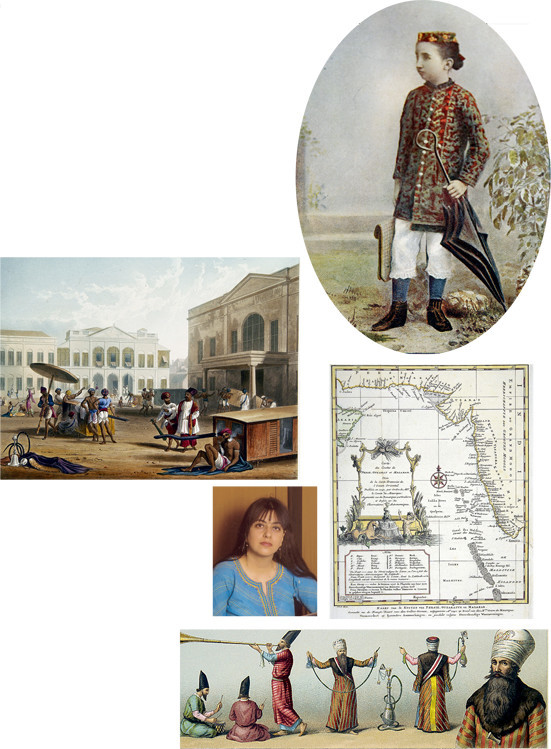
Clock wise from top left: A colored aquatint showing a scene in Bombay by Capt Grindlays, 1826-30; an illustration showing a "Parse school girl,” 1902; a handcolored map showing the coastline of Persia, Gujarat and Malabar; a chromolithograph showing Persian instruments and men in typical attire, 1880; Dilnavaz Mehta
Needed only by traders and travelers, maps were never produced in large numbers. Moreover as accuracy in measurements and map making improved, earlier versions were periodically discarded which accounts for the extreme rarity of old maps in today’s times, explains the Rare Finds catalog. The uninitiated also learn that the master craftsmen of yore were skilled map makers as well as print makers who could draw, engrave, print and color the maps. To enhance their visual appeal, decorative borders along with illustrations (vignettes) were added to the maps.
In addition to the maps Mehta was selling nearly 3,000 prints and 45 antiquarian books. Viewing prints as an "interesting blend of art and history,” Mehta explains how the technique and process in use determined its classification – engraving, etching, aquatinting, mezzo-tinting, lithography. Each of these earlier prints depicting landscapes, sports, events, mythology, religion, costumes, portraits, monuments, with the colors often being manually added, is considered an original. The books in Mehta’s collection were published between 1775 to 1940 and cover literature, history, travel, art, architecture, archeology, biographies, natural history and include administrative records, personal diaries and scientific works. An 1820 edition of The History of British India in six volumes by James Mill, Typical pictures of Indian natives in Colour by F. M. Coleman (1902), Charles Dickens’ Rare Print Collection in 10 parts (numbered copy) for private circulation (1900) are some of her prized exhibits. These cherished "antiques on paper” Mehta hopes to reach not just to collectors or buyers but to a large number of individuals who could derive the same joy as her from these genuine pieces made available at affordable prices (prints cost upward of Rs 500 and maps Rs 1,500 and more).
Her personal collection though includes certain valuables which she would not consider parting with like the volumes of the Vendidad and Hodiwalla’s Gujarati treatise Pak Iranshah ni tavarikh (even though she can barely read Gujarati). Among the prints in her private treasure chest is "Rite of truth” showing a man placing his hand over a fire and another of a typical home life in Yazd by an unknown French artist (mid 19th century) besides several on Bombay.
About 10 percent of her clientele must be Parsis, says Mehta though many more evince an interest in her exhibitions. Valuing the support of Pheroza Godrej, owner of Cymroza Gallery, Mehta explains how ordinarily the first floor gallery is given only to reputed artists of standing while the ground floor premises are hired out for any commercial venture. Since Mehta was permitted to hold her exhibition on the first floor, it carried with it a stamp of authority from a voice that matters in the art circle.
Prints of Parsi merchants welcoming the Prince of Wales, Parsi monuments, a Zoroastrian reciting prayers before a waterfront, depictions of Persian/Iranian history and culture are subjects that interest members of the community, according to Mehta. "By nature, Parsis like old things, collectibles. They appreciate art and like to maintain it well,” she observes. The general media often enquires whether she sources her originals from Parsi homes, little realizing how much she has to travel, to scour and tap the authentic repositories. Among the best encomiums she has received for her work were by a non-Parsi customer in Gujarat whom she has never met but who described her as "a true Parsi” for her catalogs "honestly and truthfully” describe the condition of the original work without any misleading statements. A lot of her sales transactions are with clients whom she has never met, on the basis of the reputation she has built up over the last 10 years she has been in business.
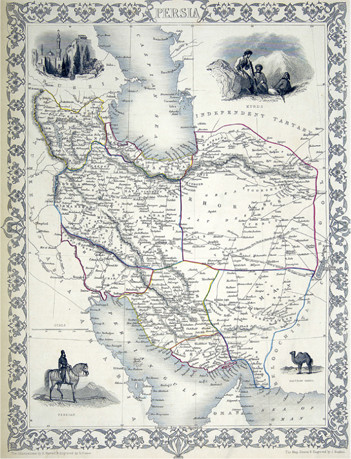
A handcoloured Tallis map of Persia with illustrations, 1851
She gives credit to some of her clients who gave her "wonderful letters of attestation” which helped her win a legal battle in 2004 when her brand name, Rare Finds, was unscrupulously adopted by a person to hold his exhibition and sale of South East Asian artefacts on the ground floor premises of Cymroza Gallery to which Mehta too was invited! Fortunately for her, within five months the case was decided in her favor.
Besides giving presentations at various institutes, cultural organizations, corporate houses within India, Mehta has authored articles on her subject of expertise and is a visiting lecturer for a postgraduate course in Indian aesthetics at the Bombay University. Rare Finds has now evolved into an organization which provides ancillary services of restoration, evaluation, book search, customized mounting and framing to individuals and corporates. In fact 40 percent of her time is now devoted to helping her clients maintain their collections, she reveals citing the instance of a map which is best preserved when mounted. But in the process of framing, if the border is erroneously cut off, the value could come down drastically. Further with a wide variety of frames on offer the customer is more confused as to which one to select.
"My background in microbiology has helped me with my restoration work,” says Mehta who studied at the J. B. Petit School and later completed her BSc from Kishinchand Chellaram College and MSc from the Bombay University. She later did a diploma in Indian aesthetics from the Bombay University. "A personal interest and search of roots” made her learn Avesta and Pahlavi four years ago at the Sir J. J. Zarthoshti Madressa.
Presently there is little time to indulge her hobbyhorse. In fact, even for the restoration work that she undertakes at home she has to ensure that her timing and planning is correct – to be executed during the hours when her two-year-old son Dorab is out of the house. Dilnavaz and husband Minoo are "very conscious that we can’t leave anything for later… He’s changed things drastically.” They have to adjust their schedule, their travels, keeping little Dorab in mind. Accompanying his mother on her trips, he gladly shows around the original works on his mother’s instructions. Since both Dilnavaz and Dorab share the same initials she happily announces, "We already have the next generation of D. M. Mehta.”