Iranian surnames came into vogue only in the
early years of the 20th century and were driven by the government’s compulsions
Farrokh Jijina
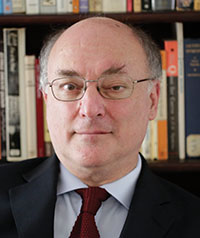
"There was no particular pattern or trend in the adoption of family names by Zoroastrians in Iran,” according to Prof Houchang Esfandiar Chehabi, professor of international relations and history at Boston University who was delivering a lecture on "The introduction of family names (1918-1924) in Iran and its consequences” on December 18, 2015 at the K. R. Cama Oriental Institute (KRCOI). Some Zoroastrians, he informed those present, took on surnames based on geographical origins and some on the basis of occupations.
The use of surnames became popular only when state registries to record births, marriages, divorces and deaths were set up in the distant provinces of the country, so said the professor who has taught at Harvard, Oxford, and University of California, Los Angeles too. "The militarization of Iran also led to the spread of family names.” In 1918, the government had control only over Tehran and its immediate surroundings while large tracts of land remained under various local chieftains. The period 1920 to 1925 saw the establishment of central rule in the provinces, thereby reinforcing the need for information on who could be conscripted. "By 1925, these registries had spread to all parts of the country,” mentioned the academician.
Linking the introduction of family names to the all-round development of trade, infrastructure and growing prosperity in the early part of the 20th century, Chehabi stated Iran was one of a handful of countries that was not directly influenced by Western imperialism in the 18th and 19th centuries and therefore ‘modernized’ using internal stimulants. The first known use of surnames was noted in Venice in the 9th century, he remarked.
The professor, who acquired his doctorate in political science from Yale University, said that prior to the usage of family names, first names alone were used. Certain words, he explained, were used to ‘individualize’ people. For instance, if "Ahmed was literate, he had Mirza affixed before his name, and if he had completed his haj (pilgrimage to Mecca) he was called Haji Ahmed.” Shopkeepers and tradesmen continued to be referred to by their professions, "so you had ‘Hasan the baker or Ali the butcher.’”
The other reason, why families adopted surnames was to show the world that they had reached a certain level of social standing. Foreign travel required forms which required family names to be filled in. "Iranians who had emigrated already had adopted surnames,” he noted, and those who remained behind "wanted to adopt surnames as a sign that they were civilized.” Drawing a parallel, he revealed that similar trends were noted in Siam (currently Thailand) from 1913 onwards. Iranians who went to work on the oil fields in Baku adopted surnames in the manner of the Russians, "so we had ‘zadeh’ (son of) affixed as a family name, much like patronymic ‘vitch’ (son of) that was popular among the Russians.” Some adopted family names had ‘aspiration’ values attached to them, Chehabi said, quoting the example of Adel (the just).
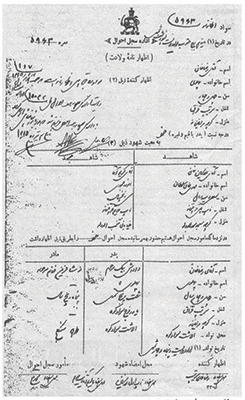
Reza Khan’s first identity card of 1919, the first time the
surname Pahlavi appears Photo: Prof Chehabi
The surname Pahlavi adopted by Reza Shah, the emperor who ruled from 1925 to 1941 had nothing to do with the ancient language, or a nod towards Iran’s pre-Islamic past, he revealed. The surname was derived from Palani, the name of the clan Reza Shah belonged to, and that "he was told that this was somehow related to Pahlavan, which in Persian means hero.”
Legislation on family names, first promulgated in 1919, was strengthened in 1925, stated the academician. Initially each family name had to be unique within a particular town or village. Newspaper editors, he smiled, made a lot of money "with insertions from advertisers on the lines of ‘My family name is Ahmedi and no one else should use it.’” Very few families used first names as surnames, according to him.
Chehabi concluded that the use of surnames in Iran "fortified the concept of statehood within the Iranian people” by bringing them together and paving the way for forging a common identity.
The Iranians were as fond of titles as Indians. Speaking to Parsiana on the sidelines of the lecture, Chehabi said that some Iranian titles were given in recognition of erudition. He found it "striking” that a Persian title — Shams ul Ulema — was bestowed by the British on four Indian Zoroastrian scholars — Dr Sir Jivanji Modi, Kharshedji Cama, Dasturs Peshotan Sanjana and Maneckji Dhalla!
In her welcome address, Dr Nawaz Mody, honorary secretary of the KRCOI mentioned that this was the professor’s first visit to Bombay, "though he has been to India several times.”