The Poona Parsee Panchayat is studying a proposal
for a burial ground on their Doongerwadi property
Farrokh Jijina
In an effort to safeguard their Doongerwadi lands and offer a choice to community members, the Poona Parsee Panchayat (PPP) is examining the possibility of setting aside "15 to 20 acres” of their existing property to house an aramgah, while continuing with dakhmenashini. Being a hilly area, no construction is possible. "Aaprij jameen par loko dataay toh su vaandho chhè (What is the harm if people are buried in our own lands)?” queried PPP chairman Homi Kaikobad, speaking to Parsiana on September 7, 2021.
In a circular to the community members of Poona, Pimpri and Chinchwad titled "Time to think out of box” dated September 2, Kaikobad put forward the background for this proposal: government regulations regarding barren properties, expanding cities, solar concentrators at the dakhmas being ineffective during monsoons, and the threat of encroachments. Cremations or burials that are insisted on by the authorities for victims of coronavirus have "further compounded these challenges… (cremation) is against Zoroastrian tenets… in Poona many are opting for cremation due to the lack of an alternative system.
"It is an accepted practice of laying to rest loved ones in the serene ambience of an aramgah where (people) can even visit their loved one’s final resting place any time… not to forget, one is doing a good deed for future generations too,” noted Kaikobad. The father-son duo of billionaire-philanthropist Dr Cyrus and Adar Poonawalla has "graciously consented to assist PPP in its endeavor for the establishment (of the aramgah),” noted the PPP circular. The discussions with the Poonawallas revolved around the possibility of having a dual system "thereby providing a choice to community members in the mode of disposal,” stated the Panchayat circular. Inviting community members to give their suggestions on the proposal by September 20, the circular ends on the note that "there will be no closing of the dakhmenashini practice… It will continue.”
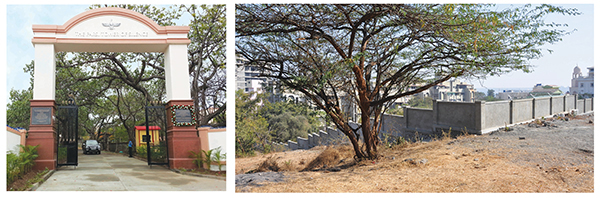
Above l: Entrance to Poona’s Doongerwadi; wall around the lands
Mazdean Memorial Park in Poona; inset: entrance
"By and large we are getting positive responses to the circular… There will always be some naysayers, notably from Bombay,” Kaikobad stated in conversation with Parsiana. The chairman reiterated the efforts of the Poonawallas to assist the Poona Parsis. "They were responsible for building the walls around all our lands fencing off both dakhmas,” he told us. The ruvan ni bungli at the Patel dakhma was built afresh and the one in Poona Cantonment has been refurbished by the Poonawallas, he added.
Reportedly, another anjuman that will allow burials, for Covid victims only, on land adjoining their defunct Tower of Silence, is Pardi in South Gujarat. Trustees Aspi Pardiwala and Aspi Sui told Parsiana on September 8 that the vacant land was in danger of being acquired by the government to set up a school for Adivasis. The anjuman, with the help of Udvada High Priest Dastur Khurshed Dastoor and The Federation of the Parsi Zoroastrian Anjumans of India (FPZAI), brought a stay on the acquisition. Sam Chothia, vice president of FPZAI’s West Zone B and chief executive officer of the Defunct Anjumans Committee confirmed that the facility for burial of Covid victims will be available to the anjumans of Udvada, Daman and Bulsar, in addition to Pardi.
A 2017 resolution by the Navsari Samast Parsi Zarthoshti General Fund, passed 156 to six favoring the use of a portion of the land adjacent to their Doongerwadi for an aramgah (see "Navsari’s pioneering decision,” Parsiana, January 21, 2017), has not come to fruition. Their honorary secretary Yezdi Kasad told us on September 9 that he had less support from the anjuman for this now. "Bov maatha dukhan chhè…koi haa paadéch…koi na…ghana farri gayéla chhè [Too many headaches…some are agreeing… some disagreeing (to go ahead) and some have changed their stance],” he stated.
The Parsee Voice has, expectedly, protested against the Poona proposal. In an email dated September 7 to the PPP, they stated that "the proposal of creating a so-called aramgah neither protects the religious tenets and spiritual requirements nor does it serve anyone’s interest… On the contrary, it does just the opposite... Neither burial nor cremation fulfill this criterion.” The communication ends thus: "The religious position on this matter is unambiguous and the aramgah proposal needs to be dropped immediately.”
Sarosh Bokdawalla, deputy general manager at the Dr Cyrus founded Serum Institute of India expressed his personal views on the aramgah to Parsiana. The community needs to "be practical” in its "long-term interests.” He stated that "each Parsi trust is governed differently and (needs to) serve its local community’s needs and above all is duty bound in law to safeguard its vast estates… The various plots in our vast and open estate which are away from the dakhma (are) under attempt by local politicians and the municipality to acquire a vast portion for public amenities.” Bokdawalla noted that "Dr Poonawalla and the PPP trustees have succeeded with the help of then Parsi-Zoroastrian member of the National Commission for Minorities, Dastoor in thwarting” a first attempt at acquisition.
"To the best of my personal understanding there are people in Poona who do not wish for cremation nor to be consigned to the dakhma and have long expressed their desire for an aramgah as a dual system,” stated Bokdawalla.
A private aramgah already exists in Poona. According to Zaheer Vakil, chairman of the Mazdean Memorial Park, their cemetery has 50-60 graves of Parsis and non-Parsis. Burial plots are yet available.