Nineteenth century poet Kavi Firoz Rustomji Batliwalla, who composed the Parsi anthem Chhaiyé Hamé Zarthoshti, also wrote several monajats and songs. He prepared several music books such as Firozi Gayan, Sarode Avestani Notation Tatha Jarthosti Bandagio and Sarode Paak Daamani ané Sitamé Minar — the last being the tragic story of two Parsi women who, to save their honor, sacrificed their lives from the Rajabai Tower in Bombay. On the occasion of his death centenary a function was organized jointly by the Rahnumae Mazdayasnan Sabha (RMS), Youths Own Union (YOU) and the Bombay Parsee Association (BPA) on September 17, 2012 at the Sir J. J. School’s Fort premises as a musical salute before a hall packed to capacity, notes Marzban Giara in a write-up sent to Parsiana.
Vispi Dastur, president of BPA and RMS and a great grandson of the Kavi welcomed the attendees. A garlanded portrait of the poet was placed on the stage. Giara lauded the poet’s contribution to the musical heritage of the Parsi community and narrated the history of the Sarode Avesta. Thrity Dalal, the Kavi’s granddaughter, reminisced how as a child she used to sing his songs daily along with her family. The evening’s event was compered by Lily Udhnawalla who, along with her daughter Prof Pearl Pastakia sang songs in their melodious voices. They were joined in the chorus by Pervin Surti, Giara and his wife Bapsy. Music teacher Viraf Daruwala provided accompaniment on the harmonium, mentions the write-up. Parsi students of the Bai M. N. Gamadia School rendered the monajat Khudavind O Khavind, composed by the poet.
Social worker Kumi Daroowala, 85, and religion teacher Ratamai Peer, 86, urged all present to sing these songs regularly. They are now available on an audio CD titled Zoroastrian Hymns, the write-up notes. (Priced at Rs 100, it can be obtained from Marzban Giara, Dhanmai Building, 667 Lady Jehangir Road, Dadar,
Bombay 400014. Tel: 022-24166204; email:
marzbang@gmail.com) Peer recalled that when she first introduced a competition for Parsi songs under the aegis of the Iran League, there were only eight entries. This year the entries numbered 80.
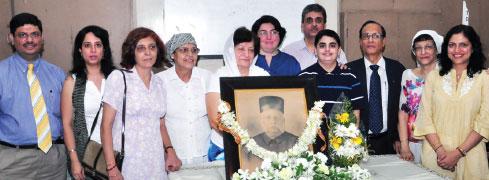

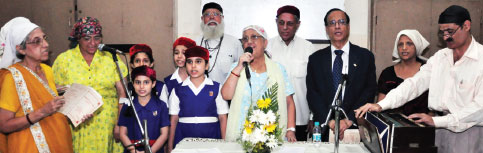
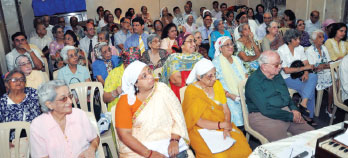
The function was attended by Roshan Irani, principal of Gamadia School, Adi Mehta, president of FOZAWAC (Federation of Zoroastrian Associations for Welfare and Culture), Bombay Parsi Punchayet public relations officer Godrej Dotivala and his wife Havovi, Rustom Cooper, president of YOU, Anahita Desai, chief executive officer of World Alliance of Parsi Irani Zarthoshtis, singer Marazban Wadia and other notables. Tehmina Peer proposed the vote of thanks. The evening ended with the singing of both the Parsi and national anthems, followed by light refreshments courtesy Desai, mentions the write-up.
Kavi Firoz was born in Navsari in 1846 and studied at the Elphinstone Institution, later serving as a cashier in the Great Indian Peninsular Railway, mentions Giara in a biographical sketch of the poet sent to Parsiana. From early childhood it was his hobby to compose Gujarati poems and songs. In 1893 he won a competition organized by RMS for his devotional hymns in simple Gujarati. These lyrics were published by the Sabha a year later. The Sarode Avesta is a collection of devotional hymns in Gujarati giving the meanings of most of our daily prayers like Ashem Vohu, Yatha Ahu Variyo, Kemna Mazda and others. Dastur Peshotan Sanjana was very pleased at hearing them and they were later taught in Parsi schools. Vistasp Bulsara, well-known musician along with Dhunnawaz Indorewalla produced a gramophone record of these lyrics, which are now available in CD form, as mentioned earlier.
Kavi Firoz taught music in Parsi schools and performed at public functions before viceroys and governors. The Gayan Uttejak Mandali, started by Kaikhushru Navroji Kabraji in 1870, conferred a honorary life membership on him on November 23, 1889. He became secretary of the Mandali for some time and presented it with a collection of his books, Giara reveals. The poet passed away on September 17, 1912, at the age of 66. Giara bemoans that Parsis who flock to programs of film music are unaware of their own rich musical heritage.