A friendship with a school teacher,
Amy Bilimoria, spanning 70 years
Hoshang Merchant
I visited my 95-year-old Parsi teacher, Amy Bilimoria, one day short of Jamshedi Navroz this year. At one time a toughie, she wept when she saw me. I said, "I’d be remiss in my duty, Miss, if I didn’t come and see you. I’m 78 and you are 95. Who knows if we’ll ever meet again?”
She told me about the Parsi boys in our Gujarati natak (play) group who had died: Minoo Engineer who loved theater and food, in that order, died nearly two decades ago, a successful caterer and an unsuccessful actor. More recently, about a year ago, Gustasp (Gusti) Forbes, a chartered accountant, died. Gusti was known for the Parsi skull cap he never abandoned and for sending Miss Bilimoria the best birthday card. That Amy — widow of a Punjabi who taught Hindi, but one who never abandoned Parsipanu, and Gusti, who drove out anyone married to a parjat (non Parsi) — remained fast friends, is a tribute to the gregariousness of us Parsi kagras (crows).
As middle-school students of St Xavier’s Boys’ Academy we were afraid of Miss Bilimoria’s (one was never to call her Amy) stern demeanor. The teachers, especially my fifth and seventh year class teacher Marina Frank, had told her about this Parsi child called Ho-shang (as she pronounced it) who was good at English. "Ho-shung” is how you say it,” Bilimoria corrected the teachers and won my 10-year-old incipient queen’s heart. "I thought it was a Chinese name. We had a Chinese student called Kou-cheng in Homi’s class, so when I heard "Hon-sheng,” I thought it was another Chinese student, till I learnt better!” added Miss Bilimoria in her dry, wry way.
Miss Amy Bilimoria in her youth
My grammar I owe to Miss Frank but my flourishes started when Miss Bilimoria came into my life. "Arty-farty, airy-fairy,” she cut me down to size. I once said someone had "an inferiority complex” and she retorted, "You don’t have to tell me that in a superiority kind of way.” But I was her best student in class, both in history and in English. By Std X I was turning in flawless class essays which she returned without any blood-red correction ink massacring my purple prose and in the SSC (Secondary School Certificate) exam I stood first in the state in history.
So much so that when the school cancelled the history option three years later and a student wanted to study it, Miss Bilimoria sent me to their flat at Napean Sea Road. This was in 1967. The student’s generous father offered me Rs 1,000 a month for a weekly hour-long session, a prince’s ransom at that time. A year earlier I had earned Rs 50 monthly doing a part-time job and a year after that Rs 300 as a full-timer. "No,” Miss Bilimoria put her foot down. "I don’t earn that much” giving tuition. I was 19 and the student 16. So I ended up earning Rs 750 to burn at Bette Davis matinees, Bombay Theatre Group plays and Nanking Chinese lunches, all of which Miss Bilimoria had introduced me to. Miss Bilimoria helped me find my feet after my parents’ divorce. She helped Gusti learn English, for which his father was eternally thankful. She tried to impress on Minoo the futility of his Royal Academy of Dramatic Art dreams, which was a thankless task. Minoo continued to direct plays at college for the Padamsee Trophy, yodel Madam Butterfly’s operatic death scene, and curse playwright and director Adi Marzban for not making the promised miracle out of him. Then Minoo found food in his life which would also be the death of him. But not before irking my mother by saying that he would write a play on her divorce trial at the Parsi Matrimonial Court molding her role after the life of Catherine of Aragon in Shakespeare’s Henry VIII.
Miss Bilimoria cast Minoo and me as mother and daughter in Bhoot-Mama in which a supposedly dead grandpa comes to life. My one-minute shock scene extended to three, much to Miss Bilimoria’s delight, but she had to put her foot down when I demanded a full five-minute rant. The idea was to upstage Minoo who had the meatier role of mother. Boy! Did he slap me around on stage, much to Miss Bilimoria’s amusement. My other stage triumph was as mother in Gian Carlo Menottii’s Amahl and the Night Visitors. But for all my efforts at sex-switching on stage, the only trophy I received was for playing a hen-pecked husband. My father was having none of it. He bent the trophy out of shape and accused Miss Bilimoria of making his only son a sissy. She remained unfazed, though she did tell me that she had to send home another young student who had come dressed as a woman on a dress-as-you-like day.
Class of 1963-1964, Bilimoria (seated 3rd from l), Hoshang Merchant (circled)
There was antagonism between my father and my teachers who loved me. They berated me for his habitual non-attendance at our annual parent-teacher meetings. He was obliged to attend one but would tip-toe out of it as he said he couldn’t bear Miss Bilimoria’s dramatic gestures of public politesse any longer. I had to hear about his behavior from teacher after teacher the next day at school. This antagonism never abated. When he died, Miss Bilimoria declared my father had been "a bully and a coward.” Though initially shocked, I smiled wryly because that was her opinion of most Parsi men.
My homosexual nestling had begun early, and I spent most of my spare time before and after school listening to Miss Bilimoria.
My other favorite was the Hindi master, Bhal. Miss Bilimoria was to subsequently become Ms Bhal. But I have never called her by that name. She would think up fancy dress costumes for me. Once I was a rag-doll which her husband carried around for a better part of the evening despite his back injury. Another time I was Nefertiti, minus her bust, in Miss Bilimoria’s sister’s lamé sari. Parsi stage actress Piloo Wadia, whose nephew Homi was my irrepressible classmate, much loved by Miss Bilimoria, saw me strutting around paper crown on head and gold foil ankh (Egyptian cross) in hand and told her cohorts "Éné jo (look at him).” I won the competition hands down both times.
Gift giving was an important ritual for Miss Bilimoria’s birthday. One year she expressed a desire for a fire-engine red sweater. I scoured the hosiery stores on Carnac Road for days and came up with one from the trusted Moses & Son. It was dubbed a watermelon pink by Miss Bilimoria, ever the critical Virgo. Three Virgo Parsi women have ruled my mind to this day: My mother, my elder sister and my Parsi English teacher.
When I returned from America for seven days, after seven years, "starved and beaten on the shores of Jerusalem,” Bilimoria’s wish for a record player on which she could listen to her favorite ’40s show tunes and jazz could not be honored thanks to the then prevalent import-export rules and my penury. Nevertheless, she treated me to steak (buffalo) at Gourdon’s and a baba-au-rhum.
Miss Bilimoria worked hard and played hard. Toiling from eight to eight daily at school and giving private tuitions, she amassed two lakh rupees with which to purchase a flat near her beloved alma mater, Sophia College. It sold recently at many times that price. She now lives with Baby, her niece, in a legacy family flat on Marine Drive where she showed me two chairs from her Nagpur family bungalow’s 14-seater dining table and her mother’s small ornately carved rosewood secretary (writing table), the dream of Chor Bazaar antique merchants. Her mother drove an ambulance during World War II, rode horses and went at a spry 80 for hip joint surgery. The doctor declared she had the body of a 17-year-old. Amy has good genes. And good karma. When we were in the SSC she had a cancer scare, the curse of Parsi women. Dr Ernest Borges at Tata Memorial Hospital operated on her free of charge because she taught at a Jesuit school for a monthly salary of Rs 200. Her elder sister, Baby’s mother, wasn’t so lucky. Her cancer felled her. Now Baby and aunt have each other for support.
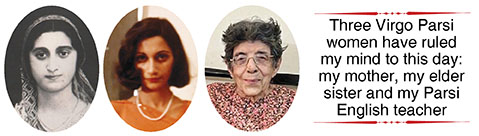

Above: Merchant; top, from l: his mother, sister and Bilimoria
On our SSC picnic day Miss Bilimoria sat alone, reading about Cleopatra. I noticed the similarity between my hook nose and the queen’s. Years later she told me that her brother-in-law had passed away on that day, but she couldn’t let her class down.
Baby and Miss Bilimoria tour the world. Most recently they were in Greece. It was a bit late for her to visit that country as it involved a lot of walking. I had to speedily repay the Rs 30,000 she had lent me at demonetization. For no one funds Miss Bilimoria but herself. Her fixed deposits fetched handsome dividends, according to her money-manager.
Ever the trouper, she said she liked her Russia trip the most. She also visited China and described the consummate artistry of the Peking Opera, having learnt stagecraft and directing from thespian Adi Marzban in his group Play Box, Herbert Marshal, principal of Natya Academy and Alyque Padamsee, professor of English in the Indian Academy of Dramatic Arts. When young, she had made a good shrew in English playwright William Shakespeare’s The Taming of the Shrew.
My drama training stood me in good stead as an eloquent teacher and a dramatic reader of my own poems. When I returned to Bombay after 40 years Miss Bilimoria came to listen. Four men stood silently at the rear of the hall and left early. I later realized they were my SSC classmates who did not wish to reveal their identities to an openly gay man. Miss Bilimoria dubbed me a romantic poet (I call myself a new World Poetry exponent) and took me out to dine at the Bombay Gymkhana. Another lady who was in the audience offered to take us all to dinner, but Miss Bilimoria declined. On another occasion, a poet and award winning writer turned up with his latest girlfriend at a Gaylord lunch for me hosted by Miss Frank. I hid in the ladies bathroom fearing his ire because I had just critiqued his Collected Poems. When I finally emerged from hiding, my gender intact, he embraced me. I introduced him as India’s leading poet. Miss Bilimoria was unimpressed. It takes a lot to impress her.
She kept me informed of deaths at our Academy: an industrialist’s scion died of cancer at 36, leaving behind three sons and a young widow. Another former student gambled his way to bankruptcy and drank himself to death blaming his widow. Miss Bilimoria assisted in publishing a souvenir volume for the school’s jubilee year and restored to us all our memories.
Recently the autopsy on a 117-year-old woman revealed she had a rare gene that repaired old cells, which explains Miss Bilimoria’s longevity. Everyone could take a gene injection some day and live forever. "How horrible!” she reacted. Permanence is not physical but in memory, especially for teachers and writers. Lovers die, love remains.