Died: Piloo Dara Reporter, 84, international cricket umpire who enjoyed the distinction of being selected among the first neutral umpires in the game; in Thana on September 3, 2023 following cardiac arrest.
"Bombay sé aaya umpire, umpire ko salaam karo (The umpire has come from Bombay, welcome him)” was the chant that rang out from the stands in Lahore improvising the line from a well-known Bollywood song when Reporter and V. K. Ramaswamy were selected as the first pair of neutral umpires from India to officiate at a Test match between Pakistan and the West Indies in 1986. Having stood in 14 Test matches and 22 one day internationals including seven matches in the World Cup, "Piloo (or PD as he came to be known) was popular not only with the players but also with the spectators,” erstwhile India team captain Sunil Gavaskar had written in his preface to Reporter’s autobiography An Umpire Remembers published nearly two decades ago. Gavaskar had further commented, "The pressures, the tensions are all part of the game, but if one is an umpire then one has the best ‘seat’ on the ground.”
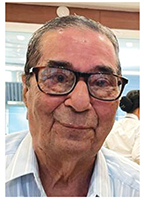
While definitely not a ‘seat,’ being an umpire continuously on one’s feet was no mean feat. More so, when an umpire has to cope with variable temperatures and temperaments. "Reporter has managed admirably over the years to combine enough good Parsi earthiness and Maharashtrian aplomb to tackle the wrath of cricket’s superstars. (Pakistan captain) Imran Khan at his wildest, a snorting (West Indies captain) Viv Richards and a threatening (Barbadian fast bowler) Malcolm Marshall have confronted Reporter’s slight frame and have had to back off before his basilisk gaze,” it was reported in the Mid-Day of June 1, 1997.
Senior cricket player and commentator Fredun Devitre referred to Reporter’s "remarkable ability to diffuse on-field tensions before they escalated — he did that with a good-humored remark or a stern warning or a quiet word. He was a thorough professional who loved umpiring, whether a Test match, an international match or a friendly maidan game… For many years he umpired our High Court Judges vs Senior Advocates annual fixture for the M. C. Chagla Trophy after he retired from international cricket.” With his characteristic humor, Reporter had later joked, "I judged the judges!”
When relating "the pleasures and pains of officiating,” Reporter had regretted that the stipulated retirement age for umpires in India was 55 years in those days (now relaxed). From a young age, he enjoyed playing cricket and serving as an umpire, sometimes at the same game! At the age of 22 he saw an advertisement by the Bombay Cricket Association for the post of an umpire that prompted him to apply. He scored 69% on cricket laws when the passing requirement was 80%. But they gave him a break when they needed a last minute standby umpire. The next year he appeared for the test again and cleared it.
To qualify as a Ranji Trophy umpire he appeared for another test where the passing requirement was 90%. He first officiated at a Ranji Trophy match at the age of 29 and made his international debut as an umpire in 1984 in the Test between England and India in Delhi. He had also stood in ex-Zimbabwe skipper Heath Streak’s international debut game in Bangalore. Ironically the day Reporter passed away, Streak succumbed to cancer at the age of 49.
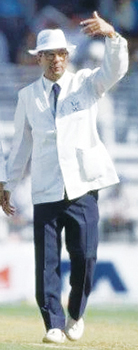
Top and above: Piloo Reporter on the field
The only Indian umpire at the 1992 World Cup in Australia and New Zealand, Reporter became renowned with his signature, energetic style of indicating a boundary. This visual that had become a regular feature on the New Zealand commercial accompanying the World Cup Cricket series is now popular on Youtube as his distinctive "milkshake” boundary signal.
Umpiring, believed Reporter, "is a job very much like traffic policing. The traffic must move, as also the game.” Tea, he admitted, "was all that kept me going and helped me to concentrate.” He did not need to diet or exercise for he used to "walk and walk for miles…” Former India skipper Dilip Vengsarkar admitted in The Times of India of September 4, that when playing a game in the Times Shield he was losing his concentration after scoring a century. He recalled Reporter whispering in his ear "Have you got a batting prize in the Times Shield?” That motivated him to score a double century!
Over the years Reporter has been honored by many associations. In 1997 a benefit match was held in Valsad in honor of him and fellow umpire Dara Dotiwala by the Bulsar District Cricket Association. The star-studded teams included national players like former Indian captains Sachin Tendulkar and Mohammad Azharuddin. Richards had been personally invited by Reporter himself for they shared a good rapport after an earlier face-off when his appeal had been turned down by the umpire. Knowing that Richards was enraged, the umpire had walked up to him but the captain preferred to turn his back. Reporter enquired, "Don’t they call you king?” Retorted the cricketer, "I am not of royal descent.” "But you can always act like you were,” suggested Reporter and thus helped to diffuse the situation! Reporter had also been felicitated by the World Zoroastrian Organisation in 1997.
On the 125th anniversary of Parsee Gymkhana in 2010, Reporter was among the sportsmen conferred an honorary life membership. As a mark of respect, a minute’s silence was observed by Parsee Gymkhana and the MIG (Middle Income Group) Cricket Club during their Kanga League game on the day of his demise. As remarked Gymkhana president Mehli Golvala, "Reporter had a pleasing personality but displayed firmness on the field when he encountered aggression from players... His place is firmly reserved in cricketing lore.” Two years ago he had been honored by The Cricketers Foundation for his services to Indian cricket.
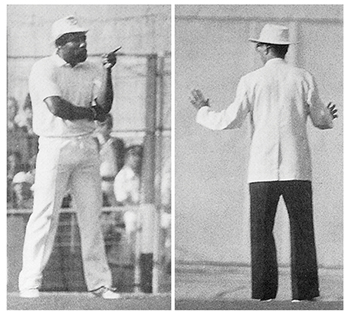
Above: Viv Richards (l) in a face-off with Reporter
Cover of biography
Above: Sunil Gavaskar (l) with Reporter
"If a batsman can get out playing a bad shot or a fielder can drop a sitter, umpires too should be given that little bit of space. After all they are human beings too. But they should make the best use of technology and be courageous enough to admit their mistakes,” Reporter had stated a decade ago. Rather than feel insecure when the third umpire was introduced he believed, "Why not try out the best technology when you have it at your disposal?” Later in life he conducted umpiring coaching classes and served as examiner for the Mumbai Cricket Association. Retaining his interest in the game until the end, even when he was in hospital he would follow the matches on television and give his verdict while a decision was awaited from the third umpire!
Known to be prompt and punctual, these were the traits he had acquired from his father Dara, an honorary magistrate who he described as "a strict disciplinarian.” After his early education at St John The Baptist High School in Thana, Piloo earned a diploma in electrical engineering from the Victoria Jubilee Technical Institute (now Veermata Jijabai Technological Institute). He was keen to become an engine driver but his father was not in favor. Since Dara’s heart was weak and he passed away when Piloo was only 22 years old, as the eldest of six children he was expected to start earning. He joined the Thana Electric Supply Company which later merged into the Maharashtra State Electricity Board from where he retired after nearly four decades.
In an interview with his granddaughter Freny Daruwalla featured on evergreenstory.org Piloo admitted that his sisters Rukhshana and Hutoxi who were classical Indian dancers, performing on stage and featuring in Indian films, earned more than the salary he would hand over to his mother Parin each month.
A staunch Zoroastrian, he would always do his kusti, agarbatti, divo before leaving for a match. He believed strongly in the power of prayers and was grateful for His blessings, constantly acknowledging "Maalik saheb ni meherbani (God’s grace).” Standing for hours in the blazing heat and sweating it out on the field, his sudrehs would tear but that did not deter him from wearing them. On his travels when he was invited to umpire in different towns and cities, he made sure he visited the agiary in that place, mentions his daughter Khushnuma Daruwalla.
Keen to see Parsis participate in sports, he would take his building children to the playground and teach them the importance of sports, share his knowledge and motivate them, remembers Freny. "He was very courageous and faced every challenge that was thrown in his life,” stated elder daughter Farzana Warden. She appreciated that "his biggest quality was ‘never give up’ and he made sure we practiced it in our daily lives.”
The respected sportsman is survived by his wife Homai, daughters Farzana Khurshed Warden and Khushnuma Coover Daruwalla, brother Cyrus, and sisters Rukhshana Irani and Hutoxi Reporter.