A Feast of my Persian Heritage by Shirin Simmons. First published in Great Britain by Homa Far Publishers, now available from www.shirinsimmons.com free of cost. Pp: 496.
Shirin Simmons, the "first Persian born cookery writer to present (recipes) in the English language from salads to complex exotic banquet dishes,” according to her website, is offering her third book free from her website.
A detailed introduction to Iran, its history and geography and the origins of Zoroastrianism occupies the first 20 odd pages of the book which is divided into sections — ingredients, soups, hors d’oeuvres, fish, traditional meals (khoresht), and stuffed dishes or dolmeh. A glossary at the end of the book translates the names of ingredients to English, though both Farsi and English names are used throughout the tome. Aabgoosht or "two meals in one soup” covers this simple dish that serves as everyday food and which can be fancied up for a banquet.
Shirin Simmons with a spread of sweets
Simmons has provided over 220 traditional Persian recipes, some simple, a lot very elaborate, some distinctive but all varied, and largely non-vegetarian. The recipes are given a historical and cultural context, including details of festivals. The book includes recipes purportedly popular with Zoroastrians, Jews, Muslims and Christians.
Throughout the book, the cookery expert emphasizes on fresh ingredients, particularly fruits, nuts, vegetables and pulses, making these recipes ideal for a modern, health conscious audience. If Persians do not grow vegetables in their garden, they carefully select them from the greengrocers, she writes.
The section on ingredients opens with a paean to the red rose, the traditional symbol of love in Persian poetry. Simmons, who left Iran in the late 1950s to study English in London and has lived in the UK since 1970, recalls childhood memories of her father picking the first bloom and handing it to her mother on a small white plate embellished with small gold flowers. "In the West, it is best to buy rose water in Persian and Armanian (sic) supermarkets. But never buy them in an Indian shop ... as it will not give the same flavor,” she informs her readers. This section has similar personal memories associated with other staples of Persian cooking like Brussels sprouts, figs and parsley.
It was somewhat comforting to note the faith Iranians have had in eggs — they use them to "remove the evil eye,” by drawing circles, representing eyes, all over an egg, until there is no more space on its surface and breaking it into a bowl of water held above the person who is to be ‘cured.’ Also Indian Zoroastrians, lovers of the potato, will be pleased to learn that the humble tuber was first introduced to Iran only in 1799 at the hands of Sir John Malcolm, a British diplomat and envoy of Lord Wellesley, the Governor-General of India, while on a mission to promote trade.
Simmons recounts various anecdotes from her childhood in Yazd and growing up years in Tehran. However, the sheer number of these recalled instances tends to slow down the pace of the book to a large extent. The writer also weaves the medicinal properties of ingredients native to Iran along with her recollections from nursing school in Tehran into the book at appropriate junctures.
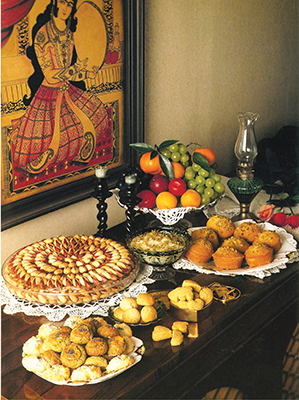
Left to right: Pistachio munchies, coconut drops, chickpea tears and Yazdi cake;
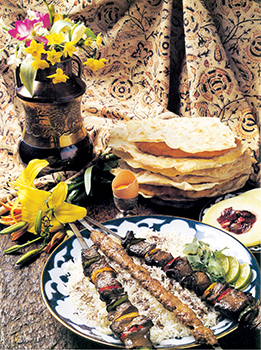
Kebabs, turmeric and cumin nan
The book could have done with professional proofreading to eliminate grammatical errors. There are certain instances where repetitions could have been avoided, such as referring to her mother both as Meme and "my mother.” The chapter on "Zoroastrian Festival” sits rather incongruously between chapters on recipes for dolmeh and sweets. While readers in India may find details of the celebrations of the gahanbars interesting, this section also has descriptions of how Zoroastrian weddings are celebrated in Iran. The family photographs that are interspersed throughout the book are captioned, but largely undated.
It is recommended that readers pick a section they want to know more about and dive right into it, or alternatively pick those items that tickle their fancy from the five-page index at the rear of the book.
The treatise has been written in memory of her late husband Michael, her late nephew Farshad and "all her family past and present,” informs her website. This is Simmons’ third book. Her first, Entertaining the Persian Way was published in 1998. Her second offering, A Treasury of Persian Cuisine, won the Gourmand World Cookbook Award in 2002 (see "Menus and memories of Iran,” Parsiana, August 21, 2008).