Growing a business needs financial support
Farrokh Jijina
Three entrepreneurs are benefitting from the Entrepreneurship Scheme initiated by the World Zarathushti Chamber of Commerce – India (WZCCI). The trio consists of specialty chemicals manufacturer Dr Murzban Karai, Cyrus Pithavala who runs a container depot, and Urvakhsha Tavadia, manufacturer and marketer of lithium ion batteries kits for electrical vehicles. They are the first recipients of financial support of Rs 25 lakhs each. "The initiative was launched to fulfill a long felt need” to encourage community members to venture into new businesses or expand their current ones. WZCCI is hopeful that the initiative will "boost the Zarathushti spirit of entrepreneurship… latent in the minds of many in our community,” noted WZCCI India region president Capt Percy Master, in a press note announcing the disbursements in January this year.
WZCCI chief executive officer Aspi Antia, and member of the Business Advisory Committee (BAC) of WZCCI that oversees the funding program Phiroze (Philli) Kharas, explained that the disbursements are interest-free and there is a six-month moratorium on repayments. "We were hunting for businessmen with innovative ideas and unique businesses, and these three of the approximately 20 applicants impressed us most… one of them has even started making repayments ahead of schedule,” he said. In a meeting with Parsiana on March 11, Kharas explained the process behind the funding: The BAC works within a vision and mission statement, performance standards and selection criteria. Personal interviews follow; a three-year business plan is sought from the intended recipient. Collateral security is evaluated; in the case of the trio of Karai, Pithavala and Tavadia, the security was either of land, equipment and personal guarantees. Monitoring will include quarterly projections and action plans of the business’s senior management professionals. In case the business requires more funds than the limit of Rs 25 lakhs, the BAC can provide names of other funding houses.
The BAC considers funding applicants if 75% of the capital in the business, not including bank funding, is from Zoroastrians (including parents/in-laws/relatives). For projects the committee considers innovative, a minimum of 51% of the capital must be Zoroastrian-funded. Kharas said that the 10-member BAC consists of WZCC office bearers, including those from the global body, a lawyer and other prominent business/philanthropic people.
Under the Scheme, WZCCI is a facilitator for evaluating the business proposals while the World Zoroastrian Organisation Trust Funds holds and disburses funds. The two bodies had invited donations from fellow Zoroastrians towards creating a corpus of five crore rupees to help community members under the Scheme. A total of Rs 1.50 crore has been received from Zoroastrians worldwide. "We are hopeful that more high net worth Zarathushti individuals and businesses will come forward to donate funds for this noble cause,” noted Master. WZCCI also requires funding for its ongoing administrative and overhead expenses, explained Kharas.
"We often get asked, ‘How will WZCCI benefit me?’” noted Kharas. "Besides bringing together like minded businessmen and professionals on a common global platform, there is much more,” he emphasized, referring to the networking programs, sharing of knowledge, insights and wisdom of senior members as well as programs for the younger generation.
The Chamber has three active chapters in India — Bombay, Poona and Bangalore — and about 15 worldwide.
About their businesses
Karai acquired his doctorate in dyestuff technology from the Institute of Chemical Technology in Bombay on the subject of development and manufacture of laser dyes, he told Parsiana. Having set up his business in 2005 with his wife Dr Rupali, the couple shifted their manufacturing base to Mahad in Raigad District in 2016. "We are (also) consultants to numerous chemical manufacturing industries… We offer… research and development services to pilot plant operations and manufacturing,” he wrote in a detailed email. His sole proprietorship firm named Jenrashid Consultants also audits chemical processes used by manufacturing companies. The 10-employee company had a turnover of Rs 10 lakhs last year. Karai proposes to use 15 lakhs of WZCCI’s funds for capital expenditure and the remainder for running expenses and research and development. The funds will help him tap the export market, he told us.
"The tree that sways with the cyclonic winds always survives,” wrote Karai. "One has to change with changing times… (I) will always follow the core principles of Humata, Hukhata, Hvrashta. These… will always remain the guiding principles of Zoroastrianism and reform wherever necessary,” he said. The Karais are parents to twin girls Zeenish and Zoish, who turned two in March this year.
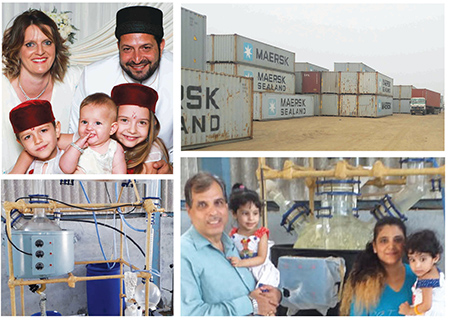
Clockwise from above left: Barbara and Cyrus Pithavala with, from left, Karl, Karin and Kyra;
a view of Hazira Container Yard; Zeenish, Dr Rupali, Zoish and Dr Murzban Karai;
at Jenrashid Consultants’ Mahad factory
An alumnus of Jai Hind College in Bombay, Pithavala says, "We are a one stop solution for all container handling requirements including logistics, storage and repairs to international standards… The funding from WZCCI gave a base for expansion of my business space.” The container yard requires "lots of space with hard surfaces… capital expenditure is high,” noted the entrepreneur. The sole proprietary business Hazira Container Yard (HCY) he started in 2017 was operational late that year with the first client being Maersk Line. The 18-employee facility with a turnover of Rs 10 crores now serves other shipping lines such as Evergreen and Avana Global too, he stated. He divides his time between Suvali (near Surat) where he lives and where the facility is located, and Poona where mechanical engineer wife Barbara Luck, who is a German, works and brings up their three children Kyra, Karl (both of whom have been navjoted) and Karin.
Armed with a master’s degree in science (energy systems) from the State University of New York, Tavadia started Ruzen Inc in June 2016 with funding from his father. "We export 99% of our products,” he explained in a detailed email to Parsiana. "Mahindra and Mahindra could be a potential customer for Ruzen,” noted Kharas. When asked about his future plans, Tavadia noted that he

preferred letting his work show where he was heading. Tavadia said he "would not be comfortable answering ‘Parsiana’s questions’ knowing this will be in the public domain.” (Karai, Pithavala and Tavadia were sent identical questionnaires.) He did, however, respond with a 606-word essay on his views on religion, which dwelt on the need for flexibility and better leadership, the Parsi contribution to the country and the need to accept the children of intermarried Parsi women into the faith. "We need to realize that we ourselves are hurting our chances of making it (succeed) due to half-understood, ill thought of logic,” Tavadia noted.
The Poona chapter of the World Zarathushti Chamber of Commerce — India (WZCCI) organized a talk by Jas and Maneesh Johari of the Buzan Center on mind maps and how they can be used in various fields to train minds and increase thinking ability, chapter chairman Tehmasp Bharucha informed Parsiana in an email. The February 16, 2019 event at their quarterly members’ night was attended by Bombay chapter members Phiroze Kharas, Adi Siganporia, Xerxes Dastur and Homai Mehta. Kharas updated the members on the progress made under the Entrepreneurship Scheme of WZCCI.