The first Indian woman to get a British aviator’s licence, Aban Chenoy is
remembered during her birth centenary
Beyniaz Edulji
No history of Hyderabad’s aviation can ever be complete without mention of Aban Pestonji Chenoy, the teenager who in 1938 became not only Hyderabad’s first woman pilot but also the first Indian woman to obtain a British pilot’s licence from the Portsmouth Aero Club, UK. Her feats are remembered by the aviation fraternity even today with her photograph prominently displayed at the Rajiv Gandhi International Airport at Shamshabad, Hyderabad, as well as in The Nizam’s Museum.
Born in 1919, Chenoy was the first woman member of the Hyderabad State Aero Club, being proposed by the state pilot of Jaipur, her mother’s brother-in-law Capt Homi Bharucha. This was the year in which 55 of the Club’s 70 members were Indians. The Club’s operations were suspended during World War II (WWII) and its pilots, aircraft and facilities were commandeered for use by a training squadron. In Anuradha Reddy’s book, Aviation in Hyderabad State, Chenoy recounted the founder secretary of the Aero Club warning members about strict adherence to confidentiality and security in taking care of flying maps, with the impending WWII.
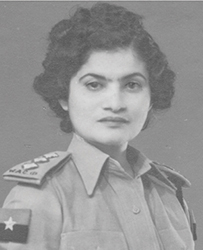
Aban Chenoy in Army uniform
Chenoy flanked by P. O. Holland and Sq Ldr Mitchell at Portsmouth Aero Club
In those days women were not allowed to fly in the air force. So she chose the army instead, seeing active service in Visakhapatnam (Vizag) where a Japanese air raid attacked her base. After the unsuccessful bombing of their base in Vizag, there was a victory parade, led by Chenoy who was commended by her seniors. She had also put in service at Madras, Bangalore, Bombay, Dehra Doon with the Women’s Auxiliary Corps (WAC) during WWII. She was demobilized as senior commander (equivalent to army major).
During Chenoy’s army career she was known for her ability to open up closed doors. She was often sent by her senior officers as an unofficial intelligence courier to ensure that important material was safely delivered. She had acquired this ability during her early life when she accompanied her father all over the Rajas and Rajwadas extending well into today’s Afghanistan, living in palaces, seeing the best of life. Her son Dr Feroze Duggan recalls being told: "Your mother was the only woman at the Vice Regal receptions in her own right, as all others were there as spouses!”
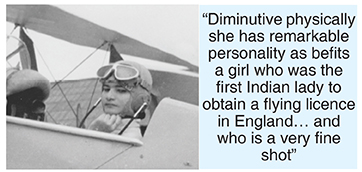
As a child, Feroze remembers her proceeding on flights: "These were transportation type flights, in various aircraft including Dakotas, with a senior captain who would be happy enough to have her on board. However, this did not last for long. Although being in the air was most liberating for her, she had to give up her passion as it was not feasible to keep up her flying skills which involved more modern training and instrumentation alongside being a mother.”
Aban was married to Homi Duggan, son of renowned ophthalmic surgeon Sir Jamshedji Duggan of Bombay. A report on the wedding in "From day to day” column in the Morning Standard stated, under the title, Good shot!: "The bride deserves a paragraph to herself, diminutive physically she has remarkable personality as befits a girl who was the first Indian lady to obtain a flying licence in England… and who is a very fine shot. She still technically belongs to the WAC (I), was posted to Madras latterly, which was where the romance started, the bridegroom also having been posted there by the Associated Cement Company to which he belongs. … The bride was wearing an embroidered white net sari and lovely jewelry and was being proudly escorted by Homi to be introduced to those guests who did not already know her. Her family have been in Secunderabad for years now and are extremely popular and highly respected citizens of that city.”
Aban’s father Pestonji B. Chenoy was the first Indian to be appointed as the mint master of the Nizam’s mint, notes her elder sister Nergis’ son Shapoor Toorkey of Secunderabad. All the previous mint masters had been British. He was also the first Indian to head the state’s electricity department, of weights and measures and state’s bullion. He was appointed, after his retirement, by the seventh Nizam as controller to the Nizam’s half brother Nawab Basalat Jah Bahadur, among the other posts he held up to Independence. Pestonji declined the title of nawab on retirement, but continued to serve in whatever official appointment the Nizam required.
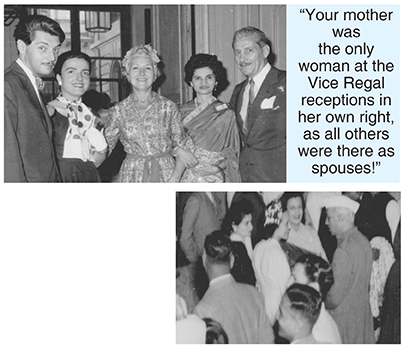
Chenoy (2nd from r) with the Baruzy family (from l) Simon, Suzanne,
Comtesse and Count Pierre; right: Chenoy with PM Jawaharlal Nehru
Anti-clockwise from top l: Chenoy’s parents Najamai and Pestonji Chenoy;
Aban with son Dr Feroze Duggan; great-grandparents Pirojbai and Edulji Chenoy
Aban’s mother Najamai was equally accomplished. When she took Aban to London for her music education, being a Francophile, Najamai enrolled at Berlitz (language school) and became proficient in French, almost bilingual, even writing essays in French. Toorkey says, "Aban was a gifted pianist who studied at the Royal College of Music and successfully passed the LTCL (Licentiate Diploma) exam of the Trinity College in London. She also performed in concerts at Wigmore Hall, London.”
After her divorce, Aban lived for many years in Secunderabad with her father until she left for London to educate her only son. During the summer family holidays at Prince Basalat Jah’s house in Bangalore, Aban decided to improve and augment her management skills at the vibrant Bangalore Institute of Management, becoming a regular at their events. She eventually set up the Hyderabad Institute of Management as its founder secretary. The Institute serviced with knowledge and expertise the then important five-year plans of the government.
When India was elected to the Committee of International Scientific Organisations (CIOS), Aban was one of the four delegates and some observers sent by India to the 1957 Paris conference. The Indian delegation, led by Sir Ramaswami Mudaliar, and observers were graciously received for being the newest entrants by the then chairman Count Pierre Baruzy. The conference banquet was held at Versailles Palace in the style of Louis XIV.
Later with her cousin Jehangir Moos and wife Maritje, Aban attended the Guildhall banquet in London for the Commonwealth Prime Ministers’ conference. The BBC (British Broadcasting Corporation) world service broadcast featured a report in Hindi on the Paris conference including the views of Aban and others. She also enjoyed a joyous reunion after 29 years with Squadron Leader Mitchell, her erstwhile instructor at the Portsmouth Aero Club who in an earlier letter to The Times of India had stated of Aban, "She is a neat little pilot… No one could be more fond of flying than Ms Chenoy.”
Following the example of her great-grandfather Edulji Chenoy, a donor member of the Indian National Congress (INC), and her mother who was close to Sarojini Naidu, INC’s first woman president, Aban became a donor member to the UK Labour Party under Gordon Brown’s premiership, as did Feroze. When Edulji became a donor member of the INC, it was an act of bravery as the Nizam was known to be a faithful ally of the British.
Aban died in London on August 29, 2010. When asked to speak about his mother, Feroze, a nuclear physicist who is a member of Scientists for Labour and Scientists for the European Union remarked, "Any quote would be inadequate for such a modern polymath — music, aviation, army major, Institute of Management. Her father, Pestonji, had to point out to her that things did not come as easily to me as they did to her and I needed support with guidance.” As a mother "she was unstintingly loving but demanding of me and I hope I am worthy of her countless single-handed sacrifices.”