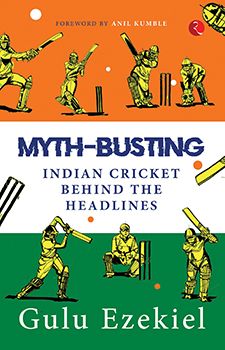
Myth-Busting: Indian Cricket Behind the Headlines by Gulu Ezekiel. Published in 2021 by Rupa Publications India Pvt Ltd, 7/16, Ansari Road, Daryaganj, New Delhi, 110002; website:www.rupapublications.com Pp: 207. Price: Rs 295.
This is Gulu Ezekiel’s (pictured) 14th sports book, having published bestselling biographies of Sachin Tendulkar, Sourav Ganguly  and Mahindra Singh Dhoni. This reviewer found his Myth-Busting the most revealing. The history of cricket is shrouded in myths from apocryphal stories on England’s Dr W. G. Grace in the 19th century to Farokh Engineer and Salim Durani of recent vintage. Ezekiel has concentrated on myths surrounding Indian cricket.
The famous Indian Test cricketer Anil Kumble writes in the Foreword that in cricket stories there is "a fair degree of exaggeration … and the author tries to get rid of such myths in order to purify this beautiful game.”
I thought I knew all about Indian cricket till I read Ezekiel’s current masterpiece. I must admit that I was guilty of writing in my articles that Sunil Gavaskar started his Test career in 1971 scoring 774 runs at a splendid average of 154.80 against the "frightening pace attack” of the West Indians. Yes, amassing 774 runs in four Tests for a 21-year-old on foreign soil is fantastic. But the West Indies attack was not frightening as Wes Hall, Roy Gilchrist et al had retired by then.
Ezekiel opines "Twitter, WhatsApp, Facebook have all been carriers of fake news which spread like wildfire.” But myths have invaded cricket long before these new forms of communication. The author enumerates all tied matches at Test, first-class, one-day international (ODI) and Twenty20 levels and points out the myths surrounding some of them.
Gavaskar holds many Test batting records for India but has also been engaged in a few on-field controversies. During the Melbourne Test of 1981 against Australia he was given out wrongly by the umpire. He was so angry that he told his batting partner Chetan Chauhan to follow him to the pavilion. This would have resulted in a forfeit but India’s manager Shahid Ali Khan Durrani wisely ordered Chauhan to continue batting. Gavaskar later explained in his book Idols that it was not just the umpiring decision which angered him so much as fast bowler Dennis Lillee uttering profanities including a "two-finger salute.”
Ezekiel waxes almost lyrical in the chapter "Lagaan and Six Appeal.” He reminds us about the 2001 movie Lagaan which features a match won by a sixer. He goes on to describe the West Indies legend Garry Sobers hitting six sixes in one over, and similar feats by other batsmen. He points out the myth about commentators screaming "Maximum” when a batsman hits a six. I agree with the author that six is not the maximum number of runs a batsman can get off one ball. There are instances of batsmen getting eight or more runs off one ball due to overthrows.
 Then Ezekiel moves on to the myth of the term "Mankading” when the famous Indian all-rounder Vinoo Mankad ran out Australia’s batsman Bill Brown while bowling (after having warned him previously) during the tour of Australia in 1947-48. The author insists that it was not an act of bad sportsmanship. Recently umpire Simon Taufel said, "Just call it run out” as the batsman was taking unfair advantage. Ezekiel suggests the term "bowler’s run out,” BRO for short, instead of Mankading which falsely implies an unsporting act.
This reviewer was shocked on reading about myths surrounding the legendary cricketer Ranjitsinhji who was scintillating while playing for England, but did little for Indian cricket. He even advised his famous nephew Duleepsinhji not to play for India in 1932. The author quotes English cricket journalist Simon Wilde who revealed allegedly murky details of Ranjitsinhji’s life off the pitch. Those reportedly included "financial skulduggery … with lies, deceits, thievery and extortion involved.” Former Indian cricketer Raju Mukherji hinted that Ranji was against India gaining independence.
Now to another legend, all-rounder Kapil Dev who led India to many triumphs in the 1980s. Many proclaim him as India’s first fast bowler. Not so, stresses Ezekiel. Mohammad Nissar, L. Amarsingh and L. Ramji who represented India in the 1930s were equally fast. But wait, there is more.
Parsi immortal Mehellasha Pavri (1866-1946) was in fact India’s first fast bowler. In theParsis’ second tour of England in 1888, Pavri captured 170 wickets at an economical average of 11.66. Back home, the experience gained in England held the Parsis, and Pavri in particular, in good stead; they proceeded to inflict a string of stunning defeats on English cricketers in Bombay, which fired up the imagination of their countrymen. Parsis crushed a strong European side in 1890 with marvellous figures of seven wickets for 34 runs by Pavri. Parsis had two other fast bowlers, Maneksha "Demon” Bulsara and K. B. Mistry.
Ezekiel describes the "bloodbath” at Sabina Park, Jamaica, 1976 in three-dimensional effect when the West Indies fast bowlers unleashed a barrage of short-pitched balls aimed at Indian batsmen’s heads. When India’s captain Bishan Singh Bedi closed India’s innings at 5 for 97 he was criticized for declaring too soon. Actually, Bedi had not declared the innings but five of India’s batsmen were badly injured while facing the fierce blood-curdling West Indies attack. Some of the Indian batsmen had to be hospitalized. According to the West Indies management, the reason behind balls bouncing so dangerously was "the appearance of a ridge on the pitch.” A myth, explains Ezekiel. He quotes India’s eminent sports writer K. N. Prabhu who was there in person and did not see any ridge.
The near fatal injury to India’s captain Nari Contractor when struck on the head by Charlie ‘Chucker’ Griffith in the match against Barbados in 1962 is described by the author as one of the darkest days in the history of Indian cricket. The myth perpetuated by the West Indians was that Contractor had ducked at a bouncer which was not a bouncer. Not so, according to vice-captain Nawab of Pataudi junior and reporter Dicky Rutnagar.
Another myth in Indian cricket is that Polly Umrigar was scared of fast bowling. That may have been true only during his first tour to England in 1952 against the fearsome pace of Freddie Trueman. But not afterwards. Umrigar stood up to bouncers hurled by the dreaded Windies quickies Hall and Gilchrist. As Clayton Murzello wrote in Mid-Day, "Cricket was Umrigar’s oxygen.”
Ezekiel sums up, "Gavaskar inspires admiration, Kapil awe, Tendulkar worship. But only two have inspired adoration, even love… Durani and Gundappa Viswanath… Tall, gaunt, green-eyed with dashing matinee idol looks, he (Durani) lit up 1960s with his silken batting, brilliant left-arm spin and dashing presence.” Mystery surrounds Durani’s place of birth. Was he born in Kabul? Read the book to get an answer.
Another flamboyant cricketer was Engineer. "His name spelt magic for cricket lovers,” writes Ezekiel. "Many tales surrounding him are apocryphal… Even in Lancashire, he is loved as one of their own.”
Ezekiel ends the book on a romantic note: Abbas Ali Baig and that kiss! In the 1959-60 Bombay Test against Australia, handsome Indian batsman Baig was kissed by a young girl who ran on to the field. Mystery surrounds the identity of the girl. Contractor’s son Hoshedar told Ezekiel that she was a 20-year-old Parsi girl, barefoot and wearing a black skirt. But according to Lok Sabha member Shashi Tharoor she was a sari clad Hindu girl.
This reviewer was present at the Brabourne Stadium on that day and witnessed a girl in a black skirt kissing Baig. Even after 61 years, I recall that magic moment with excitement. Thus Ezekiel in Myth-Busting arouses mystical memories, injecting life into his spot-on narration. KERSI MEHER-HOMJI
Meher-Homji, a retired research virologist, is an author of 16 books on cricket.