Jamsetjee Jejeebhoy of Bombay – Partnership and Public Culture in Empire by Jesse S. Palsetia. Published in 2015 by Oxford University Press, YMCA Library Building, 1 Jai Singh Road, New Delhi 110001. Pp: ix + 209. Price: Rs 795 (hardback).
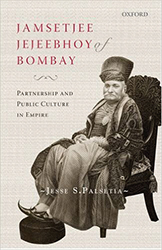 Even 157 years after his passing, there will hardly be any inhabitant of the great megapolis of Bombay who has not heard of Sir Jamsetjee Jejeebhoy Bart (July 15, 1783-April 14, 1859) and the great institutions he and his wife Lady Avabai set up largely with their own funds. This biographical book is divided into an Introduction and six chapters, each of which deals with different progressive aspects of the great man’s life. It also includes a bibliography and a useful index. The printers in New Delhi have done an excellent job not only on the cover design, but also on the type and paper used in the book which deserves a place in any library or household dealing with the British colonial era and the history of the Parsis. The only other person, to my knowledge, who comes close to the philanthropy of Sir JJ (as he is affectionately called by the people of Bombay) is Andrew Carnegie of the US.
In the book, the author, Canada-based Jesse Palsetia (pictured), also immerses himself in the controversy about Sir JJ’s birth. The people of Navsari, a town that is close to the west coast of India and renowned for being the birthplace of many a Parsi sethia, consider Sir Jamsetjee as one of their own. The ancestral home where he was born in 1783 has been renovated and transformed into a memorial museum to commemorate his 225th birth anniversary by the Sir J. J. Charity Fund and Sir J. J. Parsee Benevolent Institution. The town, originally established by Zoroastrian migrants who came by boat to India, many of whom came from Sari in Iran, was named Navsari (New Sari) by them. However, it has been argued that Sir Jamsetjee was born in Bombay, though this remains doubtful as in the 1780s Navsari was a much more thriving and popular dwelling place for Parsis.
After the death of both his parents in Navsari in 1799, Jamsetjee moved to Bombay at the age of 16. Bombay became the center of his commercial, sociopolitical and charitable world where he crafted the image of himself as one of the most prominent of Bombay’s sons. Palsetia notes that Jejeebhoy’s public life combined a three-fold purpose: to elevate his personal fortunes and standing in society; contribute to the Parsi community; and enhance the larger civic environment for all Indians under colonial rule.
 From humble beginnings as a used bottle merchant, under the tutelage of his uncle Framji Nusserwanji Jejeebhoy, Jamsetjee rose to prominence just as the colonial era began to prosper on account of trade with other countries, including China. By the age of 20, he had wooed and married Framji’s daughter Avabai. They had 10 children, but due to high infant mortality in those times, only three sons and one daughter lived past infancy. Soon, Framji took him into partnership. Later, as the business expanded, Jamsetjee took as partners other well-established merchants like Motichand Amichand and Mohammedali Rogay, carrying on his business under the name of Jamsetjee Jejeebhoy and Company. The consignments of Indian opium from Malwa (central India) to East Asia and China constituted Jamsetjee’s major business enterprise and was responsible for a substantial portion of his wealth. Although there were others in the opium trade, Jamsetjee emerged as the most prominent Indian merchant dealing with China in the first half of the 19th century. He made five trips to China and had contacts with the major Chinese, British and American traders and commercial houses. His most famous business association was with Jardine Matheson and Company of Canton. Jamsetjee and William Jardine formed an abiding personal friendship. Jardine Matheson and Company still exists and has diversified and flourished in many areas of businesses. The details of Jamsetjee’s early life is a classic rags to riches story which exemplifies the early careers of Indian businessmen under colonialism.
By the late 18th century, Parsis were active in the inter-Asian trade between India and East Asia. The British desire for Chinese tea saw Indian opium being exchanged for the brew. Jamsetjee was the premier Parsi China trader, establishing a shipping and commercial family business empire from the trade. Palsetia notes the linkages and network of associations he forged with family members, Parsi and other Indian merchants, Chinese contacts and European commercial houses. Parsi traders treated the opium trade as a lucrative enterprise alongside trade in other commodities, and benefited from the opium wars between Britain and China. Palsetia notes both Jamsetjee’s close attention to and thoughts on political affairs from his letters and correspondence with business associates during the opium wars as well as his often naïve thoughts on the wars. Palsetia also describes the great risks taken in the overseas trade including the loss of shipments, detainment by the Chinese authorities, the disadvantages of the costs of consignments, delays in credit remittance and price fluctuations. While history has recorded the opium trade as a dark episode in relations between East and West, as a historian Palsetia notes this is a post-facto assessment. In the first half of the 19th century, this was a major contributor to the rise of global trade; and Parsi involvement provided much of the seed capital for later generations to advance industry and enterprise in Bombay.
By the 1850s his business activities slowed down, but his personal reputation and influence grew with the funding of charitable institutions favoring the Parsis, Bombay society, as well as British and international causes. The knighthood in 1842 and hereditary baronetcy conferred on him in 1857 by Queen Victoria further enhanced his stature, being the first well-known non-European to have been conferred such an honor. At a feast hosted by Sir Jamsetjee and Lady Avabai for the prominent Parsis of Navsari, a spoon of pure gold was given to each guest as a souvenir. Two of the guests, being doubting Thomases and thinking that the spoons were made of a less costly metal, went to a bazaar goldsmith the next morning, and were amazed to find out that the spoons were indeed made of gold!
What Palsetia refers to as ‘partnership’ was central to Jamsetjee’s vision of Indian participation in colonial society. This emerged from his successful commercial and social dealings with Europeans; and he sought to apply this model to the larger goal of his personal elevation in society, the benefit of the sethia class and most significantly the improvement of Indian civic society. Indian-British cooperation often took the tangible form of both parties financially contributing to charitable and other causes, with the British overseeing the management of charities and trusts.
Palsetia explores in depth the creation of many of Jamsetjee’s larger charities, and how they provided him the opportunity for involvement with the British. By the end of his life in 1859, the total of his charities — including public works, Parsi and non-Parsi-centered charities — was some £ 246,000 pounds sterling (a very large sum of money at that time). Parsi charity was well-established by the 19th century, but Jamsetjee innovated charitable action in western India. At the relatively young age of 25 he had already amassed a great fortune with his China trading and exports of cotton to Europe during the Napoleonic Wars (1803-1815). His munificence was not limited to Bombay and India. Jamsetjee made generous donations to help people wherever tragedy struck. Although he had suffered bitter pangs of hunger and captivity at the hands of the French on board the English navalship Brunswick, he sent £ 500 for the victims of floods in France in 1856. He donated large sums to the relief fund during the Irish famines in 1822 and 1845. Famines in Bengal in 1832 and the Deccan in 1833 also received donations from Jamsetjee’s purse. The more money he made, the more he gave away to various causes benefitting the poor. The greatness of Jamsetjee’s philanthropy can be better appreciated as donations came from his own purse and not from any company or corporation, nor did he claim any tax exemptions on them. He built lasting institutions for the welfare of the common man, such as the Jamsetjee Jejeebhoy Hospital and the Grant Medical College, as well as the Jamsetjee Jejeebhoy School of Arts, all of which are thriving and in existence today.
Jamsetjee’s rise to power, fame and fortune was not sans setbacks. On February 17, 1803 a great fire broke out in the Fort area and Jamsetjee lost all his merchandise, mainly opium and cotton, suffering a great financial loss. Lesser men would have declared bankruptcy, but he started afresh with what remained of his assets. His second misfortune was during his fourth voyage to China aboard the Brunswick that sailed from Bombay on June 30, 1805. On reaching the southern tip of Ceylon, the Brunswick was met by two French men-of-war with a total of 130 cannons. Although armed, the English vessel was captured by the French and Jamsetjee was put in chains. Under French command the Brunswick sailed towards Mauritius and from there to the Cape of Good Hope where it ran aground. The English Captain Grant made arrangements for Jamsetjee and other passengers to sail on a Danish ship bound for Calcutta. Having lost all his merchandise and left with only his personal things, Jamsetjee had to pay an exorbitant sum to Captain Fasteau of the Danish ship by way of a promissory note payable on arrival in Calcutta as all his money had been confiscated by the French. Starving, cold and living under horrible conditions on board the Danish vessel, Jamsetjee somehow made it to Calcutta. After a few weeks there he returned to Bombay to the great amazement and joy of his young wife Avabai, friends and associates for they had given him up for dead! Captivity, severe financial losses and dangerous episodes at sea had failed to cow down Jamsetjee and he set forth on his fifth and last voyage to China around 1807 with his reputation and line of credit intact.
Amongst many biographical books previously written about Sir Jamsetjee Jejeebhoy’s life, is one by Jehangir R. P. Mody titled Jamsetjee Jejeebhoy – The First Indian Knight and Baronet (1783-1859) published in Bombay in 1959. This book carries a fold-out which shows the entire genealogy of the Jejeebhoy family, right from Sir Jamsetjee’s parents till today. Palsetia, seems to have referred to this publication to some extent while writing his own book. There was also a booklet published in 1855 listing the charities set up by Sir Jamsetjee and his generous donations to worthy causes titled Memorandum of the Life and Public Charities of Sir Jamsetjee Jejeebhoy. The baronet’s statues adorn all the institutions he set up and are among the Bombay greats on Veer Nariman Road. In a recent work published in January 2016, Three Merchants of Bombay — Business Pioneers of the Nineteenth Century, author Lakshmi Subramanian tells the story of Tarwady Arjunjee, Jamsetjee Jejeebhoy and Premchand Roychand. Jamsetjee has been described as a leader not only of all inhabitants of Bombay but of all western India in Govind Narayan’s book Govind Narayan’s Mumbai — An Urban Biography from 1883. Set against the backdrop of global and local economies undergoing rapid and unforeseen change and colonial intrigues, these stories stand as a microcosm for the history of indigenous capitalism in western India and the courageous and risk-taking character that these pioneering businessmen possessed which the Parsi Zoroastrian youth of today could emulate.
The great man breathed his last around 2 a.m. on April 14, 1859 at his Fort House. He was 75. The news of his passing spread quickly in the city to which he had contributed so much and all over the world. From common people to lords, all came to Hornby Row to pay their respects. Banks, government offices and businesses closed their doors immediately and flags were lowered to half-mast on all government buildings, British navy ships at dock and in the harbor. Tributes began to pour in from all over the world. Lord Elphinstone, who was personally grieved by Jamsetjee’s death, offered to give the Queen’s greatest subject a military funeral complete with a 21-gun salute, military band, a battalion of troops and all, but this rare honor was declined due to the Zoroastrian religious funeral practice. The funeral procession from Fort to the Towers of Silence at Malabar Hill was packed with Parsis and mourners from all walks of life. Charles Forjett, the police chief of Bombay and much beloved of the Parsis, kept the entire route clear of all traffic and ensured that, according to the custom of the time, no non-Parsi crossed the path of the procession. However, this did not prevent the Bombay populace from lining the streets from Church Gate Street to Dhobi Talao and from there to Chowpatty and the ascent to Malabar Hill.
Palsetia is eminently qualified to write this biography as a historian of South Asia trained in the fields of ancient, medieval and modern India. He is a specialist on the Parsis (Zoroastrians) of India, the history of Bombay city, and examines topics relative to colonial-imperial interactions and ideologies. He teaches courses and supervises students in the area of South Asia, and the British Empire at the University of Guelph in Canada.
The book is very well researched with a detailed list of references and a useful index. I quite enjoyed reading this book.
Of all the books on Sir Jamsetjee that I have seen and read, Palsetia’s book has the best cover. The facial features of this outstanding Parsi merchant and philanthropist come alive in minute detail. I can actually visualize Jamsetjee looking at me with benevolence and a hint of a smile as he is pictured seated on an ornately carved ebony chair. Both the hardback and paperback versions are available at a very reasonable price.
This is an amended version of a review which first appeared in the FEZANA Journal, Summer/June 2016, Vol 30, No 2.