Tanya Mehta’s new media art attempts
to show unification of conflicting concepts
Parinaz Gandhi
"One night, lying awake while doing my master’s degree in photography and the electronic arts (I wanted to get into advertising at the time) and trying to figure out what my final project would be, it all just struck me with a clarity I’d never had before. Art was something that could combine all the things I was fiercely passionate about and give them a voice and visual tangibility that I always had locked up in my head,” states Tanya Mehta who had her second solo exhibition, "The Unity of Opposites,” at Bangalore’s Sumukha Art Gallery from June 24 to July 29, 2017.
Tanya Mehta with The Road Most Taken
The Penrose Triangle (far left) and Creation and Destruction
(Inset): Real and the Imagined at Mehta’s exhibition (below)
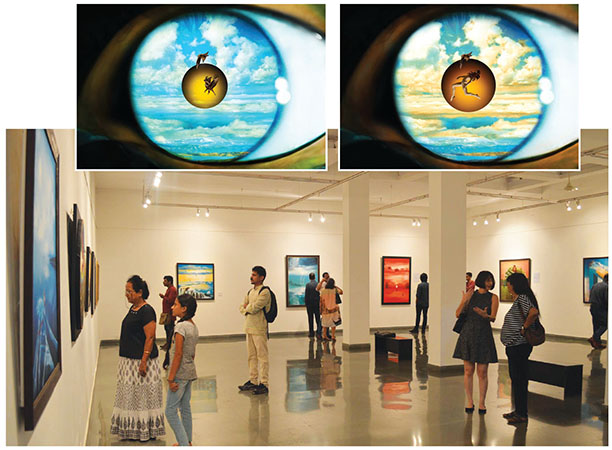
"What we define as opposites are, in reality, unified,” believes the new media artist who worked for nearly two years to build her current repertoire. Each of the 15 artworks on display "is very personal to me on many different levels, be it in concept, technical execution or even the stories of the multiple photographs within each one,” she notes in her email responses to Parsiana.
"I aimed to explore the narrowness of human perception,” says the 29-year-old artist who has "always been fascinated with what is perceived to be a still image morphing into something dynamic,” which she presents as "alternate realities.” While working on her second exhibition, "medium and technology were also things I needed to keep in mind conceptually.”
She chose lenticular prints, a technology employed for 3D images, to show two opposing artworks and concepts in one unified frame. "The artwork Real and the Imagined, for instance, represents a constant looping between the mind’s eye and the physical eye — a process that is continuous and never ending for most of us,” explains Mehta. Since she had conceived it as a moving image when seen from different angles, she specifically requested Parsiana "not to use one image without the other… It is impossible to accurately represent that artwork in print.” In Life and Death where the body of a young maiden appears to be concealed within wreaths, she used the depth illusion of lenticular prints to depict how "each state is nested within the other.”
The circular imagery that is evident in Life and Death is also engaged in Creation and Destruction which shows a tree of life flourishing amidst ruins. "Looping mediums” like portals, circles and archways are visible in Mehta’s work as she seeks to transform her photographs of everyday objects into something profound through collage and digital painting. Melancholy and Contentment are two artworks where Mehta uses the same arched backdrop to depict how one’s circumstances like a free growing vine can be viewed as a confinement or a liberating force.
The invite to the exhibition carried her depiction of The Penrose Triangle (an impossible triangle) bringing together in one frame a deep sea diver at the lower left corner, a boat perched on land in the right corner and a bird descending in flight at the apex. This artwork features under "Order and Chaos” as does The Road Most Taken, where a lone traveler in the midst of a forest appears to review his life in flashback mode.
Mehta also uses animated light boxes (a translucent surface illuminated from behind to provide high contrast) to add another perspective. In Join the Dots and From the Pale Blue Dot, "the front screens for both artworks are simpler – what one would see with one’s naked eye... But once the backlight comes on, it’s a completely different story.” They are meant to show how human imagination leads to scientific exploration and greater comprehension of the universe.
Alongside each artwork one sees a lyrical verse that provides the viewer a glimpse of her intention and thought process. In her quest to explore the gaps in knowledge she strives to construct bridges. "I hope to take the audience over those bridges to the singular reality or truth that exists for all of us,” says Mehta.
As she struggles to get new media art accepted in India, Mehta asserts, "Art to me is an idealistic pursuit; I am fiercely determined that there should be no external pressure that influences my vision.” Her exhibits are priced between Rs 30,000 to Rs 2.5 lakhs depending on size, complexity and medium. Requiring substantial financial investment in terms of set-up and production with no commensurate returns in the initial stages, Mehta additionally works as a freelance graphic designer to support her passion.
Soon after completing her MA in photography from Goldsmiths (London), she had participated in a group show in London, followed by another one in Washington DC. Her first solo show was based on Plato’s allegory of the cave and was exhibited in Bangalore and Madras, with some of her artworks traveling to Delhi during the India Art Fair, and to London and Washington.
Born and brought up in Bombay, Mehta appreciates that "my family has been a huge support to me throughout the whole process.” Her mother Shirin who works in the financial service industry and father Cyrus Mehta who is in advertising, "encouraged creativity and thinking outside the box from a very young age and then saw me all the way through to a master’s degree with the same enthusiasm and pride. I am also lucky to be married to Tushad Bahadurji who helps run his family business Vantage Advertising. He understands all the ups and downs that come with the career of being an artist. My husband’s family, similarly, encourages the arts and my own need to express myself through it. It is rare to have a family structure that supports you so unconditionally and for that I will always be eternally grateful.”
It was her in-laws, Madras based Tehnaz and Darius Bahadurji, who intimated Parsiana about her exhibition saying, "She’s been busy as a beaver these last few months, ensuring that every shade, texture and effect in the print work exactly actualizes what she’s seen in her mind’s eye.” Tanya’s younger sister Tashan is an author whose debut novel The Liar’s Weave, parts of which are based in a Parsi colony in the 1920s, has just been launched by Juggernaut Books.
"I believe the Parsi community is one that is very open to the arts and their appreciation,” observes Tanya, adding, "We have had influencers and people at the top of their game in a whole diverse number of fields like Zubin Mehta in music, Rohinton Mistry in fiction, Jehangir Sabavala in painting …”
Attempting to "use my art to find universal truths,” the young artist comments, "The subconscious is aware of, and holds, deeper truths to life that are not always tangible but that nonetheless exist.” To her, "Art is as much about what a person takes away from viewing it as what was intended by the artist. It is out there with the purpose of making you think and feel.”