The Bomonjee Hormarjee Clock Tower and two other heritage
sites were beautified by the Kala Ghoda Association
Farrokh Jijina
Bombay’s heritage conservation efforts received a boost in January 2017 with the unveiling of a trio of renovation and beautification projects undertaken by the Kala Ghoda Association (KGA). The projects include the restoration of the 135-year-old Bomonjee Hormarjee Clock Tower in Bazargate, a drinking water fountain at Horniman Circle and the unveiling of a statue in the art district of Kala Ghoda. Maneck Davar, chairman of KGA elaborates that all three projects are "in keeping with its philosophy of instilling art and beauty into the precinct” of Kala Ghoda. KGA has in recent years accelerated the pace of its restoration projects. The Prince of Wales Museum, the David Sassoon Library, Bombay Natural History Society, the Oval and Cross maidans and the Horniman Circle Gardens have all been beneficiaries of KGA’s conservation efforts, met from surpluses generated from their annual Arts Festival. Lawyer and activist Shirin Bharucha serves as the honorary secretary of the Association, whose core committee includes corporate adviser and erstwhile Bombay municipal commissioner Jamsheed Kanga. Corporate executive Ashad Mehta serves as honorary treasurer.
Maneck Davar, Shirin Bharucha, Vikas Dilawari
Front view of Clock Tower
Davar with Devendra Fadnavis
Ajoy Mehta (center) with spectators
Kayomi Engineer (2nd from right in the foreground) with onlookers
Built in 1882 in commemoration of a merchant prince and sheriff of the city, the Clock Tower that also houses a fountain had long quenched the thirst of both humans and animals, but had fallen into disrepair. Restoration work was flagged off in March 2016 (see "Preserving a Parsi landmark,” Parsiana, April 7, 2016).
On the evening of January 5, 2017, the refurbished Tower was decorated with chalk, torans and lit divas. Kayomi Engineer, the administrative director of KGA was supervising the final touches, straightening the torans, and ensuring the achhu-michhu tray had the right components. "Get some tinsel for the chalk,” she requested her helpers. Milling around the structure were Parsi residents of Bazargate, some dressed in daglis and traditional saris, most with their heads covered. The locality has few Parsi residents now, most having moved to the suburbs. A bystander joked, "It seems all of Bazargate’s remaining Parsi residents are here!”
As dusk fell, municipal commissioner Ajoy Mehta cut the ribbon to the entrance of the Tower and walked into the interiors, at the head of the milling crowd who, according to Davar, "have probably been born and had grown up in the vicinity... To them the Tower had holy significance.” He felt "glad and satisfied that in a small way KGA had brought such pleasure to these people in seeing their monument restored.” On the cards is a jashan to be performed at the Tower, "seeing the local Parsi population’s enthusiasm.”
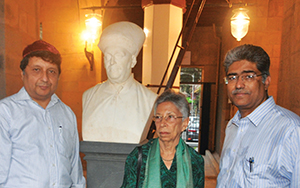
Lit with hundi lamps of the kind seen in agiaries and atash behrams, in addition to the spruced up bust of Bomonjee, the somewhat spartan interiors have white plaques that carry English translations of the inscriptions in Avestan cuneiform atop the Tower. Engineer informs that these were translated with the help of scholar Ervad (Dr) Parvez Bajan.
Award winning conservationist architect Vikas Dilawari who was engaged to handle the project states that "there was a lot of engineering work to be done to this structure. The two main difficulties were that the Clock Tower is bang in the middle of the road and it was in very poor condition. So we had to be very careful that no debris fell on any passers-by.” The upper floor was inaccessible, and large peepal tree roots had opened up the joints in the structure, he says. Davar narrates a gratifying experience: "After the inauguration, Dilawari went with his professor to have some nariyal pani (coconut water). The vendor refused to take money from him. It was a small contribution and recognition of the architect’s efforts.”
A pyao (drinking water fountain) near the Horniman Circle Gardens, constructed in 1873 was another of KGA’s restoration projects. The fountain, funded by Seth Gagandas Vijbhukhandas is fed by an underground well excavated in 1811, according to KGA’s press release. For this project, the Urban Development Research Institute was appointed as architects. Unveiled to the public by commissioner Mehta after the inauguration of the Tower, the brief function was followed by refreshments for invitees, al fresco in the Horniman Circle Gardens.
The Horse
Earlier, on January 3, The Spirit of Kala Ghoda, a 35-foot statue of a black horse commissioned by KGA was unveiled in the parking lot of Bombay’s art district. The name derives from an equestrian statue of King Edward VII that stood there till 1965. Speaking to Parsiana at the inaugural function, Davar let on that they "wanted to have a representation of a real horse, not an artist’s impression.” The speeches that followed the arrival of Maharashtra’s chief minister Devendra Fadnavis were short. "Not looking back, we are looking forward instead… On the suggestion of Mehta, we decided to make this statue. We hope it becomes one of the tourist attractions of Mumbai,” said Davar. Thanking all those involved in the project, Davar and Fadnavis pressed a button that slid the sheath off, revealing the stallion.
Brinda Miller, director of the Arts Festival lets on that "there were no issues, no hiccups during the execution of the artwork,” emphasizing heavily on the ‘no.’ "That was because we were not embarking on anything controversial …we were not replicating colonial art as-is.” The project was flagged off in February 2016. Keen to have a Bombay artist "who could work to our schedule, and within our budget,” to execute the work, Miller explained that they interviewed several potential sculptors "who had done Shivaji-on-a-horse-type sculptures.” She signs off with, "We hope we have recreated a bit of Bombay’s history.”
The new statue stands at right angles to the location where King Edward’s horse had stood. Miller informed The Times of India a day after the inaugural, "the heritage committee was concerned that placing the horse in the same location as the equestrian statue of the late monarch might ‘distort history’ and confuse future generations.”
Self-taught artist Shreehari Bhosle, who has executed Ganapati mandals, painted houses and billboards, was selected to create the installation. "I have always dreamt, ever since I was in class seven, to do something that would be remembered for a long time,” Bhosle informs. Sculpture maestro Arzan Khambatta, whose memorial to INS Vikrant, India’s much loved aircraft carrier (see "Bringing a legend alive,” Parsiana, February 21, 2016) stands about 200 m from The Spirit of Kala Ghoda, was one of the shortlisted sculptors. He came on board as mentor for Bhosle. Present at the unveiling, he excitedly says he "visited Bhosle’s studio (in Goregoan) eight times and gave some suggestions to him while it was in the making.” Alfaz Miller’s firm ABM Architects was responsible for designing a granite pedestal for the 2.5 tonne bronze statue and landscaping the surroundings. Meanwhile, the statue of the original steed, with the monarch who died in 1910 astride it, stands in an alley near the museum in Victoria Gardens, oblivious to the new one that has taken his place.
So what’s next, after these three projects that cost the Association Rs 1,20,00,000 (about US $ 176,000)? "Work has already begun on the (conservation of) Ruttonsee Muljee Jetha Fountain at Fort Market… Dilawari is undertaking the delicate job of peeling layers of paint and restoring the Fountain to its original glory,” Davar shares. The public can look forward to its unveiling before the monsoon arrives. "We are also involved in the restoration of the Kothari Pyao, opposite the Metro Cinema and are awaiting permissions,” he ends.