Seervai Vad was snooty, conservative and constipated. Not that the Seervais were rich; far from it. In the distant past, they had been revenue collectors of the Gaikwads of Baroda which included Navsari. However, even prior to India’s independence, their wealth had dissipated but not their inner feelings of privilege and superiority. They were the Brahmins of Parsi Navsari. Genealogically, they were divided into three branches, pompously called sarkar — motti, vachli and nalli (under the heads: upper, middle and lower); all cousins many times removed. To marry a non Seervai was not exactly frowned upon but the new bride received a frosty reception. Murder may have been pardoned but not juddin marriage.
On ceremonial occasions, the leader of their clan was accorded a pride of place. Seervai was a weighty surname throughout the town. The leader, selected by consensus for a life term, usually hailed from the motti sarkar. Until the 1950s, he wore, believe it or not, a blood red lengho and a pristine white dagli with a shiny pheta adorning his large head (a pugree was sacrilege). Pointed inquisitive shoes, called jodaa, made a loud squeaky noise heralding his august arrival, as he planted his royal posterior upon a slightly cushioned chair to distinguish it from the inferior wooden seated ones. Even if bedbugs infiltrated his red outfit and made him itchy, he remained tight lipped and unsmiling. Seervais seldom smiled and bore an expression as if they had lost both their grandmothers an hour ago. They spoke little, and forget swear words like MC or BC, even a "sala” did not escape from their thin lips. Of course, they did not have a single funny bone, something like "I am Lord Nathaniel Curzon, a very superior person.” They thought other Parsis in Motafalia to be uncouth; as for Malesar Parsis, they were simply unspeakable.
They were scrupulously honest; some of them academically brilliant, even creative. Loyal to the short Queen and the Georges and Edwards who followed her, to them Congress was a dirty word. Marriages were solemnized quietly without any boisterous laughter or the cacophony of tin pot brass bands. Emperor Aurangzeb would have been proud of their abhorrence for music. On the morning of the wedding, rather reluctantly, they invited an orchestra called takorkhaanu from Surat which played doleful, mournful music from wailing harmoniums and funereal pipooris. Even their children spoke in hushed tones.
While they were uniformly ultraorthodox, their eclectic religious proclivities form a tale by itself. They were simple, frugal, Spartan, stoic. They looked after their own and ensured that none went to bed hungry. They were the pioneers in organizing communal muktad where all distinctions were obliterated. If anyone of their ilk indulged in any deviationist behavior, like a pristine nudist called Mancherji Derki, he would be ignored as if he did not exist. The Seervais were not outwardly proud or pompous; only grim, serious and humorless. They were certainly noblesse oblige. After the Second World War, their world started to come apart. It all began with the appointment of a new leader.
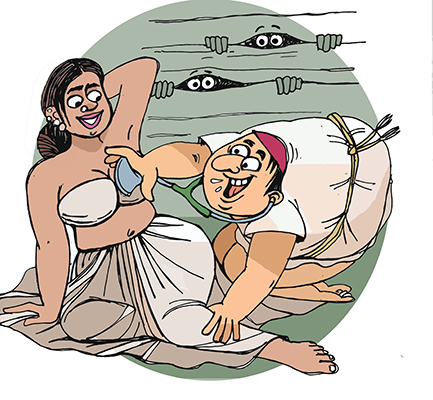
Illustration by Farzana Cooper
As one leg of the 90-year-old patriarch came to rest on the astral plane, the confabulations began in the clan to anoint his successor. Maneckji, the patriarch’s eldest son, was the obvious choice. In 1942, he had migrated to Bombay to work with one of the Tata companies. Even by the Seervais’ exacting standards of dullness, he was outstanding. The timber of his voice was extremely reedy and over the telephone he was often mistaken to be a woman. Surprisingly, he had fallen in love with a girl from Bharuch who was his co-student at the Xavier’s College. They had an idyllic, if mirthless, marriage. His wife called him Mackie.
A section of the clan was opposed to Makie’s candidature on the grounds that he had migrated to Bombay, married a non-Seervai, that too a non-Navsari girl, as also his professed reluctance to wear a red lengho on ceremonial occasions. This section succeeded in convincing the elders that instead of Mackie they ought to select Naval, a shy and quiet gentleman from the vachli sarkar who worked as a bank manager in Navsari and loved to wear the red lengho. While Mackie was not at all disappointed, Naval was super enthused about his impending coronation.
In accordance with tradition, a day was fixed to officially appoint him as a leader of the clan which he was expected to serve for many long years. A week before the appointed day, one of the elders hastily convened a meeting to report in shocked tones that Naval had been spotted coming out of the hut of his domestic help, Shanti, from the thicket behind Seervai Vad. The elders present disbelieved this news. However, since a couple of members were persistent, they formed a committee to swoop down upon the concerned hut that summer afternoon. This committee included the penisless doctor. After waiting for a couple of minutes outside the hut, they decided to barge in.
Shanti, a childless widow, was a dusky, husky, busty woman with exquisite features. The horrified elders spotted Shanti giggling on the ground and Naval wearing only his sudreh, trying to measure her heartbeats with a stethoscope. "That’s my missing stethoscope!” protested the doctor. No voices were raised, no accusations were leveled; Naval was not even spoken to. They booked an ordinary trunk call to Mackie, which took seven hours to connect, and informed him that it was fine with the elders if he chose not to wear the red lengho. Perhaps it was better than not wearing one at all.
Berjis Desai, author of Oh! Those Parsis and The Bawaji, occasionally practices law.