From Rangoon where we had led a “cloudlessly happy” life the family came to Delhi as refugees
Fali S. Nariman
My mother’s family (the Burjorjees) hailed from Burma (now the Union of Myanmar). My father, Sam Nariman, came to Rangoon from Bombay (now Mumbai) in the year 1927 to establish a branch office of the New India Assurance Company Limited. Here he met and fell in love with my mother, Banoo Burjorjee (16 years younger than him). They married early in 1928, setting up home in Rangoon, where my father was posted as the company’s branch manager.
Shirinbai Burjorjee, Fali Nariman’s grandmother
As to how my mother’s ancestors first came to Burma is a story of adventure. Since the early 19th century, my great-great-grandfather, from my mother’s side, had settled down with his family in Calicut (Kozhikode) on the west coast of India. Before the year 1865 (when the first Indian Succession Act was passed), Parsi Zoroastrians living in India — like all other religious communities — were not enjoined to be monogamous. Men folk could lawfully marry, and marry again. But when my mother’s ancestor in Calicut decided to marry again, during the lifetime of his first wife, it was his sons (the Burjorjees of the second generation) who rebelled, and in protest they left home, setting out in a sailing boat, not knowing where they would land. Three months later, after much privation, they found themselves at the mouth of the Irrawaddy. Sailing up the river, they landed in the port of Rangoon. There they made good. Burma was ruled at that time by King Theebaw. The Burjorjee brothers soon ingratiated themselves with the ruler and even got to run the king’s postal service for him… Theebaw was the last king of Burma, defeated by the British in December 1885, in what is described in history books at the third Burmese war. With his dethronement and deportation, Burma (like India) became a part of the British Raj.
I grew up in Rangoon (then capital of Burma) in the 1930s under the loving care of my parents (I was their only child). Spoilt? I am afraid so; I was always ‘Baba’ to my parents. We lived in a rented double-storied bungalow (Kennedy House) near the Royal Lakes. I can truthfully describe my childhood as ‘a cloudlessly happy one.’ The clouds gathered, but only later when I was 12 years old in December 1941, when the Japanese bombed Rangoon and then invaded and quickly conquered Burma…
Nothing very eventful disturbed the even tenor of our lives in Rangoon — until Japan declared war on the Allied Powers after bombing Pearl Harbor on December 7, 1941. Within a week, the city was targeted by air attacks. We witnessed intense and incessant bombing, and spent more time in our makeshift air-raid shelter in the garden of our home than in our bungalow. Soon we moved north to Mandalay for what we thought would be a brief sojourn. This was on the advice of the then governor of Burma, Colonel Sir Reginald Hugh Dorman-Smith, who confidently told my father at one of his war council meetings: ‘Don’t worry Sam, we will get rid of the Japanese in a month of two. My father was taken in by this assurance — how could the chairman of the War Council of Burma be wrong? But he was wrong — hopelessly wrong. Contrary to Dorman-Smith’s expectations, the invasion by the Japanese Army was so swift and fierce that for us the road back to Burma’s capital city was cut off.
We were then forced to embark on a long overland journey to India with what little we had carried to Mandalay: it included several boxes of office records (life policies and general insurance policies); the head office in Bombay greatly appreciated my father’s thoughtfulness in saving these important documents. The overland journey to India lasted 21 anxious and eventful (but for me, also memorable) days, through forests by bullock-cart (which took about seven days), along the Upper Chindwin River by country-boat (for the next seven days), and then (for a week more) up and down steep mountainous terrain on foot and by doolies (a frame suspended by four corners of a bamboo pole and carried by two or four persons) till we reached the Indo-Burma border — all without any travel agent’s guidance or even a tour map to help us along the way! But not without excitement. When we were on the mountainous terrain we were providentially saved from being trampled to death by an elephant. The Bombay Burmah Trading Corporation owned about 400 trained elephants who were used in Rangoon for removing logs of wood from forests in Lower Burma. These pachyderms were brought up north on account of the war, and were made to carry into British India the baggage of the corporation’s senior staff (only the baggage of the sahibs). Our luggage was carried by Manipuri porters whom we picked up at the starting pointing of our trip. These porters were extremely scared of elephants. They would insist on waiting for a full hour after each cavalcade had passed.
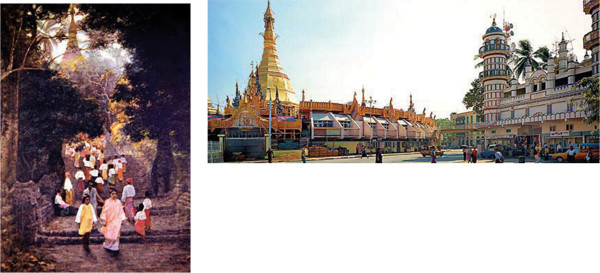
(Left) Entrance to Rangoon’s Shwedagon Pagoda, 18th century painting (Photo courtesy Website: burma-all.com) (Above) Sule Pagoda, Rangoon
On one such occasion, after an entire group of 19 elephants had passed us, we resumed our journey on foot (and doolies). Fifteen minutes later, when we were on a straight narrow path with a deep ravine on one side and a steep hill on the other, we saw a lonely elephant trundling down without his mahout. The nimble-footed porters left our luggage on the narrow path and clambered up the trees on the hillside. But we had to stick as close as we could to the side opposite the ravine with my parents saying their prayers. They feared it was the end. Just then, the leader of the troupe (a young Englishman), who had trained the elephants, came back looking for the missing one. When the beast was just 30 yards from us, ambling down to where we were (and would have certainly trampled us), this good man seeing the plight we were in shouted in Burmese, ‘Shamba! Shamba, pyam ba, pyam ba (Elephant! Elephant, go back, go back).’ Apparently something clicked in the recesses of the small brain of the trained elephant. He obeyed his master’s call and turned around as he was commanded. We then implored the porters to pick up our baggage lying strewn on the narrow path, and quickly rushed on…
In the trek out of Burma, apart from biscuits and sweets which my mother had thoughtfully stocked up for the journey, there was not much to be consumed by way of food. In early February 1942, we arrived at a refugee camp in Imphal where we ate our first hot meal after a three-week trek. It was here that we were given the sad news of Rangoon having fallen into the hands of the Japanese Army. There was no going back now. We took the train from Dimapur to Calcutta (now Kolkata), and from there another train to Delhi (happily it is still Delhi), where we stayed for a while with my father’s old friend Dady Cooper and his wife Rutty who very kindly gave us shelter in their spacious bungalow at Barakhamba Road.
Our arrival in New Delhi marked the first turning point in my life — landing as a refugee from Burma, uprooted from hearth and home.”
Extracts from Fali Nariman’s book Before Memory Fades... An Autobiography.