The life and times of an ancestor, Dr Rustom Manekjee
Kalapesi, come alive through a 120-year-old correspondence
discovered in an old rolltop desk drawer
Gool Ardeshir
At the back of a drawer in a rolltop desk which once belonged to my maternal great-grandfather Dinsha Manekjee Kalapesi, there was a small cardboard box. In it were over a hundred picture postcards dating back to 1902.
I began to go through them, and slowly pieced together the life of Dr Rustom Manekjee Kalapesi, MB (Bachelor of Medicine) (London), LRCP (Licentiate of the Royal College of Physicians) (London), MRCS (Member of the Royal College of Surgeons) (England), DTM (Diploma in Tropical Medicine and Hygiene) (Cambridge), LM & S (Licentiate in Medicine and Surgery) (Bombay) from his correspondence. He was just an ancestor to me, whose huge life-size portrait painted by his niece hung on the wall of my grandparents’ living room in Bombay, quite unnerving us as children! It is only now, after finding photographs, certificates, medals and letters along with the collection of postcards that I have come to realize just how much he achieved in his short life despite fighting a terminal illness for so many years which ended his life at the young age of 36 years.
Staff and students of the London School of Tropical Medicine, 1905,
with Kalapesi standing 3rd from r behind the seated row
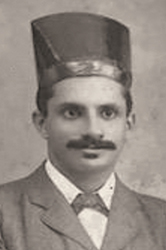
Kalapesi family with Rustom (standing in pugree), 1899
Postcards and letter found in Kalapesi’s cardboard box
He was my great-grandfather Dinsha’s brother, born on April 16, 1870 in Bombay to Manekjee and Soonabai Kalapesi whose families were originally from Surat. The name Kalapesi is a contraction of two names — Kalabhai and Pestonji. The family in the 17th and 18th centuries manufactured the famous Surat silk. Subsequently they moved to Bombay and Manekjee was employed in the Queen Mills there. Rustom went to school at the Sir Jamsetjee Jejeebhoy Parsee Benevolent Institution on Hornby Road, Fort, Bombay, and passed out in December 1888. The principal, Mr Wadia, certified that his second language was Persian and his mother tongue was Gujarati. After school he joined the Grant Medical College and graduated in 1893.
Rustom was an outstanding student and was awarded scholarships every year, including prizes and silver medals. Testimonials given by his teachers as well as top surgeons and physicians of the day were all very positive. Dr H. M. Masina said: "I found him to be the best student of the year, displaying an amount of zeal, intelligence and ability much above the ordinary run of students.” Dr R. Manser described him as a "hard-working, painstaking student of more than average abilities who took the head place in the class in medical work” and Dr L. F. Childe referred to him as "one of the best students of the year.”
Rustom worked for eight years at the J. J. Hospital in Bombay as an honorary physician and a lecturer in pathology. In 1896, when the plague broke out, he was selected by Dr Waldemar Haffkine as his assistant in the research of the anti-plague serum. I have found two references to the fact that he was Haffkine’s assistant: in the 1898 published compilation of The Plague in India 1896 and 1897 by R. Nathan, and in Western Medicine and Public Health in Colonial Bombay 1845-1895 by Mridula Ramanna. He assisted Haffkine and with him developed the plague prophylactic at the Plague Research Laboratory which was later renamed the Bombay Bacteriological Laboratory and then the Haffkine Institute.
Ill health seems to have been his constant companion — all his professors at Grant Medical College have certified that the reason he didn’t pass his LM & S with honors is solely because he had an attack of jaundice immediately before and during the examination. I came across a letter dated August 13, 1901 from a gentleman by the name of N. M. Kharegat who appears to be a family friend, in which he says: "My dear friend, I was awfully grieved to learn from a friend of mine that the cause of your ill health for so long a time is tuberculosis. I actually shuddered and my mother is so depressed ever since she has heard it too. Is it a fact? How I wish it is only a mistake.”
Rustom’s health must have improved as in May 1902 he sailed to England on the P&O liner Arabia via the Suez Canal. He wrote to his family from the ship describing the journey in detail. In London he studied further and passed the LRCP and MRCS exams. The next year, 1903, he joined "Barts,” the Bartholomew Hospital and in less than two years passed the Preliminary Scientific Intermediate MB of London University. He passed the final MB in 1904 within three months of passing the intermediate MB, which was recorded by the registrar of London University as a unique achievement.
From London he wrote letters to his family. These have been fabulously preserved considering they are 120 years old! They are in Gujarati which I was not able to read, but on having them translated, revealed wonderful insights into life in England in 1902-1905. He wrote descriptively and in detail whether it was a visit to Buckingham Palace to attend King Edward VII’s levee, watch the King’s coronation procession, join the other Parsis of London at J. N. Tata’s home to celebrate Parsi New Year, or just ordinary life in Edwardian England. The letters have you transported to another era, fashion, food, transport, travel, the weather; he covers it all!
In May 1905 he obtained with distinction the Diploma of the Doctor of Tropical Medicine from Cambridge University standing first in the examination. He was the first Indian and the first Parsi to obtain this Diploma. Ironically, during his stay in England he specialized in diseases of the lung. His postcards show that he went to many seaside places like Bexhill-on-Sea, Cliftonville, Swanage, and Bournemouth for the "pure air” in the hope of a cure for his tuberculosis but with no success. He also went to Llanbedr Hall, a sanitarium in Wales, for three months but nothing halted the continuous and rapid spread of the disease.
On August 24, 1905 he wrote from London to his brother Dinsha in Bombay about the rapid onward progress of the disease: "Such is my life doomed and dangerous; but nay I am sure and hope it will be so, that in the battle against my disease I will succeed in the end to live a long, though delicate and systematic life. It has made me study the whole question of tuberculosis very minutely in all its relations and given me an opportunity to have practical experience of the work of the special sanatoria for the disease. But though experience bought is better than experience taught it’s a high price to pay and that too not in money but in a part of one’s own vital organ…”
Several of the postcards that I found in the cardboard box were sent to him from Bombay and Poona by a mysterious woman who signed off only as ‘G’… beautiful old postcards with wistful messages hinting at longing and loneliness. By matching handwriting and postal stamps it appears she was a lady who lived on Malabar Hill in Bombay, visited Poona often and even went to England for a year-and-a-half in 1902-03 while Rustom was studying there. Sadly he could never marry as he wrote to his brother "the disease being infectious to a certain extent, I want to avoid contact with susceptible children and people by avoiding constant and close contact and mixing. Here you will see that the question of matrimony is put off till I am safe to my wife; perhaps that will never be” and his words proved prophetic.
He returned to Bombay in 1906 as he was advised to return to a warmer climate, and he passed away on July 16, 1906 at the age of 36, never realizing his dream of opening a postgraduate college of tropical medicine and pathology in India.