Bombay in the Age of Disco: City, Community, Life by Tinaz Pavri. Published in 2015 by University of North Georgia Press, Dahlonega, Georgia, USA. Pp: 122. Price: Rs 1,096 (on Amazon).
"Everything I remember about Bombay is connected with the Parsis. Having lived over 20 years in the US, I felt the need to write this book before Bombay would recede from my memory,” stated Tinaz Pavri when she came to the Parsiana office to present a copy of her book, Bombay in the Age of Disco: City, Community, Life. On her annual visits to Bombay, she finds that "every year the city changes so dramatically.”
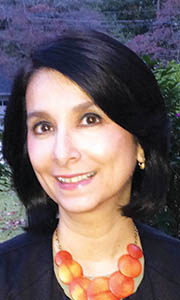
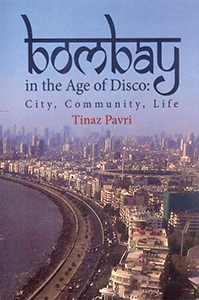
Professor of political science, division chair, social sciences and education, and director of Asian Studies Program at Spelman College, Atlanta, Georgia, in her introductory chapter she ex-plains that fol-lowing "the tu-mult” of the 26/11 terrorist attacks in Bombay "grew a need to write what I remembered. My city, my childhood, my Bombay.” Identifying herself with Bombay, "the pre-global child,” that was "warmer, shyer, slower,” Pavri perceives the birth of Mumbai "by a chauvinist Maharashtra state government” as "brash…bold, fast, divided.”
The 122-page book offers an incisive first person narrative, candidly weaving in her reflections and relations. "It is a personal book,” declares Tinaz without any qualms. From her residence in Santacruz, to her maternal grandma’s home at Gowalia Tank, from her school, Bombay Scottish, in Mahim to her college, St Xavier’s near the Victoria Terminus station and her architect father Bomi’s office near Flora Fountain, she covers the panorama of the city like a seasoned commuter.
Interwoven in the 13 chapters of her narrative are insights into the city’s bygone social, political and economic life as also "the pain of inexorably losing, literally and physically, the Parsi community which surrounded me in its rambunctious and warm embrace and put its indelible imprint on my life …”
Parsi readers will be able to instantly recognize the Gujarati jargon but Pavri had to reserve four-and-a-half pages of her book to explain over 80 terms like bechari (poor thing), tamasha (avoidable or unavoidable drama or chaos)… in the glossary for her international audience. The engaging raconteur provides graphic images of Nani Palkhivala delivering his budget speeches, Behram Contractor’s Busybee columns that enhanced the popularity of afternoon papers, Indira Gandhi for whom Pavri had a soft corner because of her resemblance to her grandmother… Reference to Godrej cupboards or Parsi Dairy Farm kulfis or the Taj Mahal Hotel conceived by Jamsetji Tata reinforce her pride in Parsi products and institutions.
In the chapter "We Were Parsis,” Pavri’s liberal views surface at different times as in her refusal to identify a good Zoroastrian merely with the wearing of the sudreh-kusti. When referring to the absence of vultures at Doongerwadi, she vents her ire: "The real vultures are the new so-called Parsi leaders who have viciously and deliberately torn apart what remains of our community on new fault lines of who is a real Parsi and whose child can be raised Zoroastrian.”
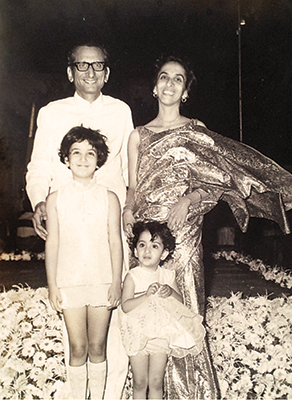
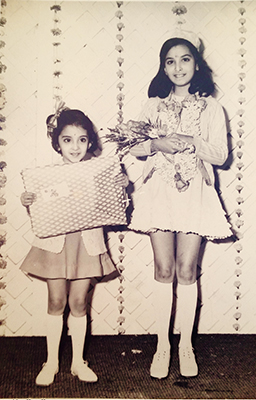
Tinaz Pavri with family Bomi, Gool and Rashna Pavri
Tinaz Pavri's maternal great-grandparents with their five children
She is happy that at the functions organized by the Zoroastrian Association of Atlanta, USA "there are no restrictions and everyone is welcome,” she mentions to Parsiana. Married to Tom Rotnem, also a political science professor whom she met during her graduation days at Ohio University, she would have liked her sons Darius, 17, and Ethan, 14, to be navjoted in Bombay but finally decided not to impose any religion on them. On her last trip to Bombay in July 2015, her father’s decision to present his precious violin to the musically inclined Ethan was akin to the passing of a baton in the family.
The photos of Pavri as a baby, growing child, young mother, plus her parents and other relatives bring to life the characters in the book but we are not told why there are two identical photos of the family on Tinaz’s navjote day with barely any reference in the text to that event except that she was presented a gold horseshoe ring set with tiny Basra pearls on her initiation into the religion.
Another impressive piece of jewelry that earns considerable space in the narrative was a family heirloom, a stunning bracelet with 13 diamonds, worn by her mother Gool at Tinaz’s wedding. Its loss on that fateful day signified the end of "the magnificent eras that it had seen, now long gone, finished, khalaas, along with their people, their relatives, along with Parsis themselves. Neither we nor anyone we knew, would ever again be able to afford anything like it in any of our lifetimes…”
The Bombayite who had once longed for ‘abroad’ admits that the glamor seems to have paled into insignificance. In the last chapter "Leaving Bombay” she conveys the initial euphoria of securing full scholarship for postgraduation studies in the US, and the excitement and embarrassment of the departure day. The subsequent years have brought in remorse at having left her parents behind who "couldn’t have known that the two of them would grow old together and talk to their girls (Tinaz and her younger sister Rashna) on Skype and fall in love with their grandkids and see them once a year instead of all the time, and their girls would carry this burden, this guilt with them forever, haunted by the stooped backs and grayed hair and confused looks and utterly destroyed by the enormous generosity and love that propelled both parents to not once, never ever, utter these words to them: ‘Why didn’t you come back?’”
The pining for Bombay surfaces at different times: "In my American life, Bombay always intruded…” And the final admission, "Just as all my waking dreams in Bombay were of America, so all my nightly dreams in America now became, unbidden, sometimes unwelcome, but always of Bombay.” PARINAZ M. GANDHI