The 100-year-old Bharat Floorings and Tiles is reinventing its portfolio to reach newer markets
Farrokh Jijina
When two Jewish sisters in Cochin had complained of four misaligned tiles in their home, Bharat Floorings and Tiles (Mumbai) Private Limited (BFT) director Dilnavaz Variava visited the duo. "You must be a Parsi,” they told Variava. "They believed only a Parsi business would be concerned enough for their top brass to attend to the complaint,” Variava mentioned on February 13, 2023, seated in her Fort office, in a building that once housed East India Company governors. "We have never abandoned any of our customers over the years. Our commitment to quality, integrity, innovation and service has been constant” over the 100 years the company has been operational says Variava, now chairperson. She is the daughter of the co-founder Pherozesha Sidhwa.
"I keep telling (my son) Firdaus we need to have more celebratory events” to mark the centenary, noted Dilnavaz, who has taken a back seat, leaving her son Firdaus "to lead the new initiatives.” The events held so far included unveiling their Centenary Range, "a collection of tiles specially designed that pays tribute to those who were integral to BFT’s rise,” their founders, key production managers. Among these is the Rustom Sidhwa Tile which commemorates the co-founder’s leadership "with a simple, humble, straightforward design… that represents his creativity and caring.” Dilnavaz says her favorite from the Range is the Artisans Tile, "a tribute to the artisans who are the pillars of BFT’s production… the pattern’s river motif symbolizes continuity and the ups and downs BFT has gone through… The modern and classic look represents the intersection between production, sales, installation and maintenance, all equally important aspects of BFT’s success.”
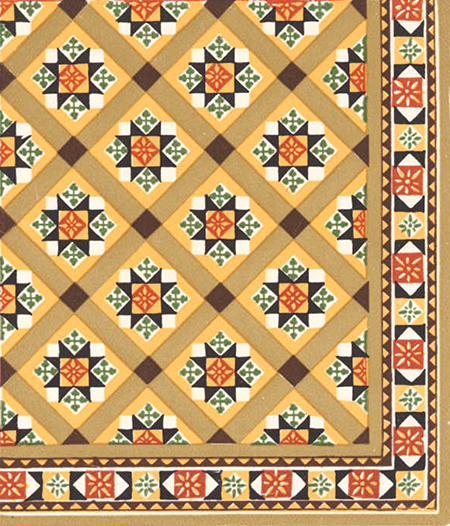

Select designs from Bharat Floorings and Tiles’ (BFT) products
Dilnavaz (l) and Firdaus Variava
The company hosted a series of programs to showcase their past, present and future in January 2023, "through archival finds, new products and avant-garde experiments.” A travelling exhibition to explore Bombay’s architectural heritage with a focus on flooring, titled "Cabinet of Curiosities” was held from January 5 to 15 at the show venue Kathiwada City House in Worli. A panel discussion "New Design Frontiers” on January 7 moderated by media personality Shaan Khanna featured design and décor experts Sarah Sham of Essajees Atelier, Rajiv Parekh, founding partner of Red Architects and Pavitra Rajaram, founder and creative director of Pavitra Rajaram Design. A heritage walk by tour company Khaki Tours on January 8 took guests through the city bylanes to sites and buildings where BFT’s tiles have been used. All this was capped off with a tile making workshop on January 14 that allowed "visitors to get up close and personal with the process of manufacturing tiles.”
Also launched was a range of 10 limited edition shirts in collaboration with couture company Bombay Shirts. "I have always wanted to see BFT patterns and designs translated on to fabrics to create apparel or a range of lifestyle products, as I believed it would look wonderful,” Firdaus told the Mint Lounge on February 1.
The company’s new website bft100plus.com which is in the making will bring out, in an online campaign titled 100 Years 100 Stories, "a century’s worth of engaging stories from its past and present.” Archival family photos, those of the Uran factory, reminiscences of employees, product details, advertising, all find a place in this section, which, though incomplete, offers a glimpse of what could be a business archivist’s or history aficionado’s dream.
Their tiles, which Dilnavaz lovingly calls floor art, are for those who want a unique ambience in their homes and offices. In addition to tiles, their range of products includes wall cladding materials, heavy duty tiling for outdoors ("made with material next only to diamonds in hardness”), micro-toppings for existing floors for quicker installations, and now, increasingly, rugs, table tops, wall papers, lamps and other decorative knickknacks. Their international range of tiles draws inspiration from design elements from Japan, Sweden, Argentina, Hungary and Mexico while their Made in India range pays homage to traditional designs from 13 Indian states. BFT regularly collaborates with known designers for their range of tiles. For cost conscious customers, they can mix and match heritage tiles with un-patterned ones, and even stone, Dilnavaz stated. As states their corporate video, "Even today, every tile is hand crafted in cement, made with love and imbued with the company’s original motto, ‘Equal to the world’s best.’” BFT’s services include designing and customizing floor layouts and contracting of civil works via an associate company.
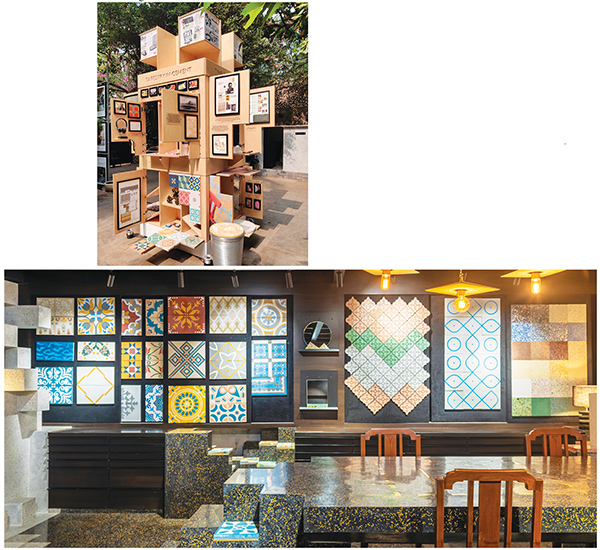
Top and above: showcasing their traditional and new products to celebrate BFT’s centenary
Top: Artist’s rendering of their Uran factory;
2nd and 3rd rows:"hand crafted tiles made with love"
"A bigger share”
Fifty-year-old vice chairman Firdaus who calls himself "chief troublemaker” at BFT on his Instagram handle, has ambitious plans: to drive it from the current 30-crore-entity to 100 crores in three years with outlets in six countries. A master’s degree holder in marketing from the College of William and Mary, Williamsburg, USA, he said: "Our range of handmade tiles will continue… We want a bigger share of home owners’ wallets,” emphasizing the focus on lifestyle products that they want to popularize. Terrazzo work casted in site (in situ), where the material is poured at the home or office of the customer, is a focus area for the company. "We will export in a way that does not require extensive labor for installing and polishing,” he stated. Focus markets for the company will be the United Arab Emirates, Sri Lanka, Bangladesh, the United Kingdom, "and later all of the Middle East.”
Firdaus sees a bright future for the building industry. "Home owners, especially after the pandemic, are taking more pride in their homes…They are not content with standard designs that builders provide, which is good for us… The focus on heritage helps… Also, builders are increasingly selling ‘bare shell’ flats (without decorative flooring),” leaving home owners to choose their own floor art.
Manufacturing currently takes place in a facility that stands on four acres of land in Palghar near Bombay. "We must expand our footprint… We are currently constrained by the built-up area of the factory…We are not well dispersed geographically, too,” said Firdaus. Sales outlets are in Bombay, Goa, Bangalore, Delhi and Hyderabad.
Mirroring history
From a nascent sense of nationalism to Independence and now towards a "resurgent India.” From shortages of raw materials resulting in a downturn in business and even closure for a while. From a world war to changes in building styles. From the era of quotas and unions to now launching lifestyle products in addition to their continuing flagship products, i.e. floor tiles, BFT has survived and even seen some years of growth in its 100 years of existence.
Inspired by the ideals of Karachi-based politician Jamshed Mehta, Pherozesha and his nephew Rustom Sidhwa founded the company in a burst of nationalism to counter the import of tiles from Britain.
When Pherozesha passed away in 1972, the tile business was bleeding. That was a period of lull in the business. Tehmina, Pherozesha’s wife kept the company afloat after his passing "with her determination and courage,” said Dilnavaz. Tehmina had told Parsiana in 1998 (see "Paving the platinum way,” Parsiana, January 1998) that during World War II "overnight the British government told us to surrender every bag of cement for defense purposes.” The company suffered a substantial loss, she recalled. Dilnavaz involved herself full time with the company after stints as chief executive officer of World Wildlife Fund India and vice president at the Bombay Natural History Society among others. She is one of the two women to graduate in the very first batch of students of the Indian Institute of Management, Ahmedabad. "I thought I would buy over the tile business in 1999 from the other shareholders and take a chance at turning it around.”
"In a way, the history of the company mirrors the history of the country in general and the building industry in particular,” stated Firdaus. When the Sidhwas started the company in 1922, their products were made to largely anglicized designs. Their manufacturing base was in Uran across the harbor from Bombay, where the family had a distilling business. Material had to be carted in sailing boats, when the weather was fair, Dilnavaz told us. Among their first clients was Sir Cowasjee Jehangir who ordered tiles for his town house on Churchgate Street. The Raj era saw the company doing business with grand government houses and clubs, even the 1930-inaugurated Bombay Central Station and the now dismantled Mole Station in Ballard Pier; then followed the Art Deco era with smart cinemas and apartment blocks, particularly at the Oval Maidan and Marine Drive.
In the early 1940s when cement was mandated to be used only for defense purposes, the Sidhwas started making tents to supplement the war effort. "Then came metal printing,” said Dilnavaz. BFT diversified into grinding and abrasives via another partnership firm, Grindwell Adhesives later named Grindwell Norton Limited. "We had to innovate to take care of the lean periods,” narrated Dilnavaz. BFT has ventured into production of wall panels, cement based paints, cleaning liquids, wood wool, even soaps and cartons for Polson butter, at different points in time, she stated.
Then came the era of large business houses and banks. "Grand floors in marble became fashionable,” Firdaus commented. The 1950s-1970s saw the fashion of terrazzo tiles "featuring the richest colors and the whitest chips.” In the 2000s when heritage conservation became buzz words, BFT re-did the floors for venerable establishments including the Bhau Daji Lad Museum, The Cathedral and John Connon School, the Salar Jung Museum, the Royal Bombay Yacht Club and the Rugby Hotel in Matheran. "As we keep improving our designs and technologies, we remember our roots and our journey,” states their website.
"Apart from the production managers Shapoorji Madon and Dinsha Patel, there were others over the years who have contributed…A special mention must be made of Rumi Palsetia who was associated in one way or another with Bharat Tiles for over 50 years,” noted Dilnavaz.
The first edition of the Kala Ghoda Arts Festival in 1999 was a turning point in the fortunes of BFT. When emptying out a factory in Kurla, Dilnavaz discovered old patterns and molds. The company exhibited its restored Italian molds and finished products for reviving the tradition of floor art. "It made everyone realize flooring is an art too…It is one of the longest-lasting items of anyone’s home décor,” stated Dilnavaz. While BFT earlier had not more than a dozen colors in their 1920s catalog, the new collection showed over 30. This "considerably expanded” their customer base, noted Firdaus.
From l: Zia and Naira Jejeebhoy, Dilnavaz, Sam, Firdaus and Shai Variava,
Jehangir and Ava Jejeebhoy, Kabir and Nidhi Variava
Dilnavaz’s husband is Supreme Court Justice Sam Variava (retd). Firdaus’s wife Nidhi (née Ramachandran) has co-founded Peel-Works, a grocery-focused ecommerce company. She and Firdaus have two children, Kabir and Shai. Firdaus’s sister Naira Jejeebhoy is a legal counsel who focuses on domestic and international arbitration law.
Dilnavaz says she is highly involved in overseeing The Sahayak Trust she founded in 2016, and which has partnered with over 500 nongovernmental organizations to spread awareness about anemia in women. Under their program Anaemia Free India Forum, the Trust imparts training on development of organic kitchen gardens. She credits Pherozesha and Tehmina with having sown the seeds of social service in her via a school for the disadvantaged in Deolali. (Pherozesha was prescribed to spend time in the drier climes of that cantonment town, having damaged his lungs due to long hours of work with cement in the tile factory.) That school has now grown into the Saraswati Education Society that has a student strength of 3,800 children from Deolali and surrounding villages. Dilnavaz’s sister Almitra Patel oversees another trust that runs balwadis (creches) and conducts educational courses.
"Ours is a fabulous religion in terms of the teaching of Zarathushtra…but we are not into the rituals of the faith… for us what is important is good thoughts, good words, good deeds and vohu mano to tell us what good thoughts mean,” stated Dilnavaz.