Forty-six years after the denial of funerary prayers for my father, the powers that be, in another agiary, in another city, replicated the despicable behavior.
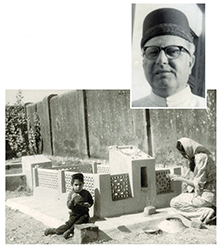
I mention this in light of the Parsiana editorial "No rites for the ‘wrong,’” Farrokh Jijina’s article "Rites and rights,” and Mehroo Kotval’s letter "Priest and prejudice” (Parsiana, October 21-November 6, 2020) about the denial of funerary prayers by the panthaky of the Karani Agiary in Cusrow Baug for the late Baug resident Bahadur Hansotia. It reminded me of the time when my late father Sheheryar Kaoosji (pictured) was denied funerary rites because, to respect his desire, we chose to bury him at the Zoroastrian aramgah in distant Nizamabad (pictured) and not the dakhma used by the residents of the twin cities of Secunderabad and Hyderabad.
Interfaith marriage and dakhmenashini are two of the most provocative Parsi social issues. A difference in these two cases is that in Bombay, the position on interfaith marriage disqualification was decided by the panthaky while his employers, the trustees approved of his ban. In contrast, in Hyderabad, where the panthaky, the late Ervad Shavakshah Patel, was willing to perform the paidust rituals, he was prohibited from doing so by his employers, the Chenoy Agiary’s trustees. These decisions have no religious basis and are dependent on the personal opinions of people at the helm.
More than 30 years after my father’s demise I wrote an article to describe the events of that difficult time which my mother and family had experienced, ever grateful to all relatives and friends who came to pray by my father’s coffin, while we made arrangements to drive 100 miles to the Nizamabad aramgah (see "Direct action,” Parsiana, November 7, 2006).
Fast forward: Eighteen years after my father’s demise my mother passed away in 1992. By then a municipal crematorium had been installed in Hyderabad. Members of my extended family chose this option instead of burial at the distant Nizamabad aramgah. All remaining siblings of my parents have since been cremated in Hyderabad. Of course the priests would not perform the paidust rituals. But, lo and behold, after the cremation they turned up at the doorstep with offers to perform all post funeral rituals and prayers for the souls of the departed, whom they had never come to bid goodbye! They started by offering a first month ceremony, then progressed to including the 10th day, and now have no hesitation to start prayers on the fourth day after demise, whether the deceased was cremated or buried! I will leave these facts to speak for themselves without commenting on their obscene absurdity!
Across the world, values of all religious systems are focused on how its adherents treat their fellow human beings. The orthodox Parsis (note, I did not say Zoroastrians!) are obsessed with the myth of preserving racial purity, and about how to treat a cadaver after the soul that occupied it has exited!
These disputes arising from Parsi orthodoxy underlying interfaith marriages and dakhmenashini have had a polarizing impact on the community. Moreover, the fragility of the objections is rendered ridiculous when these absurd rules are not applied with the same severity to wealthy families. Neville Wadia’s example was cited in the referenced Parsiana articles. But there is another more significant example that needs to be mentioned. The late J. R. D. Tata was the son of an intermarried couple and is buried in his family mausoleum in Paris under a three-panel tombstone wall inscribed "Humata, Hukhta, Huvrashta.” So, where is the "religious” basis of these Parsi positions on intermarriage and dakhmenashini, if these so-called taboos are conveniently relaxed to accommodate a few?
The Parsiana editorial rightly concludes, "Sadly, the Parsi supremacists in India are ringing the death knell of a once universal religion.”
To it I add, when will this ever end?
YEZDYAR S. KAOOSJI
California, USA
yezdyk@gmail.comYour editorial "No rites for the ‘wrong’” (Parsiana, October 21-November 6, 2020) left me literally numb and speechless.
Perhaps our learned as well as not so learned Zoroastrian priests and scholars could profit from reading Kabir: "Pothi padh padh jag muva, pundit bhaya na koi,/ Adhaai akshar prem ka padhe so pundit hoi [In vain the study of scriptures old, in vain the parroting of holy chants,/ In death’s relentless grip lie scholars untold who engraved not LOVE in letters of gold upon their barren hearts” (my take on the couplet).] ABAN MUKHERJI
mukherji.aban@gmail.com