Died: Burjor Jal Avari, 80, a pioneer of multicultural education in the UK and a founder of the North West Zoroastrian Community (NWZC); on March 29, 2019 in the UK following a 14-year battle with cancer.
"He was at his best involved in thinking, writing and debating subjects which usually had a universal theme. He was a multiculturalist at heart, passionate in his advocacy but willing to listen to those who had different views. His intellectual incorruptibility in argument was amazing,” remarked George Gheverghese Joseph, an economist from Manchester at Avari’s funeral on April 12. He further recalled his good friend’s "impish sense of humor, particularly effective in puncturing pomposities. He had an uncanny way of dealing with people who felt that they had been slighted, but my abiding memory of Burjor remains the last time I saw him at the door of his house when he gave me a hug. During the 60 years of close friendship, we had dispensed with physical demonstrations of affection, including even handshakes. And that was the true measure of the man.”
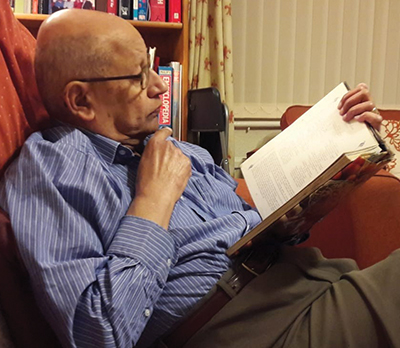
Burjor Avari: proponent of peace and mutual respect
Whilst Avari was a lecturer in the Department of History at the Manchester Metropolitan University (MMU), his influence extended to peers from the other departments. William Martin Whalley, a senior lecturer in microbiology who had known Avari for nearly three decades, stated in his eulogy, "We both relished the history of this city. Myself, very much an amateur, mainly concerned with the restoration of its historic networks of canals, whilst Burjor investigated the whole range of sociological issues associated with the rise of Manchester to international fame. Together we attended one of Burjor’s celebrated Town and Gown evening lectures, advertised as ‘multicultural studies.’ Burjor firmly believed that interracial harmony and religious tolerance could be achieved provided people took the trouble to listen to each other’s point of view… Our one-to-one seminars lasted anything up to two hours, over two different slices of cake, each halved and shared; we covered everything from politics, via religion to Brexit (Burjor being very much a man of socialist principles and me somewhat on the opposite side). Never a cross word was uttered and each difference usually ended with laughter.”
"A Trojan horse infiltrating colonial history with the truth of multiculturalism, (his) weapons were honesty, (his) goals peace and mutual respect,” summed up SuAndi, OBE (Officer of the Most Excellent Order of the British Empire) of Black Artists Organisation in Manchester.
Avari’s preoccupation with multiculturalism commenced in 1987 after race riots tore apart the peace and tranquility of UK society. Avari wrote a paper for the Department of Education recommending that the school syllabi should promote multicultural understanding in every subject. His paper led to "the establishment of the first and only faculty in the UK of multicultural studies in Manchester,” recalled his brother Noshir, counsel emeritus and past trustee of the Zoroastrian Trust Funds of Europe. Burjor also impressed the police with his understanding of the subject to deal with multicultural protesters. This led to Baroness Margaret Thatcher recommending Avari’s name for inclusion in the 1988 Queen’s Honours List when he was conferred the MBE (Member of the Most Excellent Order of the British Empire).
His three books, British Soil – Chinese Roots, India: The Ancient Past – A history of the Indian Subcontinent from c 7000 BC to AD 1200, and Islamic Civilisation in South Asia are believed to have been written whilst he was fighting cancer, often after returning home from chemotherapy sessions when instead of curling up in bed, he would sit at his computer to expound his understanding of historical developments for the academia and laymen. Known to always stand up for the underdog in society, he never raised his voice, nor did he judge, attributes that paved the way for his multicultural contributions.
On the recommendation of Prof (Lord) Bhikhu Parekh, the Burjor Avari Memorial Fund will be initiated to sponsor an annual lecture on the theme of multiculturalism under the auspices of MMU.
Born in Navsari, at the age of three Burjor traveled with his mother to Mombasa in Kenya to unite with his father. Despite the travails of World War II, Burjor was fortunate in being tutored by dedicated Asian teachers who made him learn tables up to 40 by heart, recall pages from the Oxford English Dictionary, and memorize Shakespeare’s immortal plays, stated Noshir. Scoring high grades at the Cambridge Overseas School Certificate examinations, he qualified for a full British Government scholarship to proceed to the UK for higher studies and set sail for the UK on the Union-Castle Line ship Braemar Castle. In the UK he initially enrolled at Portsmouth College of Technology and read five A levels, including classical Latin. This earned him admission to Manchester University where he read history.
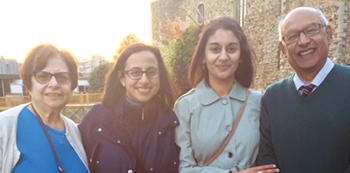
From l: Zarin, Rushna, Anahita and Burjor Avari
After graduation, the Colonial Office, funders of his education in the UK, insisted that he obtain a formal qualification in education. He thus proceeded to Oxford before returning to Kenya in 1961 where he became one of the first Asian teachers to teach in a prestigious all black school. The Department of Education in Kenya assigned him the task of updating the secondary school history syllabus in readiness for Kenya that was to become independent in 1963. A few years later he returned to the UK to continue his teaching career, largely in Manchester where he became a close friend of the late Prof John Hinnells, one of the strongest exponents of the Zoroastrian faith in the UK in the 20th century.
"Burjor was an iconic Parsi within our minute community and a true Zoroastrian in spirit and action. His selfless kindness and generosity of spirit and his intellect left us in awe as did his powers of oratory and his desire to help others,” remarked the current NWZC chairman Derius Dastor.
The engaging educationist is survived by his wife Zarin to whom he was married for 47 years, daughters Rushna and Anahita, and brothers Noshir and Edul.
With inputs from Noshir Avari