A quintet of concerned individuals are lobbying to save
Victoria Gardens’ green cover from depletion
Farrokh Jijina
"We are in for a long fight,” says Hutokshi Rustomfram, founder-trustee of Save Rani Bagh Botanical Garden Foundation (SRBBGF), in a telephonic interview with Parsiana on April 4, 2017. The group is on a mission to resist the hike in the entry fee to the Victoria Gardens (commonly known as Rani Bagh, formally Veermata Jijabai Bhosale Udyaan) proposed by the Bombay Municipal Corporation (BMC) from Rs 5 to Rs 100. For children, the current fee is Rs 2 and is proposed to be increased to Rs 25. The Gardens are home to over 3,200 trees comprising 286 species and host about 8,000 visitors each day, with 30,000 on holidays. "We are approaching the mayor, the chief minister, and the standing committee of the BMC and are going to use the social media to mobilize public opinion… Egalitarianism has been the hallmark of Rani Bagh since its inception,” she shares. Any fee increase has to be affordable for all, the activist states vehemently.
The 60-year-old journalist and law graduate initially banded together in 2007 with former teacher Hutoxi Arethna, author Katie Bagli, former banker Shubhada Nikharge and ophthalmologist Dr Sheila Tanna when it first came to their notice that Bombay’s largest open green space was under threat from a proposed development plan. All five are now trustees of SRBBGF. "An allegedly fuddy-duddy park was to be transformed into a Singapore-style international zoo at the astounding cost of Rs 433 crore,” explains the website of the Foundation. The heavy construction activity envisaged was "sure to turn a natural green heritage site into a synthetic glass and concrete zoo,” says the indignant Rustomfram.
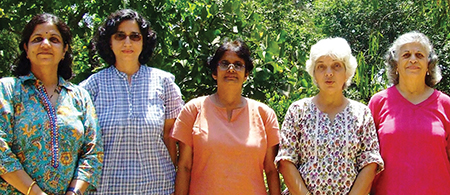
From left: Dr Sheila Tanna, Hutokshi Rustomfram, Shubhada Nikharge, Katie Bagli, Hutoxi Arethna
The Japanese Garden within Rani Bagh
Fountain in memory of Ardeshir Dadysett
Welcome arch completed in 1868
The activist explains that the five women, all amateur botanists and nature lovers, are members of the Bombay Natural History Society. They undertook signature petitions, awareness campaigns, RTI (Right To Information) litigations, interactions with the BMC, appeals to the Bombay High Court and the central government’s environment ministry. The women, who according to a report in The Free Press Journal (FPJ) dated March 30, 2017, have "jointly contributed to take care of shared expenses,” pored over tomes of gazetteers, and "volumes of historical data” to establish their case. At one point, the BMC denied the existence of a botanical garden in the city, according to Arethna, quoted in the FPJ report.
After nearly five years of campaigning, the heritage conservation committee of the BMC and the Central Zoo Authority "rejected the redevelopment plan in 2011 and sought a fresh plan which did not encroach upon the green space of the Gardens,” according to Rustomfram. The freshly submitted plan was again rejected in 2014, she informs us, but due to a change in the constitution of the BMC heritage committee, it was given an in-principle approval. Meetings with municipal commissioner Ajoy Mehta, and deputy commissioner Sudhir Naik in 2016 followed. The trustees of SRBBGF are now "happy that most of our suggestions are accepted and significant changes effected in the master plan,” notes an update report to their well-wishers: Some animal enclosures were scrapped and some had their designs altered to protect the greenery; viewing areas have been modified; sprucing up of the Gardens has been undertaken, with plants more suitable to Bombay’s climatic conditions; needless excavation and replacement of top soil has been halted; name boards are being affixed on each tree… Rustomfram and Nikharge have edited and published on behalf of SRBBGF Rani Bagh 150 years, a 160-page book with 200 images of the Gardens. "A large number of photographs were taken by Shubhada herself,” informs Rustomfram.
The quintet is now consulted by the BMC for the setting up of a nature education center and butterfly garden, among other projects. Publication of guidebooks to the Gardens is on the cards, and the Foundation is lobbying for a herbarium, which has been "tentatively agreed to.” Originally branded as CAVE (Citizens Against Virtually Anything) by critics, "people realized we were not going to get scared by name-calling,” Nikharge told FPJ.
The Gardens were opened in 1861, originally as a botanical garden to which a zoo was added in 1890, with the most recent addition being a group of penguins imported from Korea a few months ago. The Foundation’s website thoughtfully lists out an inventory of the trees there, albeit dated, besides beautiful images of the greenery in the park. The Gardens were laid out in the classical Renaissance axial planning design prevalent in many European cities, according to their website. "The pathways are wide and radiate in all directions, allowing the huge numbers of visitors enough space to wander about and enjoy the green space,” the site continues. George Birdwood, the first curator of the Victoria and Albert (now Bhau Daji Lad) Museum described Victoria Gardens as a "garden of delight.” The Foundation aspires to keep the space a green haven.