The festival of spring is celebrated by all without any racial,
gender or nationalistic discrimination
Davood N. Rahni
The buds of yellow, violet, red and white crocus flowers with their saffron stamens, along with blossoming daffodils, hyacinths, tulips, carnations and Persian violets, herald the arrival of Navroz in Iran and its neighboring regions. This is the Persian new year, signaling rebirth, rejuvenation and reconciliation which arrives at the vernal equinox. Spring in Iran, central Asia and the Caucasus region is the harbinger of jubilation at the earth’s fertility driven by the sun’s energy. Pristine streams begin to trickle down snowcapped mountains, while the greening of the pastures makes the landscape come alive with flowering fruit trees, flourishing herbs and the seedlings of germinating staple crops.
Many historians surmise that Navroz celebrations must have commenced in south-west Asia (Iran) at least since the disappearance of the last glaciers which was followed by the inception of agriculture and domestication of animals about 12,000 years ago. Navroz has been revered not only on the Iranian Plateau stretching between the Caspian Sea and the Persian Gulf, and Indus to Tigris rivers, but also in Mesopotamia, the Caucasus, and central and west Asia. Iranians have been celebrating Navroz since millennia. Mention was first made in the mythological story of King Jamshid of the Kyanian Dynasty, credited as the first celebrant, in the poem Paradiso in Ferdowsi Toosi’s Shahnameh, the book of kings.
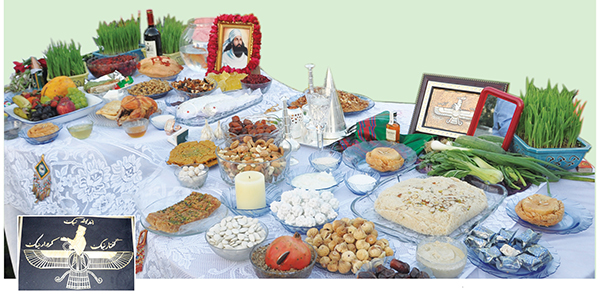
The Persian new year is a beacon of hope and reconciliation, forgiveness and love, and yearnings for liberty, dignity, fraternity, equality, tranquility, harmony, justice and peace. Navroz is a national holiday transcending class, color, creed, ethnicity, race, religion or national origin, currently commemorated by well over a dozen countries of nearly five hundred million inhabitants in central, south and west Asia, northwestern China, Asia Minor and the Caucasus.
Navroz, also known as Norouz, Norooz, Nowruz, NowRooz, etc (variations in dialectic and vernacular pronunciations) in Persian, literally translates as the first day (of the new year). It is the primary seasonal celebration of the solar calendar that has existed since prehistoric times. It was conceived by agricultural people just north of the Tropic of Cancer who have revered the sun (Sol Invictus), fire, light and enlightenment ever since. Purim, which precedes Navroz, is the Jewish celebration of blessed bounties in the Torah that also began in Iran when Queen Esther married the Persian King Ahasuerus. This contrasts with lunar calendars as followed by Iran’s southern and western neighbors who used the lunar skies to navigate while traversing the hot, arid deserts at night.
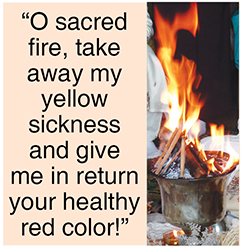
In fact, the common people and serfs in Europe and later the Pilgrims landing on Plymouth Rock in North America, in today’s Massachusetts, also observed a new year at the advent of spring until the mid-18th century. The Gregorian calendar acknowledges the spring jubilee as well. The month of March coincides with the first month of the Julian calendar at a time when Europe was still under the influence of Persian Mithraism throughout the 5th century CE. According to the Zoroastrian Mazdayasni calendar, Navroz is at 3758, calculated from the vernal equinox in 1737 when Zarathushtra supposedly proclaimed his divine message to humanity. It commences with the festival of Chaharshanbeh Suri on the night of the last Tuesday of the exiting year. At this Zoroastrian fire ritual, everyone jumps over fire, singing a Middle Persian poem that translates as: "O sacred fire, take away my yellow sickness and give me in return your healthy red color!”
The most symbolic manifestation of Navroz is the sofreh haft-seen. On a table covered with an antique hand-woven termeh silk cloth are laid the seven plant derived items whose Persian names begin with the letter ‘S’: sabzeh (germinating wheat and lentils, symbolizing rebirth); senjed (the dried oleaster fruit, closely related to olives, symbolizing love); seer (garlic, symbolizing medicine); seeb (apples, symbolizing beauty and earth); somaqh (sumac berries, symbolizing sunrise); samanu (cooked germinated wheat for affluence); and serkeh (vinegar, symbolizing ripeness, longevity and perseverance). A round, ticking classical clock, signifying the passage of time; a fishbowl with two gold fish (a later addition, due to influences from China) signifying companionship and life; decorated eggs for fertility which found their way into Easter symbolism; and a saucer of coins from the five continents to reflect prosperity are also on display. A few aromatic daffodils, tulips and hyacinth symbolizing Iran’s colors (green, white and red), flickering candelabra, and the ancient book of poems, the Shahnameh, Rumi’s Mathnawi, Divan Hafez, or Omar Khayyam’s Quatrains from which the poem The Persian Nightingale Bemoans is well known in the west, are also placed on the table.
The exact moment of Navroz has been heralded by playing the sorna and dohol, a duet drum and wind instrument, since at least five millennia back. The
https://en.wikipedia.org/wiki/Rudakimusic conjured up past melodies by Nakisa and Barbad of the 5th century and the blind poet musician Rudaki of the 9th century.
American presidents annually extend good wishes to a few hundred million celebrating Navroz; in recent decades some have even hosted honored guests in an all-day Navroz extravaganza at the White House that concludes with Persian music and dance with exquisite Persian food. The UN (United Nations) has declared the International Day of Navroz, and celebrates it at its New York City and Geneva headquarters with a large festival and Persian foods and pastries. The UN General Assembly declared the spring equinox as International Forest Day.
Navroz was celebrated by the 30,000 Iranians residing abroad way back in 1979. Today, over six million Iranians in the diaspora showcase the festival to international communities. There are numerous Navroz events in every major city worldwide, some of which attract well over 1,000 guests. The nostalgic music and dance from every corner of Iran and south/west Asia including Armenian, Jewish, Tajiki, Afghani and of course American along with Persian foods and pastries are a must at every Navroz gathering!
Davood Rahni, professor of chemistry at Pace University, New York, is passionate about reading, learning, sharing and writing across many genres of literature and history, the arts and cultures, archeology and languages. He has been extensively published in the sciences, environment, forensics and medicine.