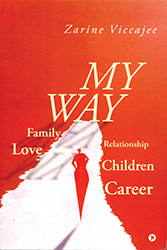
My Way by Zarine Viccajee. Published in 2020 by Notion Press, No. 8, 3rd Cross Street, CIT Colony, Mylapore, Madras 600004; website: notionpress.com. Pp: 161. Price: Rs 190.
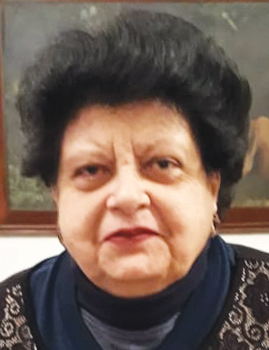
Zarine Viccajee’s (pictured) book, My Way, gives us an interesting insight into the life of a woman who belongs to an old Parsi family of Lucknow. The author has been a lecturer in English for 22 years, and head of the department of English both at Loreto College, Lucknow, as well as at Avadh Girls Degree College, where she also holds the position of president of the College and managing committee. She has played an active role in her family business, and takes a keen interest in the welfare of the community.
The book, in Viccajee’s own words, is not an autobiography, but a series of vignettes, a technique that enables her to be fluid with time and memories. The book starts with an account of her maternal and paternal forefathers, and how they came to settle in Lucknow; the accompanying photographs give the reader the feeling of being drawn into the familial narrative.
Viccajee’s father’s family had its roots in Hyderabad, where her grandfather, Seth Viccaji Meherji, the Mansabdar of Viccarabad, was closely associated with the Nizam of Hyderabad. The Nizam gave them land and villages, in return for which they maintained an army on his behalf. The Mansabdar and his brother Pestonji Meherji built and consecrated an agiary in Secunderabad; they were also known for their philanthropy which cut across all castes and communities. In a very short time, they attained a great deal of success in their threefold role as traders, bankers and farmers. Their farming activities were spread over Maharashtra; at the height of their prosperity, they had offices in the Bombay Presidency, Hyderabad-Deccan, Calcutta, Singapore and China.
In 1845 the Government of Hyderabad started defaulting in repayment of loans and ordered the brothers to relinquish and restore all the taluks (tracts of land) assigned to them in the past. As a result, there was bloodshed with casualties on both sides when the brothers liquidated all their properties to repay their creditors, and retired to a private life in Tarapore. A symbol of the family’s earlier prestige is seen in the Peshtonshahi Sicca, the only coin ever minted by a Parsi family in India. The author informs us that over 10 million such coins in silver and copper were struck from the Aurangabad Mint from 1832 to 1842. Today only a few coins remain with the descendants, and four of them are on display in the British Museum, London.
Viccajee’s maternal family has an equally interesting ancestry. Her great-great-grandfather, Nowrojee, came from Damka, thus giving the family the name Damkawala. He traded in silks and pearls with the Nawabs of Oudh, fell in love with Lucknow and decided to settle there. He was the first Parsi to settle in Lucknow; later he invited his lawyer and doctor friends to come and settle there, and thus started a small Parsi community in this city of aristocrats. With the passage of time, the family business changed to the manufacture of carriages, which were bought by the Lucknow gentry. Viccajee includes several amusing incidents concerning the carriage business, one of which involves a corpulent Nawab who insisted on getting into a carriage far too small for him and then couldn’t get out; as a result, the door of the carriage had to be dismantled to free the gentleman from his uncomfortable restriction!
Viccajee’s parents met when her father came from Lahore to Delhi for work. They married soon after and returned to Lahore; but then partition happened, and they decided to go back to Lucknow, where they settled. The vignettes in the book touch upon varied aspects of the author’s life: academics, teaching career, travels, interests, family. Indeed, it is her family that has her wholehearted love, support and loyalty: whether it’s her handsome, generous father, or her mother who turned blind at a relatively young age, or her siblings Ruudi or Manek, Zarine is completely involved in their lives as well as in the lives of their children. She writes about her parents who always supported each other as well as their children, the fun-filled, carefree family holidays in Mussoorie, the extended, loving family of aunts and uncles, the dances and other social events in Lucknow. Her strong sense of family is summed up in her own words: "According to me the two things that really matter in life are the joy that you get from, and the joy that you give to, those you love. The unbelievable pain that you experience when you lose someone whom you love so much, as we did our parents, is unbearable.”
Zarine is equally passionate about her teaching career. She describes incidents that deal with errant students and those who have become friends over the years. She instilled into them a love for Shakespeare, Shaw and the Romantics. In fact, she is a person full of life, and is even of surprises: she has acted in two films, including Mira Nair’s Monsoon Wedding. She is also endearingly honest about her own frailties, impatience and quick temper, which earned her the moniker of phuljhari (a type of Diwali firecracker) in the family!
For all her joie de vivre, her gregarious nature and her love of socializing, dining and dancing, Zarine is rather circumspect about her personal life. She writes about going for dances, about her various friends drawn from all walks of life, but only touches briefly upon her personal tragedy of losing the man she loved in an accident; as she says, she remains "happily unmarried” to this day. Again, she is reticent about the name and identity of a close friend who was killed in a shoot-out in Lucknow. It would have been interesting to have more details particularly about the latter, as that would have also thrown light on the present political climate of Lucknow. But given the repercussions of any disclosures these days, perhaps the author is deliberately being discreet about the details of such incidents.
This book is also interesting for the attitude of Zarine towards interfaith marriages and rituals; she and her family are more tolerant (and perhaps more realistic) about girls marrying out of the community, than are the many orthodox in the community in Bombay. Ruudi married a North Indian Hindu; her family accepted this with grace and goodwill. Again, since there are no Towers of Silence in Lucknow, burial is an accepted — and preferred — form of disposal of the dead. Indeed, this reviewer has always felt that there is an attitudinal difference between Parsis who live out of Bombay, and those who have been born and brought up in the metropolis.
My Way — the title is reminiscent of the old, popular Frank Sinatra song — makes for easy, interesting reading about the life of a Parsi woman who has lived life on her own terms in a city known for its culture and tameez (good manners). It also sheds light on small Parsi communities in far-flung regions of India that blend and mingle with other communities with grace and good humor. This memoir is sure to appeal not only to readers within the Parsi community, but also to those who enjoy glimpses into the way of life and culture of old and historic cities of India. SHIREEN VAKIL
Vakil has taught English literature and language for 36 years at the Elphinstone and Sophia Colleges. She has done a PhD on the poetry of Seamus Heaney.