"Iran has not been conquered by anyone,”
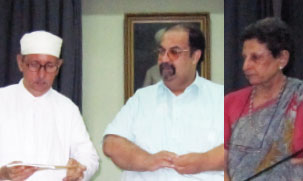
said Ervad (Dr) Rooyintan Peer, at the K. R. Cama Institute (KRCOI) on July 16, 2012 while releasing the book Iranian Kingship, the Arab Conquest and Zoroastrian Apocalypse: The History of Fars and Beyond in Late Antiquity (600-900 CE) by Touraj Daryaee, Professor in the History of Iran and the Persianate World and the Associate Director of the Dr Samuel M. Jordan Center for Persian Studies and Culture at the University of California, Irvine.
Daryaee had received a grant to carry out research in the field of Oriental literature as part of the Government Research Fellowship Lectures 2010-2011, for the book. He is the editor of the Name-ye Iran-e Bastan: The International Journal of Ancient Iranian Studies and the creator of a website Sasanika: The Late Antique Near East Project.
In his welcome speech, Muncherji Cama, president of KRCOI which published the book, informed the audience that a series of these lectures had been given in the past by eminent persons such as Dr Sir J. J. Modi, in 1980 who was a PhD in Avesta and Pahlavi. Modi, a trustee of the KRCOI, presented papers on the Gathas.
Peer’s lecture was in two parts — a detailed historic background of the three centuries and the effect of this period on Zoroastrianism and Zoroastrians.
Daryaee’s extensive research of this period through numismatic (coins) study was not touched upon. Peer elucidated on how 600 Christian or Common Era (CE) was the end of the Sassanid Empire and its influence thereafter for two centuries. He recounted
the golden period under Khusro Parwez (Khusro II) and Nosherwan è Adil which was culturally rich as they were patrons of the arts and science. He informed the audience that by 641 the Zoroastrian Empire was lost but fell in 651 CE. He attributed its fall to political
compulsions of the time during the reign of Hormizd. Wahram Cobin (or Behram Zubin as he is also known) was a militarily strategist but because he was hounded out, turmoil blazed in his wake. Ultimately Hormizd was defeated by Cobin, we learn. Khusro III came to the throne and had a glorious reign but at the end Khusro fled to Rome though his power center was Shiraz. Peer then talked of the reign of various other monarchs — Khusro Perwiz, his son Kobad, Yezdigar Sheriyar, etc.
The priest highlighted the trials of Iranian Zoroastrians which he granted were much worse than for those who had left Iran. In quoting the innumerable battles and intrigues, Peer claimed "Iran has exercised a strange fascination for all countries.” He also dwelt on the absolute devastation in Iran and talked about how Zoroastrians survived several centuries later.
Peer ended quoting A. G. Brown on Persia and the defeat of the Iranians by the Arabs — "take away from what is generally called Arabian science from exegesis theology, philosophy, history, biography or even grammar, the work contributed by Persians, the best is gone.” Peer specified that the Iranians had the scholarship, and it was the Zoroastrians who kept the state machinery intact. MEHROO KOTVAL