The WZO Trust Funds’ Bai Maneckbai
P. B. Jeejeebhoy Senior Citizens Centre
in Navsari marks its silver jubilee
Moved by the plight of Zoroastrians, sometimes three generations living together in "cramped” quarters, the late philanthropist Scylla Vatcha mooted decades ago the creation of a senior citizens center in a discussion with Bachi and Dinshaw Tamboly, chairman of the World Zoroastrian Organisation (WZO) Trusts. The facility would "cater to individuals who were mobile and capable of looking after themselves,” recalled Dinshaw in an article he wrote to mark the 25th anniversary of the Bai Maneckbai P. B. Jeejeebhoy Senior Citizens Centre in Navsari.
"The idea appealed to us and we set about scouting for suitable property in Bombay. However, locations being difficult to find and also land prices being astronomical, we suggested she consider establishing a center in Navsari, where we had our base, in addition to Bombay,” recalled Dinshaw.
"She immediately agreed,” wrote Dinshaw, while stipulating that the center should be situated in a predominantly Parsi precinct, near an agiary and with easy access to a market. A place was located at Pinjar Street in Navsari’s Malesar neighborhood. A new trust was established, WZO Trust Funds "having multiple objectives” including a sanatorium as well as providing interest free loans to those starting their own businesses. Plans for constructing a ground plus four storey building comprising 20,000 sq ft for the Centre were drawn up and construction began in 1996. "Within the space of 21 months our Centre was ready for occupation” on January 6, 1998, stated Dinshaw. The entire cost was borne by Vatcha’s Bai Maneckbai P. B. Jeejeebhoy Deed of Settlement Fund.
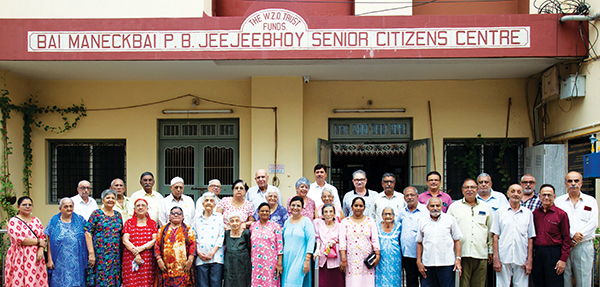
Trustees, staff and residents of Senior Citizens Centre Photo: Sarosh Daruwalla
Foreseeing that some residents could become bedridden Vatcha on her only visit to Navsari suggested a tie-up with the Abuwalla Parsi Infirmary run by the Navsari Samast Anjuman. As the Infirmary’s capacity was limited, Vatcha immediately approved funds for constructing an additional facility at the rear.
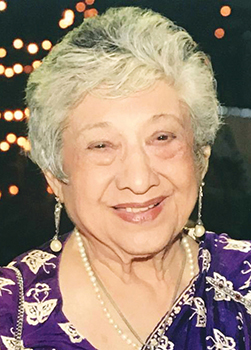
"Scylla will always be remembered as a doyenne of philanthropy,” stated Dinshaw. Through the Jeejeebhoy trust she "elevated the lifestyles of thousands of our community members.”
Dinshaw credits his wife Bachi for making the Centre "a home away from home… where all residents, whether paying or residing gratis, enjoy the same facilities, their self-respect and dignity remaining intact at all times.” He singled out for appreciation staff members Sharmin Tamboly, Homi Mistry, Sarosh Guzder and Sam Dharmpuriwala, the dedicated five ladies and four helpers who run the kitchen, and "the 16 ladies who clean the rooms and keep the Centre spanking clean at all times.”
The trustees of the WZO Trust Funds are the two Tambolys, Farrokh Kasad, Aspi Ambapardiwala, Cyrus Vandriwala, Farzana Mojgani and Homiyar Madan.
Among the past staff Dinshaw commended two chefs, Khorshed Variava and Bapsy Daruwala who were with the Centre "from the beginning for 23 years till such time they were afflicted by Covid-19 and passed away” as well as their erstwhile manager, Soli Vandrewalla "who too was with us for 23 years but retired due to indifferent health.”
Most importantly the Centre is "very grateful to the multitude of donors,” especially to the Zoroastrian Charity Funds of Hong Kong, Canton and Macao, Dinshaw stated. The Sir Ratan Tata Trust had donated three crore rupees to the WZO Trust corpus. The building in-between the two Centres was donated to the WZO Trust Funds by an elderly single lady who lived there but opted to move to the Centre.
Noshir Dadrawala, who is the program director for the Centre for Advancement of Philanthropy and a former trustee of the Bombay Parsi Punchayet, was present at the 1998 inaugural and also attended its first anniversary. He stated in an article for Parsiana ("An extended family,” July-August 1999): "The modern spacious center is a fine example of how community resources, if pooled together with a sense of purpose and commitment, can make a positive change in the lives of those for whom the wealth has been left in trust...
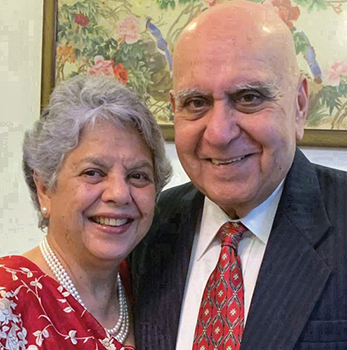
Top: Scylla Vatcha; above: Bachi and Dinshaw Tamboly
Top row: inauguration in 1998; the Centre; 2nd row, from l: Noshir Dadrawala, Rohinton Chinoy,
Rusi Dhondy, Dadi Engineer, Bachi Tamboly, Shahpur Captain, Dinshaw Tamboly; jashan
Above: At inauguration of Vandrewala Centre (from l), Dastur Meherji Meherjirana,
wife Mehrbai, Bachi Tamboly, Rena and Behram Baxter, Dinshaw Tamboly
Above r: Abuwalla Parsi Infirmary in Navsari; above l: annex of Infirmary
Below: structure between two Centres, donated to WZO
"Situated in the heart of a classical Parsi mohalla (Pinjar Mohalla), the Senior Citizens Centre provides a serene environment free of the hurry-scurry of life… Each floor has seven ample rooms — four single, two double and one quadruple. All rooms are modern in terms of facilities, well ventilated and with attached bath and toilets…
"The moment we entered the foyer our hearts warmed to the sight of a couple of aged Parsis playing carom, a few watching cricket on television, one or two reading newspapers and others engrossed in animated conversation. A few had just returned from their daily visit to the Atash Behram in Motafalia…
"So far the Centre has taken in only the poor and needy. Now, in keeping with requests and the needs of those who are well placed, the management is admitting those who are in a position to pay” part of the cost towards their stay. "We know quite a few cases where there is no financial poverty but lots of emotional poverty — persons feeling insecure, lonely and deprived in the evening of their lives. These are also‘deserving’cases in a different context. It is a very welcome development that those who can afford to pay can now enjoy the hospitality of this excellent institution.”
In February 2003 when Behram Baxter of California inquired if there was place at the Centre for his ageing mother, he was informed there was a waiting list of applicants. "Why wait?” he queried, "build a new center.” "If you finance it, we’ll do it!” was Bachi’s repartee (see "A second home,” Parsiana, January 21, 2006).
The brash San Diego based millionaire agreed. By December 15, 2005 Baxter and his American wife Rena were in the South Gujarat town to inaugurate the three-storey, 15 room center named after his parents, the Dolat and Hormusji Vandrewala Senior Citizens Centre two buildings away from the first center (the two are interconnected at the rear, the first center being L-shaped).
Rena "loves Navsari and loves India.” She finds the Parsis in Navsari "more humble, more genuine.” She refers to one of the residents, Dhun Patel who loaned her a scarf for the 8 a.m. inaugural jashan presided over by Navsari High Priest Meherji Kekobad MeherjiRana. "When I went to return the scarf she said it was for me to keep… When you have nothing, this is literally like giving the shirt off your back.”
The Rs 75 lakh project (Rs 60 lakhs for the land and construction and Rs 15 lakhs towards the maintenance fund) took 18 months to complete, once the land was acquired.
"All our projects are within a time frame of 18 months,” stated Dinshaw, in a letter to Parsiana ("WZO Centre for Seniors,” Parsiana, February 21, 2008). "Thus all the houses constructed from donations raised by the WZO to house lower and middle income Parsis in Navsari are also completed in the same time span.” Their architect is Jayant Mehta and contractor Yazdi Kasad.
"Our forte is bringing people together,” stated the letter. "One of the conditions for residing at the center is that everyone has their meals together in the dining room. The kitchen staff dishes out Parsi delicacies to suit all palates. A daily menu is prepared and residents may write their comments on the dishes selected. The variety includes spicy, non-spicy, vegetarian (fish only), pure vegetarian (no eggs) and diabetic diets…
"Here we feel absolutely at home living like one big family,” a retired medical representative and his wife were quoted by Dinshaw in his 2008 letter. "A single lady who has lived at the home since 1998 adds: ‘I am so well looked after over here, I never feel lonely.’ Another resident, a single male, who in his heyday was a professional musician and sports enthusiast feels, ‘Here I am very happy and comfortable. I go for walks, watch television and pray. What else would you expect a man of my age to do?’ An energetic 82-year-old who zipped around Navsari on his own moped, visiting friends and doing odd jobs as an electrician exclaims, ‘Most people go to heaven after they die. We are lucky to be in heaven here during our lifetime!’”
With inputs from Farrokh Jijina
"A power house"
Persis Vatcha, Scylla’s daughter-in-law recalls that the senior lady was "a power house.” She would be up by 7 a.m. and working in their home office, looking through applications for support, she narrated. Speaking of the trust she now manages, Persis stated, "We give whatever we can. If anyone writes to me it is my duty to examine the case, instead of just stating ‘Reject’… This legacy will continue.”
Top: Scylla; Above, from l: donor’s family Dadabhoy, Dhunbai,
Maneckbai, Jeejeebhoy, Serenebai
Maneckbai Pirojshaw Bomanjee Jeejeebhoy was a cousin of Scylla’s husband Rustom, stated Persis. Born in 1860 to Sir Dinshaw and Lady Sakarbai Petit, Persis said Maneckbai lived well into the 1930s. Her husband Pirojshaw (1856-1913) was the grandson of Jeejeebhoy Dadabhoy, the famous sethia. Maneckbai and Pirojshaw had "at least six children,” Sakarbai, Jeejeebhoy, Dhunbai, Shirinbai, Dadabhoy and Gulestan.
The deed of settlement under which the senior center was established is "over a 100 years old. But the trust came into its own after sale of certain properties in downtown Bombay,” Persis said.