Attendees at the Global Working Group meet learn
of programs that mark Zoroastrian presence in the interfaith arena
Text: Parinaz M. Gandhi Photos: Jasmine D. Driver
Let us achieve harmony through smart leadership… We should put aside our personal differences for the future well-being of the community… We are all equal. No single region should dominate due to its size or monetary strength,” asserted Neville Shroff, non executive chair of the Global Working Group (GWG) and president of the Zoroastrian Charity Funds of Hongkong, Canton and Macao when addressing the GWG meeting hosted by the Bombay Parsi Punchayet (BPP) trustees at the Banaji Atash Behram Annexe Hall on January 7, 2020. Viewing GWG as "a connectivity portal on social welfare and economic issues,” Shroff stressed, "Our sole objective is to create prosperity for the community.” As he further reminded the representatives, "Change is inevitable under controlled regulations.”
In his opening remarks BPP chairman Yazdi Desai referred to Al Jazeera being his favorite TV channel to get world news but distressed by the sight of hunger and starvation in regions of Africa and Syria he remarked that he was sanguine "this kind of a situation won’t happen in our community. You know why? We have good fellas like Neville Shroff wanting to help Parsi Zoroastrians.”
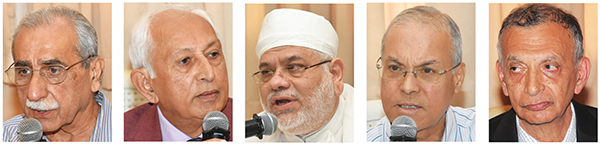
From far l: Rohinton Rivetna, Homi Gandhi, Dastur Khurshed Dastoor, Dorab Mistry, Dr Behram Pastakia
Clockwise from above l: Yazdi Desai, Neville Shroff, Dinshaw Tamboly, Katayun Kapadia, Bomi Patel,
Edul Daver, Kersi Randeria, Xerxes Dastur, Firoz Pestonji, Meher Bhesania
Having obtained finances from a well-wisher in Hong Kong for the GWG to support mobeds and their widows, Shroff assured that the help will continue for one more year. Under this scheme implemented by Dinshaw Tamboly, chairman of The WZO (World Zoroastrian Organisation) Trust Funds, aid of Rs 6,500 is extended to each of the 114 senior priests aged over 60 years, and Rs 4,500 each to 31 widows of mobeds. Tamboly advocated that similar aid be also extended to 151 full-time mobeds under 60 whose income is less than Rs 50,000. "I hope we won’t come to a stage when there will be more agiaries than mobeds,” he expressed his fears. Shroff felt attention should also be paid to projects like a resource center for the elderly. Such a self-contained home for the seniors would be ideal for those who are not dependent on institutional care.
"Looking around this table, there is a clear need for younger leaders to take over. Leaders are not born but cultivated… Empower the youth to greater heights. Engage them in the needs of our community,” stated Shroff. He appreciated the efforts of Katayun Kapadia, former president of the Federation of Zoroastrian Associations of North America (FEZANA), who has volunteered to serve as the coordinator for the GWG.
"Almost 50% of our community lives outside India. It behooves us to work as one community without borders,” noted Rohinton Rivetna, founder president of FEZANA, while alluding to Jamsetji Tata’s monogram of a hand holding a bunch of barsom twigs.
Regarding the functioning of the GWG, Firoz Pestonji, chair of the 11th World Zoroastrian Congress in Perth, opined that meetings may offer fantastic opportunities "for bonhomie but keeping in mind the time and money spent, we can keep in touch digitally within minutes. We need to play a positive role” with plans for the youth, senior citizens, mobeds that can be adopted at the regional and global level.
Since BPP trustee Xerxes Dastur was listed among observers and not as a representative of the BPP in the minutes of the last GWG meeting in Orlando, Dastur felt the minutes should be rectified. Knowing that Desai would object to this, co-trustee Kersi Randeria suggested the BPP team meet during the lunch break to resolve this contentious issue without interrupting the GWG proceedings. In the absence of a volunteer to serve on the GWG publication committee Meher Bhesania of Dubai urged Randeria who publishes the Parsi Times weekly to take charge stating, "It is a very sensitive area. We need a level-headed person.”
Zoroastrian ethos
For FEZANA to enjoy its consultative status on the United Nations (UN), the community needs to actively pursue goals as outlined by the intergovernmental organization. No poverty, zero hunger, greater equality, clean water and sanitation, sustainable cities are some of the goals spelt out by the UN requiring community members to engage in these fields, stated Dr Behram Pastakia who co-chairs the UN NGO committee of FEZANA. Tamboly mentioned that he is serving on the UN Commission for Eradication of Global Poverty, addressing poverty in Mesopotamia and Albania. To promote Zoroastrian culture and arts in the West, Pastakia urged associations to establish an endowment for this purpose. Referring to Yasmin Ghadially’s efforts to set up an exhibition on atash kadehs of ancient Iran, he felt an exhibition on gahanbars celebrated around the year would also be educative.
On the interfaith front, FEZANA president Homi Gandhi serves on the world council of Religions for Peace while Dastur Khurshed Dastoor of Udvada has been appointed one of the 31 honorary presidents. This association is committed to leading efforts to advance effective multi-religious cooperation for peace at the global, regional, national and local levels. At the Parliament of the World Religions in Toronto in 2018, Zoroastrianism was "one of the best represented religions,” believed Gandhi.
Erstwhile president of the Zoroastrian Trust Funds of Europe (ZTFE) Dorab Mistry who is the Zoroastrian representative on the European Council of Religious Leaders referred to Zoroastrians now being invited to participate in the Remembrance Day Service at the iconic London Cenotaph in November and the Commonwealth Day service at the Westminster Abbey in March "thanks to Lord Karan Bilimoria’s incessant efforts.” Shroff is vice chair of the Royal Commonwealth Society of Hong Kong. The chair of this Society enjoys a rank on par with a minister, noted Mistry. As chair of the Inter-Religious Organisation in Singapore, Rusi Ghadiali would "bless roads on the eve of the Singapore Grand Prix so that there would be no accidents,” Mistry who is currently based in Singapore informed the gathering.
The Iranshah Udvada Utsav (IUU) that saw participation from nearly 1,500 Parsis, including 250-300 youth, at the three-day celebrations in end December 2019 "is not only a Parsi event. It is open for all communities,” stated Dastoor. Alluding to the negativity expressed on social media, he added, "We need to keep our minds open. If we don’t keep hatred and jealousy in our hearts we can do better things. When people (IUU critics) say they ‘can’t see anything right,’ I would like to say ‘life is difficult for the blind!’”
Grateful to Dr Cyrus Poonawalla and Gujarat Tourism for sponsoring IUU "to showcase Parsi culture” he expressed his appreciation for the GWG supported Iranshah Initiative with individuals like Meher Amalsad of California, Bhesania, Malcolm Deboo of UK, Tinaz Karbhari of New Zealand and BPP trustee Noshir Dadrawala helping to bring in funds.
The Zoroastrian Information Centre in Udvada was refurbished with the support of Firoza Punthakey Mistree and Jamshid Bhiwandiwala, mentioned Dastoor. Bhesania’s handbook My Golden Book on Zoroastrianism that was launched at the Utsav was distributed to the GWG members too. Offering to supply more copies to those interested, she stressed, "When you distribute, please don’t charge.”
WZCC is keen to expand its work by opening more chapters. "We are counting on Pestonji to open a new chapter in Perth,” stated WZCC global president Edul Daver. Last August WZCC participated in the United Nations Civil Society Conference, he reported.
The Dar-e-Mehr on a hilly terrain that was jointly used by the Zoroastrian Association of Northern California and the Persian Zoroastrian Organization has "unfortunately been classified as non-operational” as emergency services cannot reach the site, reported former FEZANA president Bomi Patel. In Silicon Valley, two acres of land would cost between five to seven million dollars. While they have managed to raise $ 2.2 million they hope other associations will assist them in their fund-raising drive.
To be continued.