The need for a pragmatic approach to religion was a recurring theme at the second Iranshah Udvada Utsav
Farrokh Jijina
"Ay deekra, turn right (or left),” read the helpful signage directing visitors to the Gymkhana Grounds in the village where the main events for the second edition of the three-day Iranshah Udvada Utsav (IUU) took place between December 23 and 25, 2017. "Follow the threads,” stated some posters, referring to the red, blue, yellow, green and violet streamers that lined the routes to the Grounds. Yet others announced the theme, "Threads of continuity.” Selfie points, decorations replicating the theme of threads, kites and interesting signage and wall graffiti lined the paths to the venue, as did an electronic kiosk humorously labeled (and illustrated with a) "Speaking Aunty” who gave a humorous overview of the three days with helpful directions. A 20-picture gallery of Parsi portraits by photographer Shantanu Das lined the walk opposite the Zoroastrian Information Centre (ZIC). As Udvada High Priest and Parsi Zoroastrian member on the National Commission for Minorities (NCM) Dastur Khurshed Dastoor put it, IUU is about "faith, fun and food.”
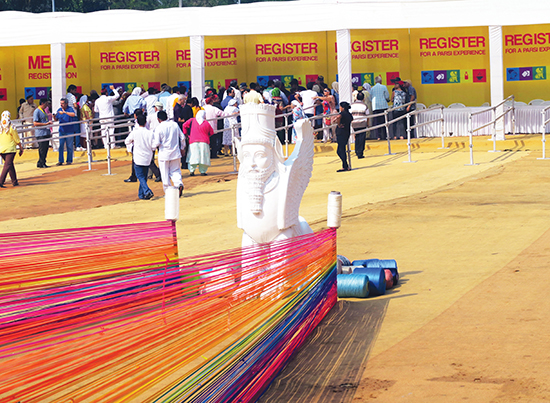
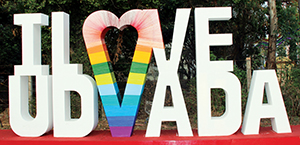
Delegates waiting to register, with decorations replicating the theme "Threads of continuity"
Photo: Farrokh Jijina
Clockwise from top: Dignitaries lighting the lamp to inaugurate the three-day Utsav; Dastur Khurshed Dastoor,
Vice President M. Venkaiah Naidu, Dr Farokh Udwadia, Havovi Dastoor
Clockwise from top: Mukhtar Abbas Naqvi, Vijay Rupani,
Homai Engineer, Dinshaw Tamboly
At 10 a.m. on December 23, last minute touches were being given to the newly installed two pillared "gate” at the entrance to Udvada village that the chief guest, union minister for textiles, and information and broadcasting Smriti Irani was to inaugurate on the second day of the festival. Bricks were being carted away and lights were being laid out on the surrounding ground. In the village, things were as laidback as they are on a normal workday. A few worshippers around the Iranshah Atash Behram chatted up the vendors of leeli choi (lemon grass). An elderly woman dressed to go to the fire temple in a Parsi-style sari haggled with a fishmonger at her doorstep.
At noon, crowds were milling at the IUU registration counters, several of which were unmanned. When an enthusiastic volunteer organized the crowds into queues by registration number, the backlog was cleared in 30 minutes. The audience was accomodated into two large pandals at the venue, while four large screens assured easy viewing of the happenings on stage. The motif of "threads” in the theme was replicated in the designs and colors in the stage décor.
The three-day festival has its origins in a 2011 visit by then chief minister of Gujarat Narendra Modi who requested Dastoor to consider an event that would bring the community together while showcasing the uniqueness of Udvada. The Utsav, organized jointly by the Foundation for Development of Udvada (FDU) with the support of the department of tourism of the Gujarat government, and the Udvada Samast Anjuman was sponsored by the Shapoorji Pallonji Group, business houses Tata, Godrej, Rustomjee and Rolta, The Zoroastrian Cooperative Bank Limited, HDFC Bank and ICICI Bank. Around 2,000 delegates and invitees registered. "Forty percent from Bombay, 30% from Gujarat, 20% from the rest of India and 10% international,” core committee member Hoshaang Gotla informed Parsiana. The participation was less than the 2,500 who registered for the first Utsav in 2015 in the south Gujarat town that houses the holiest of holy fires.
Physician Dr Farokh Udwadia and industrialist and philanthropist Pallonji Mistry were slotted as guests of honor. Mistry, however, could not attend due to ill health.
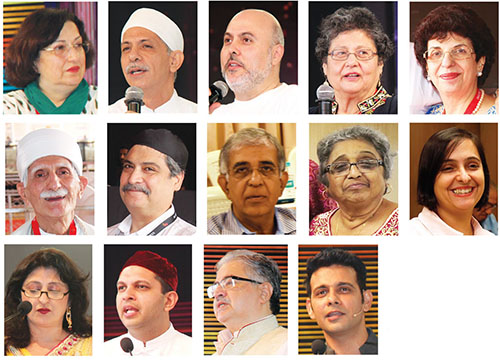
From left, top row: Dr Shernaz Cama, Ervad (Dr) Ramiyar Karanjia, Malcolm Deboo, Katayun Kapadia,
Zarine Commissariat; 2nd row: Mobed Mehraban Firouzgary, Noshir Dadrawala, Kersi Randeria, Dr Katy Gandevia,
Pearl Mistry; 3rd row: Mahrukh Chichgar, Hoshaang Gotla, Mahiyar Dastoor, Viraf Patel
Clockwise from above: Selfie point, wall graffiti, Parsi portraits lining routes to the venue
Saying nay
The event was not without its detractors. Several weeks earlier, social media was buzzing with posts on how the three days of festivities would defile the sanctity of Iranshah. Bombay Parsi Punchayet (BPP) chairman Yazdi Desai told the Hindustan Times (HT) of December 23 that he was "boycotting the event.” His wife Anahita told the newspaper that "we believe in maintaining spiritual purity at Udvada and with 2,000 people attending the festival it is not feasible to do that.” Activist Hanoz Mistry was quoted in the HT report as saying that he had written to Prime Minister Modi to not support the event, and requested the chief guest Vice President M. Venkaiah Naidu to stay away. Desai’s boycott perhaps led to several West Zone B (Gujarat) anjumans of The Federation of the Parsi Zoroastrian Anjumans of India (FPZAI) staying away. They owe their allegiance to the traditional World Alliance of Parsi Irani Zarthoshtis (WAPIZ) chaired by Desai. Some Udvada residents were not enthusiastic about the event. One shopkeeper told Parsiana: "Too much kharcha (expense).”
But BPP trustees Noshir Dadrawala and Kersi Randeria were present on the last day of IUU to show "solidarity” with the event, as Dadrawala told Parsiana.
Off the block
A 14-mobed jashan in the Atash Behram at 4 p.m. led by Ervad Zarir Dastoor kicked off the program. Later, at the Utsav venue, trilingual (English, Gujarati and Hindi) host for the evening, Maharukh Chichgar, often flowery in her introductions of the guests, welcomed on the dais union minister of minority affairs Mukhtar Abbas Naqvi, chief minister of Gujarat Vijay Rupani, Khurshed Dastoor, member of Parliament for Valsad Dr K. C. Patel, Valsad collector H. K. Kharsana, FDU trustee Dinshaw Tamboly and Jain member on the NCM Sunil Singhi. In his welcome, Khurshed reminded the audience of what Prime Minister Narendra Modi told him: "If the Parsis had not come (landed in Gujarat), the Gujaratis would not have learnt to laugh.”
Naqvi recalled that Parsis had worked with honor ("aan, baan, shaan”) for the country. Khurshed narrated the minister had earlier facilitated the granting of visas for "those who have not come to India for long.” Naqvi committed that "we will work with the Gujarat government for the progress of the Parsis.”
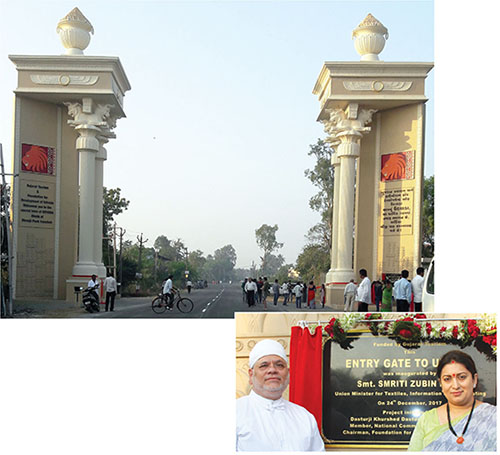
Dastoor and Smriti Irani at the inauguration of Udvada Gate
(From left): awardees Diana Marfatia, Hushrav Sadri, Delnaz Jokhi, Vispi Kharadi
For Rupani, the day was auspicious as he was confirmed as chief minister for a second term on the previous day. "Hu Iranshah na ashirwad prapt karru chhu (I am getting the blessings of Iranshah),” he claimed. Recalling Parsi greats and the milk-in-sugar fable, he said, "darék mithas nu karan Parsi samaj chhè (Parsis are responsible for all sweetness).” The chief minister hailed the Parsis as an important element of Jai jai garvi Gujarat (Hail, proud Gujarat) (a song by poet Narmad, extolling the virtues of the land) and called for the emergence of a new force ("navi shakti nu sarjan”). Earlier, while introducing Rupani, Khurshed recalled that the politician was instrumental in releasing land in Ahmedabad for the relocation of the 132-year-old Seth Navroji and Jehangirji Pestonji Vakil Daremeher from the crowded locality of Khamasa to the newly developed Sabarmati riverfront.
Welcoming Irani on the second day of the Utsav, the High Priest said, "Let the legacy of our forefathers remain,” asking the audience "Have we got the will to survive?... To survive, we have to be innovative…We have to change and adapt.” In December 2015, Khurshed had, after the first Utsav, told The Times of India, "We can’t hide from the fact that intermarriage is taking place. Why should we shy away from the problem?”
"I am a proud mother of two Zoroastrian children,” said Irani who is married to Zubin, an agriculturist from Dahanu. "When my son was being prepared for his navjote, someone asked me who will teach him Ashem Vohu, Yatha Ahu Vairyo and other prayers… I said, ‘hu pèhla vaachis né ènné shikhvadis (I will first read them and then teach him),’” noted the minister.
Irani, who is known to enjoy a close working relationship with Khurshed, revealed that the High Priest calls her by her first name while "talking daily,” but addresses her by her official designation when speaking in public. "Smriti tu vachma béssi jaa (you sit in the center)” the High Priest had told her when they got to the dais. Finally, Udwadia took the center seat, as Irani wanted to let "the man of science be between a man of God (Khurshed) and a politician (herself).
"Dastoorji has given me a long list of to-do items for Udvada: Wi-Fi for all homes, closed circuit television (CCTV) camera for all streets…” she said. The village will soon get its first primary health center, the minister confirmed. Referring to the Adarsh Gram Yojana (Model Village Scheme) (see "Udvada going cashless,” Events and Personalities, Parsiana, December 21, 2016) under which the minister is championing Udvada’s development with an eight crore rupees (USD 1,247,758) grant, Irani quipped that though she may have officially adopted the village, but in reality, "Udvada has adopted me.”
"Do the right thing; because it is the right thing to do the right thing, according to the religion,” she told the audience. She wanted the attendees to use social media to blog about the beauty of the Zoroastrian legacy. En route to the Gymkhana Grounds, Irani had inaugurated the Udvada Gate, a permanent structure consisting of two pillars on either side of the road, at the entrance to the village in the presence of a select group of invitees.
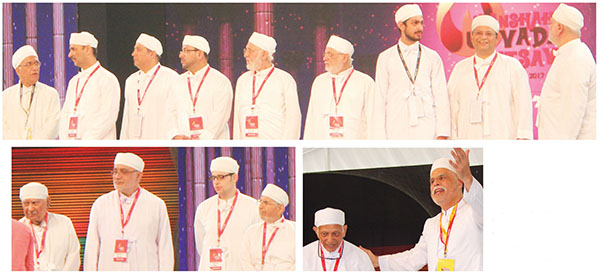
Top and above left: members of the nine Athornan families who tend to the Iranshah fire;
right: Ervads Soli Dastur (l) and Tehmton Mirza
Homi Gandhi (l) and Arzan Wadia
Dastoor with Mahrookh and Darayus Mirza
Fossilize or survive
The need for change in certain community customs was voiced strongly on the second day by Udwadia. The physician, who specializes in pulmonary and respiratory medicine, said he had some concerns about the future of the community: the dwindling and aging population, with increasing pockets of poverty. "I am seeing a lot of loneliness in the elderly coupled with age related and other illnesses to which the community is prone,” he said. Appealing to the philanthropic minded to "do something more,” he added that the mobeds need a lot of support too. "We are passing through a phase of mediocrity, a state of torpor…We are not going forward… We are in fact sometimes going backwards.” Concerned about the lack of entrepreneurial spirit, he said, "We must have a school to hone entrepreneurial skills…Can we not set up, as a community, a corpus for this?”
The doctor pointed out the Parsi trait for "being quarrelsome” as the reason for the lack of progress. "We are not united,” he lamented. Citing the demographic truths of four deaths to one birth annually and 37% intermarriages, the physician said, "We need to consider the situation a demographic emergency… we have to anticipate disaster and face it.”
"Why should children of intermarried Parsi women not be welcomed into the fold? Wouldn’t it be just to be inclusive towards them too?” he asked rhetorically. Emphasizing that there is nothing in the religion that states that this cannot be done, the amateur historian (see "The Achemenids’ success and failure,” Parsiana, December 21, 2016) said that "the Achemenids belonged to numerous races, yet were all Zoroastrians.”
"Think of answers yourselves,” Udwadia exhorted the audience, posing these questions: "Does any individual or association have the moral or legal or ethical right to bar anyone from the right to practice a faith he or she wants?… Would you not want to change some of your customs or rituals, which are not given by Zoroaster but which are manmade, to survive?”
In a grim warning, Udwadia said that "if you do not wish to change, you have made a death wish… I value the Zoroastrian faith more than anything… It will be a sad, sad thing, if this legacy is allowed to die… I pray to Zoroaster to send us enlightened men and women… Till then, I pray the community flourishes.”
On the last day, the doctor repeated his exhortation: "Remember you have a great heritage… Do not have this blind faith that Ahura Mazda will take care of us… You have to separate race from religion… Fight for each other, not with each other.” The doctor made a plea for an apex body that should get all Zoroastrians worldwide on a common platform. "The larger bodies should get together and form such an organization,” he suggested. On gender equality, he opined that "justice and righteousness demand that there be equality (between the sexes). If you fossilize yourself, you are making a death wish,” he concluded.
In the 2015 edition of the Utsav, when former advocate general and senior counsel Darius Khambata spoke on segregating race and religion, he was applauded by many but also booed and heckled by some (see "Come here and stay,” Parsiana, January 7, 2016). This time around, only applause greeted Udwadia’s talk.
On the last day of the event, Naidu was greeted by Khurshed with "The micro community of the world is welcoming you.” The Vice President had walked to the Gymkhana Grounds from near the Iranshah, stopping at the ZIC en route. After a short prayer by Khurshed, and felicitations, Naidu said he was happy to be meeting representatives of "one of the oldest cultures in the world.” He admitted that he got to know about Parsis rather late in life, the first being eminent jurist Nani Palkhivala, whose budget speeches he attended. Impressed by Palkhivala and other jurists (senior advocate Fali Nariman and former attorney general Soli Sorabjee), doctors (gynecologist Dr Rusi Soonawala) and industrialists (Ratan Tata) he had come in contact with, the Vice President admitted "Udvada would remain in my memory throughout my life.”
Taking off from Udwadia’s reiterations about change, the Vice President told the gathering "One must discuss (contentious issues) and move forward,” adding that "even after so many years, Zoroaster’s message is relevant.” Earlier, the multilingual Chichgar, compere for the session, had welcomed Naidu with a few words in Telugu, his mother tongue.
Award time
Television actor Viraf Patel, who hosted the Utsav awards presentation, called himself "a shallow, frivolous man.” The awards were presented by Irani to educationist Diana Marfatia, student achievers Hushrav Sadri and Farzan Bharucha (see "Tops in academia,” Events and Personalities, Parsiana, June 21, 2017), statistics professor Delnaz Jokhi (see "Jokhi’s study,” Events and Personalities, Parsiana, September 21, 2017) and Guinness Book record holder for martial arts Vispi Kharadi (see "Stroke of a sword,” Sports, Parsiana, August 21, 2017). The awards were sponsored by Farhad and Houtoxi Contractor in memory of Farhad’s father Dr Minocher on the occasion of his 100th birth anniversary.
Jiyo Parsi II
A film to promote the Jiyo Parsi program premiered at the Utsav. The film aims to "explain the core of the (Zoroastrian) faith to the country and the world,” Parzor director Dr Shernaz Cama told Parsiana. Directed by Divya Cowasji, who has previously made Qissa e Parsi (see "National award for Qissa,” Events and Personalities, Parsiana, June 7, 2015), Cowasji was chosen for the project by the ministry of minority affairs, which is funding the Jiyo Parsi program, Cama informed us. The importance of choice between good and evil; the relevance of ecology in the religion; the sanctity of the marriage blessing were some of the strands running through the documentary, which takes the form of a conversation between a grandfather played by actor Boman Irani and his grandson played by Rustom Tirandaz. The film closes with the duo reciting the Yatha Ahu Vairyo prayer with a translation as the backdrop. "Boman acted in the film pro bono,” Cama told Parsiana.
Reimbursement for assisted reproductive technologies will now be available for up to eight lakh rupees, up from the current five lakh rupees, and will cover delivery expenses too, stated Dr Katy Gandevia and counselor Pearl Mistry while presenting the highlights of the Jiyo Parsi program (129 babies in three years). Income limits to avail of benefits have been enhanced to Rs 25 lakhs annually (where 50% of expenses will be reimbursed) from the current Rs 20 lakhs. Income slabs have been rationalized, Mistry said.
In an effort to be holistic, the project will now reimburse child care and crèche facilities for children up to age eight up to Rs 4,000 per month per child. "To help create intergenerational support systems, a capable senior citizen who cares for community children” will be reimbursed up to Rs 3,000 per month per child up to age 10. In its maiden effort to support senior citizens, the scheme will provide support of Rs 4,000 per month per (deserving) person after the age of 70.
To hunt or to discuss?
On the morning of the second day there was thin attendance at a panel discussion on "How to make our religion relevant to modern times.” As Gotla told Parsiana, about 200 of the participants were out on a treasure hunt. After seating all those present into the VIP enclosure, there was very thin attendance in the main halls.
The compere for that morning was community activist and trustee of Mancherji Edalji Joshi Memorial Trust (MEJMT) Mahiyar Dastoor. Zarine Commissariat, who moderated the discussion kick started with: "The word ‘religion’ has its roots in the Latin word ‘religare’ which means to bind strongly.” Defining religion as a set of ethics, philosophies and practices that are ever relevant down the ages, Ervad (Dr) Ramiyar Karanjia said that the core of Zoroastrianism is as relevant today as it was when established. "We have been masters at adapting since Sasanian times…the diaspora in the USA and UK is adapting too… but we should never give up the core concepts…our survival and sustenance depends on it,” he said. "When as part of his prayers a Zoroastrian recites Nemascha ya Armaitish izhacha he is anyway showing tolerance and devotion, a love that combines ecology and religion,” the principal of the Dadar Athornan Institute said.
According to panelist and former president of the Federation of Zoroastrian Associations of North America (FEZANA) Katayun Kapadia, youth is "at the front and center” of all the activities of North American Zoroastrians. "Put your youth in the forefront… they are our future,” she said, outlining the core philosophies of FEZANA’s members (integrity, discipline, honesty, credibility and charity, "and above all tolerance”). President of the Zoroastrian Trust Funds of Europe (ZTFE) Malcolm Deboo gave an update on what Zoroastrians there were doing to keep themselves relevant (social and religious events, and interfaith meetings). "We do not shy away from taking external help,” he admitted. For panelist Cama, the directions in the faith to "nurture the environment, plants and animals” are what make it relevant today. "Perhaps the clergy should put out a document with answers to frequently asked questions (FAQ),” she enjoined.
Delegate attendance increased in the course of the day, but the two main halls were nowhere near full in the course of the day. Head of Tehran Mobedan Council Mobed Mehraban Firouzgary told the audience that while performing a Zoroastrian wedding in Iran the priest "explains the meaning of the words to the couple… explains the concepts of Vohu Mano (good mind)… reiterates the injunction to the couple to carry out all religious ceremonies for the dead (in their respective families) and to be kind to animals and plants. The ceremony includes a suggestion that "remember, knowledge is diverse and success is achieved better through consultation.” The 83-year-old industrial and electrical engineer told Parsiana that he was "delighted to be in Udvada …I have seen it develop over the decades.”
Ervad Sohrab (Soli) Dastur of Florida, USA presented his thoughts on the evolution of the afarganiyu (vessel atop which the sacred fire is placed) and the bell used in Zoroastrian ceremonies. With a slide deck, Dastur demonstrated the evolution of the afarganiyu, as came to be used in India, from a flat stone (aadosht) that was used in ancient Iran as the base for a holy fire. According to Dastur, the bells that are rung in a fire temple mimic the mortar and pestle used in a Yasna ceremony.
"We do not need Jiyo Parsi; we do (practice) Jiyo Parsi,” Ervad Tehmton Mirza of the North American Mobeds Council (NAMC) proclaimed loudly, adding that the Zoroastrians there "are 25,000 and growing.” The high energy presentation, almost like a morale-booster corporate presentation, made jointly with Dastur gave a glimpse of how their Mobed Council is structured: "There are no paid mobeds…it is a calling for all of us…we (NAMC) are an independent elected body… some (unspecified) ceremonies are tailored to suit the North American context…We have trained 10 mobeds and two mobedyars last year in Seattle and Washington DC by video conferencing.” In 2015, NAMC published a guideline for ashodads (gifts) for priests for various ceremonies.
FEZANA president Homi Gandhi and Khurshed said they want to "make Udvada a show place for the world,” while announcing a scheme of "inspiration and education for future generations and for funding of the conservation of heritage.” No details were announced in the audio presentation from California resident Meher Amalsad who has worked out the program with BPP trustee Dadrawala and Khurshed during the High Priest’s visit to Chicago in May 2017 (see "Global guardians,” pg 30). As Gandhi said, "We are here to promote Iranshah, now and forever.” The proposal has the go-ahead from various Zoroastrian bodies around the world, which was mentioned in Amalsad’s presentation.
"Accepting spouses of other faiths as their own” was one of the messages in the six-minute movie on the activities of FEZANA presented by Gandhi and vice president Arzan Wadia. The film referred to their member associations in Canada and USA, 25 working committees, a brief history of their origins and their activities in the social, cultural and religious matters. Details are available on https://fezana.org.
A short presentation by Congress chair Firoz Pestonji on the forthcoming 11th World Zoroastrian Congress in Perth, Australia in June 2018 gave an overview of the proposed program.
Priestly hamazori
On the first day of the Utsav, a film directed by social worker Mithoo Jesia and Karanjia on the arrival of Zoroastrians to India up to the establishment of Iranshah was released. The documentary celebrated the nine priestly families who constitute the Athornan Anjuman that serves the Iranshah holy fire. Eleven representatives of the families were felicitated by Khurshed, Gotla and FDU trustee Homai Engineer.
A three-minute film on the late Udvada High Priest Peshotan Mirza (see "Mirza’s modesty,” Parsiana, July 21, 2016) celebrated his achievements. Khurshed felicitated Mirza’s wife Mahrookh and their children Aban and Darayus. The first day also saw the release of a commemorative souvenir and the December 23 edition of the Parsi Times that included a detailed program for the three-day festival.
Meals on all three days of the Utsav were catered by A One Caterers of Surat. Those who had attended the 2015 Utsav were all praise for the arrangements in 2017. "No dhasara (rush) like last time,” said an elderly woman resident of Udvada. The near flawless stage management by Viraf Sarkari’s company Wizcraft came in for kudos by most attendees. Logistic support — directing delegates to the meal venues, selling of souvenirs — was provided by various Zoroastrian scouts and guides groups.
As Khurshed said in one of the many introductions and felicitations, "We will be back in 2019.”
Parsiana will feature the other components of the Utsav, mainly the entertainment, in a subsequent issue.