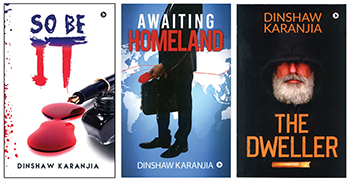
So Be It (2017; Pp: 72; Price: Rs 100); Awaiting Homeland (2018; Pp: 81; Price: Rs. 150); The Dweller (2019; Pp: 91; Price: Rs 200) by Dinshaw Karanjia. Published by Notion Press, Old No. 38, New No. 6, McNichols Road, Chetpet, Madras 600031.
His job in a multinational firm has not deterred accountancy postgraduate Dinshaw Karanjia (pictured) from publishing a novella every year for the past three years.
The protagonist of his first novella, So Be It, Siddhartha Kaul, is a lecturer (or is he a professor, we are never sure as Karanjia

uses both the terms to describe his position) at Model College and teaches the Foundation Course. He is apparently an excellent professor much admired and loved by his students in spite of the fact that he teaches what is jocularly termed as a "faltu (useless) course” as it is not an important subject on which their careers depend. Karanjia establishes in the first paragraph that he is a conscientious teacher as he is assessing papers till 11:30 p.m. when his doorbell rings and he is disturbed by Bhanu, the security guard of his society.
Karanjia slips into a flashback where we learn about his colleagues and especially his relationship with Bhanu and other deprived persons — "from domestic helpers, to garage mechanics, to chaiwalas, to paperboys”— to whom he teaches English. (The rear cover of his novellas mentions that Karanjia worked with street children during his years of formal education.) When we return to the present, we learn that Bhanu has been called to the police station in connection with a theft. The idealistic Kaul has great faith in the police force and convinces the watchman that he has only been called in for questioning. But Bhanu never makes it out of custody and the rest of the novella is concerned with the search for justice. When that process meets with a dead end, there is a desire to set the record straight through vendetta.
The novella is tightly plotted and is a fast read. The story is a bit predictable and more care could have been paid to character development and style.
Awaiting Homeland is more complex in the sense that Karanjia weaves four different stories — those of two young couples, one Malay the other Chinese, and two people seeking a "homeland.”
Sia and Sam, of Malay origin who have lived in America a long time, at the insistence of Sia want to return to Kuala Lumpur for the birth of their child. The couple faces immense problems as they become separated, the husband working in Singapore while the wife successfully manages a transfer to Malaysia. As work pressures increase, Sam finds it more difficult to commute to Kuala Lumpur to see his child and Sia faces personal tragedy and bereavement.
Linda is a German woman living in Madras and integrates very well with the family accommodating her. While on a holiday to Pondicherry, a tsunami hits the country, causing much devastation. They travel to Cuddalore, the native village of Linda’s host; Linda, is extremely sympathetic to the survivors of the calamity and stays back to help them.
The Chinese couple, Mandy and James, transfer from China to Paris as they are very keen on having a second child and object to the country’s policy of one family one child. Though their trip is successful, it is not without heartbreak and sadness.
Finally, there is Kishen Gopal, an Indian visiting Pakistan. Karanjia draws a very sympathetic portrait of most of the Pakistanis Kishen encounters; however, he does run into trouble when he wants to return with some earth which a friend asks him to bring back.
Karanjia handles these four stories simultaneously. There is no indication that he is moving from one narrative to another and hence it can be quite confusing for the reader. The trajectory of the people is sensitively portrayed as not all of them meet with the desired result. One couple has to return to their home country. The experiences of the various characters are cleverly linked. The curd which Kishen eats with his paratha in Lahore, is paralleled with the curd which Linda habitually has in Madras. However, the tale of this novella could have been the subject of a full-length novel. The brevity of the novella is a constraint in handling such a vast canvas of characters with the result that there is little scope for character development.
The last novella, The Dweller, is disappointing. Karanjia mentions on the rear cover that his main character, Prabhat Narayan Rai, "can read minds and influence them…it is his way of life.” It is true that he reads people carefully and then induces them to carry out his desires as he does with Dev, a domestic servant who, though fit and healthy, "lagged only in mental capabilities.” Though Rai trains Dev to do his will and carry out murders when required, Karanjia fails to convince us that this is some exceptional characteristic of his protagonist. Most devious characters would be in a position to manipulate others with a result Rai is more of a type than the special individual Karanjia probably makes him out to be.
In the first incident, Rai informs a Govindan that he has been recruited to murder him by Sahih, his landlord. He is aware that Govindan has a bad temper and will take revenge on his assailant; but this does not seem to be an extraordinary reading of Govindan’s mind. The entire novel reads like a bad Bollywood film — once again we are told that Karanjia has a passion for films and moderates a film group on Facebook.
Further, the novel could have done with better proof reading: on page 8, the word "found” has been used instead of "fond;” on page 12, ”alike” instead of "like;” on page 26, "sight” for "site;” on page 68, taken care "off” instead of "of;” page 69, "see” instead of "seem.” The word "back” has been used three times in the space of three lines. The novel is a disappointment, compared to a very encouraging start. I have no doubt that his next novella will be better.
FIRDAUS GANDAVIA
Gandavia holds a doctorate in English literature and is a retired chartered accountant. He is a compulsive reader of fiction.