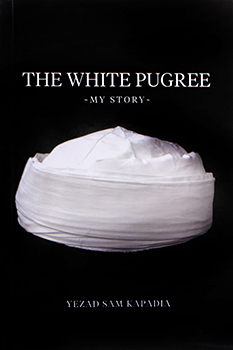
The White Pugree. My Story by Yezad Sam Kapadia. Published in 2021 by Spenta Multi Media, L. P. Todi Mills, Lower Parel, 400013; website: www.spentamultimedia.com; email: eg@spentamultimedia.com. Pp: 104. Price: Rs 350.
Pugree means turban, and the privilege of wearing a white pugree in the Parsi community is accorded only to those who have undergone the initiation ceremony for priests or mobeds. It is not enough to be born into a priestly family; before one earns the right to don the white pugree, there is work to be done, time to be served, prayers and rituals to be learnt.
There is a narrow window of opportunity within which a boy is required to undergo the navar ceremony. He must be pre-pubertal but have had his navjote performed. He must be old enough to be capable of understanding the significance of the ancient rituals he will learn to perform and to cope with separation from his family and home which he is not allowed to visit while he is in training.

Thus it was for Yezad Kapadia (pictured). His mother had told him that with the privilege of status comes responsibility. "Never do anything to bring dishonor or disrespect to the white pugree.” And Kapadia has kept this promise, made almost eight decades ago, using the Gathas, which form the core of Zoroastrian liturgy, as his moral compass, the rule book for his life. What comes across strongly is how he integrates the strong faith that underpins his life in the context of the modern world. He is an independent thinker, sensitive to the complexity of religious concepts and norms but rejects dogma and challenges orthodoxy.
However, this is not a religious book. It is a delightful account of boyhood, student life, first in India followed by four years in Germany, the ups and downs of working life as a metallurgist with Tata Steel, questioning the quality of the coke in the blast furnaces. Institutions can be very conservative, rather like traditional clubs, and do not always like new ideas or different ways of doing things, even when it is the right thing. That’s for sure. In return for pointing out the obvious, that the poor quality of the coke in the blast furnace was responsible for poor performance and also for resisting attempts to lower the sulphur content in the iron before it reached the melting shop in order to improve quality, Kapadia was reported to the general manager, operations.
At first ignored, then belittled and eventually sidelined and humiliated, the author describes reaching his lowest ebb. "Where was the place for a poor metallurgist like me?” In his darkest hour, he seeks alternative employment, taking his wife Rati and their two little girls with him. This vignette is a tribute to Rati’s devotion to her husband and the reader will realize the debt of gratitude that Yezad owes his dear departed spouse. Few women would be willing to uproot themselves and their children at a moment’s notice and board a train without reserved seats. Yet, Rati does this unquestioningly. Even when Yezad’s search for new pastures and a fresh start fails, not once does she say, "I told you so” or "You should have waited before leaving.” Not a word of reproach or recrimination. The depth of love, trust and mutual support between Yezad and Rati comes across throughout the narrative.
For readers of all ages, the strong message is that to be happy is not to have a sky without a storm, a road without accidents, work without frustration and relationships without disappointments. In the narrative of his life, Yezad is not afraid to describe and reflect on his setbacks and failures. A born leader, head boy of his school and then student of the year in Germany, each time the decision has been made "more nearly unanimously than ever before.” Yezad commanded the respect and affection of those who worked under him. He eventually got his long overdue promotion in Tata Steel and was then head hunted to Lurgi India as managing director. On the day of his departure from Jamshedpur, an acquaintance he bumped into said that the town was sad at his leaving.
Each time I read the book there is a different enjoyment, a lesson of life that I absorb. It takes the reader from the 1930s colonial India, to post World War II Germany, the industrial age of the 1960s and ’70s, bringing them into the world of today. They will find that to be happy one does not need to have a perfect life.
Birdi is a UK based practicing obstetrician and gynecologist, medical educator, teacher and author.