Radical thinking and innovative approach characterize
the World Zarathushti Chamber of Commerce winners
Parinaz Gandhi
"A frog leaps because he is afraid of predators. We should be pole vaulting…” stressed chief guest Dr Ramesh Mashelkar, offering insights on innovation to inspire entrepreneurs attending the gala awards night organized by the India region of the World Zarathushti Chamber of Commerce (WZCC) at Rhythm Resort in Lonavla on January 4, 2020. In his address on "Creating Next Gen Pole Vaulting Entrepreneurship” the scientist impressed on his audience: "Pole vaulting innovation is characterized by revolution, not just renovation; it is new to the world, not just to the company or country; it shows unprecedented cost/performance features; and it offers entirely new products/services.”
Author of the book Leap Frogging to Pole-Vaulting, Mashelkar who is also known by the name Raghunath, elaborated on the salient concepts in his compendium. "Innovation has to be disruptive; it cannot be exponential... Pole-vaulting should create the magic of radical yet sustainable transformation. Pole-vaulting innovation leaders are driven by talent, technology and trust. They see what everyone sees but they think of what no one else thinks. They seek more from less.” They refuse to accept "it cannot be done.”
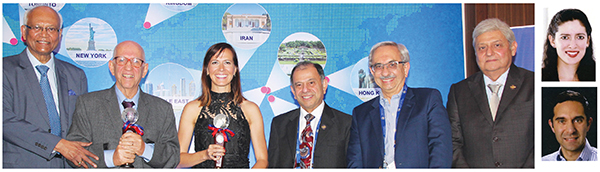
From l: Dr Ramesh Mashelkar, Farrokh Cooper, Mira Mehta, Edul Daver, Nadir Godrej, Capt Percy Master;
Pervin Taleyarkhan (above) and Dr Cyrus Hirjibehedin
Former director general of the Council of Scientific and Industrial Research that oversees a network of 38 laboratories, Mashelkar led the process of transformation and his efforts led to the creation of India’s Traditional Knowledge Digital Library, stated special advisor on WZCC’s Business Advisory Committee Phiroze Kharas in his introduction. A chemical engineer by training, Mashelkar has been on the board of several companies like Reliance Industries Limited, Tata Motors Limited, Hindustan Unilever Limited, Thermax Limited, Piramal Enterprises Limited. Whilst he earned his PhD from the Bombay University in 1969, in the next 50 years he has been conferred the honorary doctorate by 42 universities from around the world and elected a Fellow to 15 prestigious international academies including the American Academy of Arts and Science.
The audience was particularly impressed when they learnt that financial grants he received from the Tata Trusts helped him to rise up the ladder of success. Coming from an impoverished background, his mother’s resolve to educate him at great personal sacrifice convinced him that "E=F” where E stands for education and F for future, stated the scientist who never tires of formulae. To prove how education paves the way for success, as part of his PowerPoint presentation he showed visuals of himself and Ratan Tata, erstwhile chairman of Tata Sons, both receiving the Padma Bhushan honor in the same year, 2000.
Common speed breakers that reduce kinetic energy required for pole-vaulting are: complacency, cynicism, risk aversion, vested interests, bureaucracy, restrictive regulations, he elaborated. To succeed, an innovation framework should be ASSURED: Affordable, Scalable, Sustainable, Universal, Rapid, Excellent, Distinctive, he summed up.
Pole-vaulting business models that he cited were the world’s largest taxi company that owns no taxis (Uber); world’s largest accommodation provider that owns no real estate (airbnb); world’s largest movie house that has no cinemas (Netflix); world’s most valuable retailer that has no inventory (Alibaba); world’s largest phone companies that own no telephone infra (Skype, WeChat). Novel mottos that have served as an inspiration are "Think Different (by Apple);” "Music for everyone (by Spotify);” "Belong anywhere (by airbnb);” "Beyond the obvious (by Tata Consultancy Service);” "Growth is life (by Reliance).”
Urging the audience to introduce innovation with compassion and passion, he named Bill Gates, the most successful dropout of Harvard, "doing well by doing good.” Mashelkar has instituted the Anjani Mashelkar Inclusive Innovation Awards in the name of his mother believing that it is important to make high technology work for the poor. "The I in every Indian individual should stand for innovation, not inhibition or imitation,” he concluded.
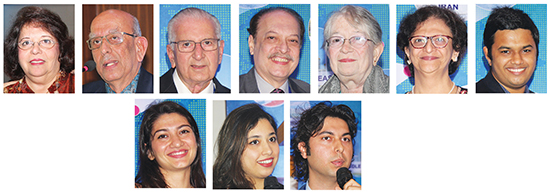
Clockwise from above l: Behroze Daruwalla, Adi Siganporia, Phiroze Kharas, Aspi Antia,
Zarine Khan, Aban Mistry, Urvax Chawda, Jehaan Kotwal, Pearl Mistry, Rashna Sanjana Aga
"Make us proud”
At a time when "many traditional institutions are failing due to government barriers,” WZCC global president Edul Daver urged prospective entrepreneurs to "be the first, be different, be the best.” The global centric WZCC that is "value driven, has a clear, shared vision,” he added.
The Zarathushti community functions "with the right wisdom, intelligence and ability to improve and impact the lives of others around them,” commended master of ceremonies Behroze Daruwalla who heads the global Women Entrepreneurs wing of WZCC. The "secular outlook of our Chamber has resulted in WZCC having a long and unbroken tradition of harmony,” she acknowledged.
Since its inception in 2000 WZCC has instituted global awards to recognize and acknowledge the excellent work done by community members. "Year after year, we come across Zarathushtis who make us proud to be alive in this day and age,” added Daruwalla, explaining the selection process where the international board of directors appoints judges from across the world and sends them details on the nominees. Usually the judges do not know the names of their fellow panelists. Awardees are rated on their proven success in their profession or business, global presence, participation in WZCC activities, commitment to their cause, involvement in various trade and commerce organizations. The judges intimate their choice to the WZCC head office in Bombay where the points are compiled and the winners declared.
For their commendable work in 2019, the winners announced were: Farrokh Cooper as the Outstanding Zarathushti Entrepreneur of the Year; Dr Cyrus Hirjibehedin, Outstanding Zarathushti Professional; Pervin Taleyarkhan, Outstanding Young Zarathushti Entrepreneur/Professional; Mira Mehta, Outstanding Zarathushti Social Entrepreneur. Daruwalla then proceeded to introduce each of the award winners.
The chairman and managing director of Cooper Corporation, Cooper’s family-owned business based in Satara has 11 manufacturing sites developing a wide range of automotive parts from engines and generators to crankshafts, pistons and flywheels. He believes Cooper Corporation has been successful due to its core values of integrity, fidelity, sincerity and transparency.
As he openly acknowledges, "Whatever I am today, half is what I inherited, and half is what I made. But what I inherited was an enormous amount of goodwill, because my grandfather Dhanjishah made diesel engines back in 1922. He was in politics and was the first chief minister of the former Bombay Presidency.”
Seventy-five year-old Cooper ventured into the unknown with common sense, a level head and a disciplined approach to see light at the end of the tunnel. His privately owned firm manufactures greenfield engines that meet the latest emission norms. These are exported worldwide for a variety of applications in the automotive, agriculture, construction, marine, defence and power generating sectors. Since he designed engines for automotive applications, he decided to make a tractor and takes pride that his is probably the only Parsi company in the world doing so. He believes in ploughing back profits for the business to grow. His total workforce is around 3,000.
Catering to international customers, he is required to travel extensively but the air passage is always by economy class. Rather than lead an opulent lifestyle, his idea of success is not only to make money but to spread happiness by contributing to the society in which we live. Thus Cooper Corporation plays a lead role in uplifting the lives of the poor in Satara.
Bombay born Cooper mentioned in his acceptance speech that there are five Parsis remaining in Satara. "I live in the heartland of the Marathas. We get the highest respect. No political party disturbs us.” He firmly believes that "life is to be enjoyed.” Just as Lord Karan Bilimoria makes the Parsi presence felt in the House of Lords, Cooper hoped the smoke of a jashan will permeate the White House with manashni, gavashni and kunashni with the efforts of Zoroastians in the US.
Hirjibehedin is a member of the technical staff in the Quantum Information and Integrated Nanosystems Group at MIT Lincoln Laboratory. According to Wikipedia, this Laboratory is a US Department of Defense federally funded research and development center chartered to apply advanced technology to problems of national security. His mission is essentially to act as a bridge between academia and industry, taking scientific discoveries made in university laboratories and turning them into prototypes for technology that can be used effectively. His high impact research has seen his findings published in leading academic journals and his presenting papers at 59 international conferences and seminars.
His work has earned recognition from the Royal Microscopical Society, Stanford University from where he graduated in physics and computer science, IBM Almaden Research Center and the Federation of Zoroastrian Associations of North America. A Charles Townes Fellow and Jerry Selvaggi Scholar from Columbia University from where he completed his PhD in physics, he has over 20 years of teaching experience, being a professor of physics, chemistry and nanotechnology at University College London. He has also been a visiting associate and scholar at Harvard University, Northeastern University and Japan Advanced Institute of Science and Technology.
Unable to receive his award in person, in a video recording Hirjibehedin referred to his "passion for science and research,” acknowledged the love and guidance of his family and community members who had befriended him in New York, London and Boston, and remarked that it is "an exciting time to be a scientist.”
Taleyarkhan, a legal counsel at Whirlpool Corporation, is the only female patent attorney in the company with over 92,000 employees globally. She works closely with their global engineering team to develop, execute and enforce Whirlpool’s intellectual property (IP) strategy and is responsible for educating Whirlpool colleagues on IP that includes patents, copyrights, trademarks and trade secrets. She manages IP litigation worldwide and engages in agreement negotiations across the world.
Active with the American Bar Association (ABA), she is chair of the ABA IP Law Section’s In-house/Corporate IP Attorney Committee, is editor-in-chief of The Young Lawyer, the flagship publication of the ABA Young Lawyers Division, and is on the editorial board for the ABA Journal and Landslide. A graduate in chemical engineering from Purdue University followed by a law degree from the Indiana University Robert H. McKinney School of Law, for four years she had worked as IP attorney at the Purdue Research Foundation’s Office of Technology Commercialization.
As a director of the Society of Scholars on Zoroastrianism she is actively involved in coordinating community activities and mentoring high school students. She is also the chair of the Professional Development Committee of the Society of Women Engineers.
Taleyarkhan who could not attend the function mentioned in a video message that her father Prof Russi Taleyarkhan had received the WZCC Outstanding Professional award some years prior. Acknowledging the love and encouragement from her family and community she valued WZCC’s three basic principles: approach every situation with an empathetic heart; focus on mentorship; promote networking within the community to make vital connections.
After completing her masters in business administration from the Harvard Business School in 2014, Mehta started Tomato Jos (TJ), a for-profit social enterprise to manufacture high quality tomato paste for the West African market. She observed the paradox that Nigeria is the largest producer of tomatoes in West Africa (the country is responsible for 65% of the tomatoes produced in the region), yet is the largest importer of tomato paste in the world. This prompted her to launch TJ, using global best practices for farming and food processing while sourcing tomatoes from smallholder farmers in northern Nigeria.
Starting with 20 tomato farmers in the 2015-16 season, over the years the company has worked with over 700 farmers. TJ has striven to make agriculture more accessible to women and youth by working with policymakers to remove the cultural barriers that undermine the potential of marginalized groups. These groups now constitute over 40% of the farmer population in her program. Mehta’s efforts have been recognized by Harvard Business School as a resilient and successful social enterprise and her case study is now taught to every student in the full-time MBA program.
Prior to initiating this venture she had gained work experience for two years at the investment management firm BlackRock where she was an analyst on a marketing and business development team and then worked for four years with the Clinton Health Access Initiative in Nigeria where she was required to coordinate with the Federal Ministry of Health HIV/AIDS division, the US Government and various UN organizations.
Whilst 5.3% of the Indian population experiences extreme poverty, in Nigeria 43% fall in this same bracket, mentioned Mehta in her acceptance speech. Having succeeded in raising the yield of tomato farms from five percent to 35%, in the coming year they plan to introduce their processing plant. Whilst this was her first experience of a WZCC meet, she promised, "I will be back for more. The values of the community, we harbor in our company. We look after our employees.”
Acknowledging the "handful of people who have put in tremendous effort” for the success of the four-day conclave, global secretary Adi Siganporia expressed appreciation to WZCC chief executive officer Aspi Antia, and the staff members Zarine Khan, Aban Mistry and Urvax Chawda from the central administrative office. Member of the WZCC Youth Team, Rashna Sanjana Aga was felicitated by Arin Master.
Before the evening could come to an end with cocktails and a sumptuous dinner, the WZCC youth director Jehaan Kotwal and his colleague Pearl Mistry auctioned two vouchers for resort stays in Bali (Indonesia) and Koh Samui (Thailand) to generate funds for WZCC activities.
To be continued