Priests and scholars need to enlighten Zoroastrians regarding
the difference between religion and customs
Fali Major
It was only after my retirement in 2009 after almost 45 years in the Indian Air Force that I was able to take time out to read about our great religion. Do forgive me if my scriptural knowledge about the religion is rather shallow and I tend to ask questions and seek clarifications which may appear rudimentary to priests and scholars of Zoroastrianism. Also, if my attempt at seeking clarifications and facts are rather straightforward, matter-of-fact, concise and blunt, it is because of my military and Air Force construct and grooming!
It was by chance that the very first book about our religion that I read was an English translation of Vi-Daevo-Datem. I found it to be both interesting and perplexing — and at times even blasphemous and contentious! With a bit of research and enquiry from a few learned friends, it emerged that certain yet unexplained customs and rituals are still in vogue in the 21st century — and it is on this that I seek enlightenment. As it would have been a Herculean task to address my queries to priests and scholars individually, I felt the most appropriate medium through which this could be done to benefit the laity and uninformed like me would be through the widely circulated and read Parsiana magazine which has a wide cross-sectional readership among community members in India and abroad.
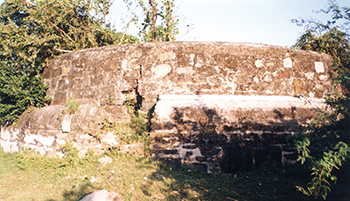
Dakhma in Bharuch constructed in the 13th century
In 1879, the respected French orientalist James Darmesteter contributed vastly to the then very poor knowledge of our sacred books by translating some of them into English. One of these was the Vi-Daevo-Datem (Laws Against the Demons), commonly known as the Vendidad. The first two chapters deal with mythical matters of the creations and counter creations of Ahura Mazda and Angra Mainyu, which appear to be recollections or remnants of an old epic and have no connection whatsoever with the general object of the rest of the Vendidad. Seventeen chapters deal with laws and religious observances/penalties for wrong doing (all this from Darmesteter). To me personally, and perhaps to many Parsi Zoroastrians like me, there is much in individual chapters that may sound absurd — if not abhorrent — in the present day context. Applying antique laws centuries later smacks of unnatural and ridiculous application.
There are certain very awkward thoughts in the Vendidad, including some perverse laws and penalties. Naturally, these have been set aside and are not being followed today by the enlightened community. If certain repugnant diktats from the Vendidad have been jettisoned with no fuss whatsoever, why should it be so sacrosanct today to follow others which some may find equally repugnant? While I do not wish to spell out these horrendous and ridiculous diktats in the Vendidad (Fargad IV, 40 & XII, 24; Farg VIII, 104; Farg VII, 107; Farg VIII, 23/65; Farg XIV, 1/4; Farg 18/67&19/72, etc), which our priests and scholars must surely be aware of, there is a need for clarification on whether these diktats are still tenable and relevant. The questions therefore that need to be answered are:
What is the logic for being selective in choosing/following diktats from the Vendidad?
Who decides which diktat is to be followed?
What was the logic behind such arbitrary qualifications?
Was there a debate to arrive at the present dispensation?
Was there a consensus?
Is there some higher authority or scripture that permits/disallows any one but not the other?
This is not to belittle the value of the Vendidad, but to highlight how some parts of the work are best not read, quoted or dogmatically accepted as truth to be blindly followed by zealous Parsi Zoroastrians. In my opinion, it would be both adventurous and foolhardy to deem the Vendidad as a religious doctrine to be followed by all good Parsi Zoroastrians when in fact there are so many injunctions that are not followed even by our priests!
If our high priests and scholars are in agreement that the references and chapters quoted in the preceding paragraphs are indeed from the Vendidad, they would also agree that some are definitely impossible to follow, let alone be in agreement with. Do we turn a blind eye to those awkward verses, completely avoid discussion on them, jettison the ridiculous regulations and pretend to the average Parsi Zoroastrian that these injunctions didn’t exist in the Vendidad? And if indeed these are found ridiculous and not practiced today, why are we being forced to follow just the one diktat which some may in their wisdom find equally abhorrent — the mode of disposal of a dead body.
A few crucial questions on this aspect come to my mind, and need to be addressed rationally:
Does dakhmenashini have religious support in any holy scripture other than the Vendidad?
Is the younger Avestan Vendidad (Pahlavi Vendidad), the only scriptural authority on which we rely?
It is a widely accepted fact that the Parsis first landed on the western shores of India between the 5th and 8th centuries. There are archeological finds and evidence to suggest that the very first Tower of Silence was constructed in Bharuch (Gujarat) only in the 13th century. So how were the dead disposed of in the intervening 500 or so years between the arrival of the Parsis and construction of the first Tower of Silence in India?
If we are comfortable about rejecting many other diktats from the Vendidad, why should dakhmenashini exclusively remain a must?
What makes dakhmenashini an all-important "religious” tenet – not following which makes a Parsi Zoroastrian an "outcast?”
Surely, if dahkmenashini was such an all-important religious tenet there would have been (even vaguely) a reference to it in the Gathas? The language of the Gathas predates that of the Vendidad and it reflects ideas and tenets closest to what our revered Prophet preached about his new, good religion. You will agree that the abstract thoughts and concepts in the Gathas are truly elevated — philosophical, metaphysical and brilliant in conception. The Vendidad, on the other hand, deviates completely from those lofty ideas and ideals and is earthy, rigid and in places utterly abhorrent.
It is my firm belief that all practicing Parsi Zoroastrians need to be enlightened about many such issues. Seeking clarifications is a litmus test that the Parsi Zoroastrian community is thinking, investigating and most importantly concerned about extracting unbiased and factual answers from the high priests in whom the community has reposed faith and trust! I had made an attempt to ask one of our respected high priests a question or two on some of these issues during a talk on dakhmenashini given by him in Bangalore. To say the least, the answer was vague and rancorous! In my opinion, answers must be not only unbiased and willingly given, but accompanied by relevant scriptural references. There should be no rancor or superiority and the priests should overcome the feeling that they are under siege! Enquiry, if honest, needs to be encouraged and indeed nurtured.
The Parsi Zoroastrian community should never ever be denied answers from those who are the custodians of this knowledge — unless of course, it is mandated somewhere that religious matters are to be kept "secret” and made available only to the select religious elite! Our Prophet exhorts us in the Gathas to debate, investigate and come to the right conclusions. He even mandates that the learned should disseminate knowledge for the benefit of the laity and the uninformed. May I most humbly urge our priests, scholars and elders to clarify, answer and unravel these dark "secrets!”
Parsiana requested London based independent researcher on Zoroastrianism Farrokh Vajifdar and the principal of the Dadar Athornan Institute Ervad (Dr) Ramiyar Karanjia to give their thoughts on the points raised by Major.
(Left): James Darmesteter; Dr John Wilson
Vajifdar clarifies
The two cornerstones of Zoroastrianism are the Gāthās and the Vandīdād. The first may be broadly considered as salutary and reflective, advancing the science of the mind — they constitute a code for moral right-living. The Vandīdād contrasts as sanitary and prescriptive, the science of the body, and a code for physical well-being. As complementary texts, the Latin tag mens sana in corpore sano (a sound mind in a healthy body) fits holistically.
The "demons” in the Vandidad’s title are malicious agents of infection, disease and sickness. To authenticate it for a rural priesthood, its composers invoked the highest authorities, Zarathushtra and Ahura Mazda, the former addressing a range of queries dealing with corruption, decay and contagion from corpses, the deity replying with purificatory remedies.
The ethical Ahuric doctrine is boldly stated: "Purity is for man, next to life, the greatest good — that purity which is procured by the law of Mazda to him who cleanses his own self with good thoughts, words and deeds.” It is concerned overall with purity; both ethical and ritual laws underpin this priestly code.
"… It cannot be said that the Parsis even now have any familiarity with the hymns which in theory stand at the center of their religion… The people collectively worship the Gathas, but it is the Vendidad that makes their religion” [James Hope Moulton, Treasure of the Magi, (1917) pg 225].
Moulton, usually very inspiring in his reading of the Gathas, declared it "a distasteful task to dwell on the drivelling nonsense which fills so large a part of the Vendidad.”
The authors of the Vandidad and the Nirangistan "were anxious to preserve the ancient laws of the Magi, which threatened to fall into desuetude, and at the same time to elaborate them in a spirit of narrowness and bigotry ...They are so busy with regulations which are often fictitious and sometimes absurd that they throw nearly no light on contemporary reality, except, of course, on the authors’ state of mind” (Walter Bruno Henning, Zoroaster: Politician or Witch-doctor?1951).
The glaring difference between the monotheistic Zarathushtra of the Gathas and the priestly mouthpiece set up in his name to ask the most infantile questions does not stand scrutiny.
The Vandidad is a thoroughly dualist, long-gestated text (4th century BCE to 11th century CE) — Ahura Mazda versus Ahriman, and is a composite work with chapters on geography, legendary history, laws of contract, on outrages against the person, the various degrees of sins with their punishment and remission, on pollution and purification, the dakhmas, on cleansing, on sexual conduct and misconduct, the care of dogs (and beavers), on good and false priests, and on healing. Its collection of 22 chapters suited the rural mobadhs and herbadhs who had busily adapted their ritual practices to the life of the cities.
It is gratifying to note that the retired Air Chief Marshal has forthrightly tackled this awkward text in translation by the evergreen Darmesteter. The French scholar had associated with K. R. Cama, the priests Ervad Tahmuras Anklesaria and Sir Jivanji Modi, with whom he discussed points of ritual and prescriptions from the Vandidad. He made sober observations with which his still serviceable translation is pertinently studded. In discussing its quirkily disproportionate penology (scales of punishments), he was "doubtful whether the legislation of the Vendīdād has ever existed as real and living law.”
Major is wasting his energies in trying to obtain credible answers from the very priesthood which has utilized select parts from the Vandidad to justify its regressive viewpoints. The text remains coherent on the dakhmas for the safest method for disposal of the dead used then.
On the dakhmas which preoccupy Major’s article, the main requirements for their functioning were: to be sited on heights well away from human habitation, from water supplies, and from arable land. The need for preservation of scarce water sources and dearth of agricultural land prompted an awkwardly framed series of environmental measures for their protection.
Concerning Major’s highly relevant questions, the substance of which is answered above, there is a perverse logic to present-day selections to form new dogmas. Had thinking Parsis examined the Vandidad for themselves, they would have summarily thrown out these priests and exposed their motives. None of their "diktats” are valid – they are not religious tenets in any respect; neither is their much vaunted but bogus "religious” calling.
There is no consensus; the call for debate is pointless and fruitless — in the absence of true learning it cannot be otherwise! Is there a higher authority to whom appeal may be made? Yes, the sage Zarathushtra who, in his Gathas (especially Ys.32) has exposed false priests as deceivers and destroyers, doomed in their very lifetimes to misery and extinction. He did not mince His words!
In responding to Major’s further questions: Dakhmenashini is a social set of customs and regulations; not being religious, one would not find support for it in any genuine religious text. Inasmuch as the Vandidad is "religious,” whatever exists on the subject has been abundantly supplied with a pseudo-religious gloss – by introducing Zarathushtra and Ahura Mazda as interlocutors — which suited the impressionable of its times, yet fools the gullible to this day.
Regarding the early/first Bharuch dakhma, I have no reliable information on it. In answer to how the Parsis disposed of the remains of the deceased, there is the evidence by the 14th century missionary Friar Odoric of Pordenone who visited Thana (north of Bombay), that the Parsis of the time exposed their corpses in open fields away from human settlements. In fact the Vandidad alludes to the earliest methods, before the development of walled dakhmas, of open exposure on hillsides with the remains being weighted down with heavy stones so that wolves and pi-dogs could not drag away polluting fragments into irrigation canals and cultivated fields.
Major will not find any references to death or dakhmas in the Gathas; as indicated, they are a moral code for the living! The Vandidad too deals mainly with preservation and protection of the living from infections and accidentally contracted pollution from dead matter.
Why do the clerics fail to recognize the clearly sequenced warnings on the stench, pollution, noxious insects (from standing water), and infections arising from within the dakhmas (VII.53-58)? How and where were domesticated canines’ corpses disposed of?
Expected answers will range from "Don’t know,” "Propaganda by trouble-makers” and "Destroyers of religion” to "Unquestioned age-old customs and traditions!” The "vague and rancorous” replies of the high priest in Bangalore should illustrate these points. Do spare him further embarrassment; just refer him to the Vandidad’s Questions and Answers from III.9:
(Zarathushtra): "O Mazda... Which is the third place where the earth feels sorest grief?”
(Ahura Mazda): "It is the place whereon stand most of those dakhmas on which corpses of men are deposited!”
Karanjia explains:
Vi-daevo data (Vendidad) is one of the most important and valuable Avestan texts as it has invaluable information about the laws, customs and practices of Zoroastrians. Today, the Vendidad is our prized possession as it is the only one of the 21 Nasks (volumes of scriptures given by Prophet Zarathushtra) which has survived in entirety. The word Vendidad means "laws against daevas.” In Zoroastrianism, the word "daeva” connotes all types of physical, mental, moral spiritual evils and negativities.
The text of the Vendidad is divided into 22 chapters called Pargarads. They cover topics on teachings, observances and practices of the religion. It has information on topics like Ahura Mazda, the Ameshaspands, Yazads, Prophet Zarathushtra, the Mazdayasni religion, qualifications of a priest, ecology, life after death and dakhmas.
Many Zoroastrian customs and practices, followed or supposed to be followed in the present times, like use of taro, the bareshnum ritual, consecration of atash behram, fumigation, menstruation, practices for cutting hair and nails, paevand (ritual connection), keeping naso away from natural elements like fire, water, earth and plants, aversion to other modes of disposal, the vocation of nassessalars and practice of Sagdid can be traced to the Vendidad. Major is not entirely correct when he mentions that dakhmenashini is the only practice from the Vendidad which is still being followed.
It is difficult to understand a few of the injunctions of the Vendidad and hence it has come under attack as a text composed in primitive times. These attacks were first started by the Christian missionary Dr John Wilson in 1833. If one studies the text of the Vendidad closely and dispassionately one realizes that the core teachings of the Gathas are consistent with the Vendidad.