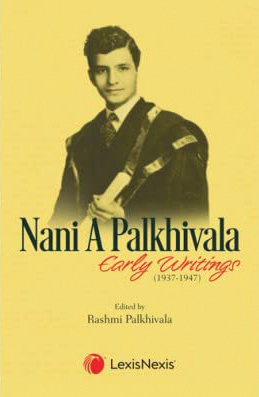
Nani A. Palkhivala: Early Writings (1937-1947) edited by Rashmi Palkhivala. Published in 2023 by LexisNexis, 14th Floor, Building No. 10, Tower-B, DLF Cyber City, Phase II, Gurgaon 122002. Pp: xxxv + 449. Price: Rs 895.
After a spate of publications of varying quality aimed at offering posthumous homage to Nani Palkhivala or perpetuating his memory (often both) in the two decades since his death, here comes a volume which should bring undiluted cheer to the many admirers of that great son of India. It is a collection of Palkhivala’s writings as a young man, and deserves to be welcomed at many levels.

For a start, the articles included in the collection show the unmistakable promise that Palkhivala held out even in his formative years, despite the many personal handicaps that he suffered from, all of which have been described at length in biographical sketches. As a preface to this volume notes, these essays not only provide an insight into the gradual development and finessing of Palkhivala’s unique style of speech and writings but also reaffirm his love of literature, his commitment to human values, his wide interests and his willingness to speak out whenever injustice was done, all of which qualities he so vividly demonstrated in his later life.
At another level, the book should be an inspiration to today’s youth, many of whom, having being brought up on a diet of frothy pap emanating from soul-destroying sources of cheap entertainment, have never been exposed to good, uplifting writing. What the book particularly illustrates — and this should be a matter of great sadness to many — is the precipitous fall in writing standards in India in just half a century (and it is worth noting that the young Palkhivala did not have the fortune of attending a fancy public school or receiving expensive personal tuitions but managed, through sheer personal effort, to develop his powers of observation, analysis and expression).
The range of topics covered is truly astounding and captivating. Arranged under six broad heads (Art and Literature, Law and Governance, Pen Portraits, World War II, Inching towards Independence, and Musings on Life), there are essays on English poet William Wordsworth, famous and not-so-famous diaries, poets laureate, prohibition, limitations of democracy, crime and punishment, romance of the law, letter-writing, former British Prime Minister Winston Churchill, Mughal Emperor Akbar, poet Kabir, industrialist Jamsetji Tata, German dictator Adolf Hitler, spiritualism, London, Mughal magnificence, China, advertisements, gambling in Bombay and the famous weepers of history, to name but a few. The reader can visualize the breadth and all-embracing nature of Palkhivala’s reading, not to mention his powers of comprehension, even at that impressionable age.
No less striking is young Palkhivala’s sense of humor and ability to see the absurdities, foibles and fatuities of people and situations. Sample this passage from an article he wrote shortly after Prohibition was imposed in Bombay. Referring to the resistance offered by the government to the avalanche of criticism that followed the decision, he says of a speech by one of the defending Ministers: "Mr Patel’s diabolically clever riposte to those who wanted Bombay to follow the example of Madras, was that Bombay is not Madras. Mr Patel presumably meant that Bombay is not Madras in so far as the gods have made a disconcertingly uneven distribution of political wisdom between the two provinces, and have moreover endowed fools with a mysterious tendency to rush in where angels fear to tread.”
Or this wry observation on the shortcomings of democracy: "The man who knows how to humbug and hypnotize the public, (sic) stands a good chance of being elected to a number of bodies: from the Board of Trustees of the Parsi Panchayat (sic), to the central Council of State.”
Or this comment on the frequent resort made by some to religion when pressing arguments that are highly debatable or dubious (notice also the dig he makes at members of his own community who opposed Prohibition on the grounds that wine was absolutely necessary for religious rituals): "Oh, Religion, I say, how many things are demanded in thy name! It is heart-breaking to see zealous Parsis who would be at sea if asked the mere names of their religious ceremonies, prattling through their hats about the necessity of wine.”
The book is not only amusement, of course. It contains much else besides, including knowledge, information, captivating invocations of a bygone era and some pearls of wisdom. "I should,” says Palkhivala, talking about biographies, "consider it a very sound principle, always to read a book about the author of the book you are going to read.” His advocacy of the arts and literature is encapsulated in his dictum that "nations do not mind spending thousands of millions of pounds every year on war. But which nation is prepared to spend even a thousandth part of that sum on its artists and men of letters?”
There is an essay in which the young Palkhivala makes some surprisingly trenchant observations about the deficiencies of India’s leaders during the struggle for independence from the British. "A few towering political personalities have,” he moans, "got exclusive and absolute control of the roaring loom on which they weave the garment of India’s destiny.” Specifically on the major players, here are his considered verdicts: "The Hindu leader V. D. Savarkar is at present absorbed in talking as M. A. Jinnah is absorbed in acting; neither has the time to think”; "There is also my Councillor Dr B. R. Ambedkar who thinks a depressed class leader the greatest character in the world and himself the greatest depressed class leader of all times”; "Gandhi… is an archangel, a little damaged. The damaged side of him has been evident in two very unwise decisions taken by the Congress High Command under his guidance — the Quit India demand and the Resolution of August 8 (1942) ... In the midst of a great struggle between existence and extinction (i.e. the Second World War), to ask us (sic) British to quit India was about as unrealistic as asking the Himalaya to quit Hindustan.”
What about the law, an area where Palkhivala excelled and achieved a pre-eminence which remained unsurpassed for a generation or more? Writing in 1947 — at the age of 27 — he makes observations whose salience has, far from diminishing, grown over the years: "Today laws are being added to the statute book of India in appalling numbers. Of the ancient Germans it is said that they proposed new laws in their legislature when drunk and considered their passage when sober. Many of our new laws seem to be proposed by the legislators while in mental state similar to that of the old Germans.”
Dissection of social ills is another area where Palkhivala brings his intellectual acuity to bear in an impressive way. Take his thoughts on gambling which rose rapidly and alarmingly in wartime Bombay, partly as a result of a growing population and partly due to the insecurity of the times. Palkhivala sets his face sternly against tough legislation, noting that it would be a wrong remedy. What needs to be done instead, he says, is to relieve "the dullness and monotony of the poor citizen’s life by providing him with proper education and rational amusements, with wider interests and a more serious but not less cheerful, view of life generally.” So far, so sensible. But those who have known and admired Palkhivala as one of India’s most articulate and vociferous opponents of state intervention in human affairs will be a bit surprised by his further prescription that "it is the duty of the State to provide interesting, intelligent and beneficial interests to occupy the people’s leisure.”
This is a book which merits wide circulation among India’s youth. Perhaps the Memorial Trust set up to perpetuate Palkhivala’s memory should undertake a mass distribution program covering all the leading high schools and colleges around the country. Rashmi Palkhivala (pictured, on pg 31), a niece-by-marriage, deserves praise for putting this volume together. The printing and production leaves a little to be desired, and the proof reading could have been more meticulous. What many discerning readers will also lament is that the articles included — most of which appeared originally in now-defunct publications like Mumbai Vartaman, Sanj Vartaman and Rast Rahbar — do not carry their dates of publication, the addition of which should not have been difficult, especially if the pieces were culled directly from those sources.
VENKAT IYER