Some readers of "Memories of Malcolm Baug” (Parsiana, August 7-20, 2023), were especially intrigued by a wartime episode I mentioned in it concerning my late father, Pessie Cooper. I had brought it up fleetingly, only to make a point. But the readers wanted to know more. In looking for details I discovered that my recollection of family lore about that incident was not entirely accurate.
So, this is both an amplification and a correction.
During World War II my father served in the British colonial Royal Indian Navy. I wrote that when his ship was sunk off the coast of Burma, he somehow survived and eluded capture by the enemy by fleeing to India through the Burmese jungles. This bit of family history came to mind years later as I watched him working at home with the same resourcefulness to hoard precious water before the day’s municipal supply ended.
Except, my father did not need to flee through the jungle ahead of a ruthless Japanese advance, as so many Indian expatriates then working in Burma did. He was among the lucky few who were ferried out of harm’s way by ship.
In describing the incident, I had relied on my recollection of a story related in the family, but in this instance my memory turned out to be faulty.
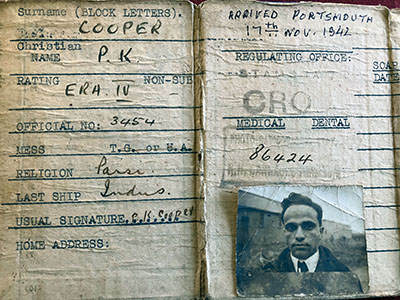
Pessie Cooper’s naval ID card
In seeking answers to the readers’ queries, I turned to a participant in that distant event — my father. No, he was not around to consult in person. But I had a video of him from the early 1980s, a few years before his death. My brother and I had persuaded him to speak at some length about his life, including his wartime experiences. We had the presence of mind to put a camcorder in front of him.
I had misplaced that video until recently and did not have it to refresh my memory when I wrote the Malcolm Baug memoir. (Note to myself: organize your family archives). In summary, this is what he told us:
The ship he served on, HMIS Indus, was lightly armed and used as a minesweeper to escort convoys to Burma which, like India, was then a British colony. The Indus was guarding the Burmese port of Akyab (now Sittwe) in the Bay of Bengal when Japanese warplanes dropped bombs on the vessel. The bombs struck the ship’s "quarterdeck” (the command center at the stern), my father said. As the ship’s engineer, he was in the engine room, in the bowels of the vessel, when the attack began. But he managed to extricate himself and leap into the waters. He and other crew members made their way to the tenuous haven of a British military outpost on shore that itself was beleaguered.
For weeks survivors of the Indus and their hosts endured hunger and other privations as the Japanese, having chased the British out of Rangoon, pounded Akyab to the north, a strategic port and airfield. In the fog of war, families of the Indus crew feared the worst. Had a friendly ship not turned up unexpectedly, before the Japanese captured Akyab, the survivors’ next best escape route likely would have been through the jungles.
An estimated half million Indians — laborers, administrative officials, professionals — took to perilous jungle paths as they fled jobs and homes in Burma. An uncounted number did not make it to India, falling victim to hunger, disease, marauders or Japanese air attacks. The 24th Mile: An Indian Doctor’s Heroism in War-Torn Burma by Tehmton S. Mistry, reviewed in Parsiana (Books, "Road to Rangoon,” August 21-September 6, 2022), tells of the harrowing experience of one survivor of that trek, Dr Jehangir Anklesaria, a public health officer in Rangoon.
The rescue ship took my father to Calcutta. He was so emaciated and unkempt that "when I finally came home to Bombay, my mother did not recognize me,” he recalled.
Over the years, my sporadic Internet searches for more information on the sinking of the Indus yielded little. Understandably. The Indus was not as well-known as the German battleship Bismarck. Then, recently, I found fragmentary references online.
They reveal that the attack that sank the Indus occurred on April 6, 1942. Targeted by Japanese Mitsubishi G3M bombers, the ship took three direct hits and sank in 35 minutes. Fortunately, all the crew survived though 10 suffered unspecified injuries. I do not know whether my father was among them. I did not think to ask, and he did not say.
As it turns out, the Indus was at Akyab that day only because the local British fleet commander had declined an option from his superior to withdraw to safer waters.
This feels like a good opportunity to note that more than two million Indians served in the allied ranks during the war. Nearly 90,000 died. They served in nearly every theater of the war. The motivation for enlisting in the services was often economic. My father said he joined the navy in 1938, the year before war broke out, mainly because it paid Rs 75 a month, Rs 25 more than he earned working for the railways. The recruiting slogan also promised that those who enlisted would travel the world. Going to war to save humanity from tyrants was not on my father’s mind when he signed up. But he was steadfast in doing what he felt was his duty, serving on multiple warships throughout the conflict.
He and others who survived that conflict returned home unsung. The side they supported with their toil and blood was not very popular at home. They had reason to be conflicted because even as the British campaigned to save freedom in Europe, Indians were struggling to be free of Britain. In 1942, the campaign for independence was reaching a crescendo. That August, Mahatma Gandhi and the Congress party launched the Quit India movement.
A handful of those who served in the colonial military — future Field Marshal Sam Manekshaw comes to mind — did earn plaudits, but for their service to India after independence. Manekshaw, incidentally, was grievously wounded by Japanese bullets in the land war in Burma.
So, like so many others, my father returned home, resumed civilian life, married, raised a family, worked hard to support them, and almost until the end of his life said very little about his war years.
PORUS P. COOPER
New Jersey, USA
poruscooper@hotmail.com