Palcare assists the families of terminally
ill cancer patients to deal with medical and psychological issues
Parinaz Gandhi
"When I lost my husband to cancer and I saw, firsthand, how difficult the end can be, I felt the need to help others in the same condition so that their plight could be made easier,” declared Pheroza Bilimoria, founder trustee of Palcare, a homecare palliative service that she launched for Bombayites. Within a year of enrolling their first patient in December 2015 they were able to register 181 patients of whom 129 expired, 80% at their residence, 13% at the hospice and seven percent at the hospital. Patients generally prefer to spend their last days amidst their family and "to die at home in dignity.”
(From left) Jimmy Bilimoria, Pheroza, Rishad and Leila Bilimoria
(From left): Deepak Parekh, Ishaat Hussain, Keki Dadiseth, Rustom Mehta
The compassionate care the 12-member Palcare team of doctors, nurses and psychologists extends to patients suffering from terminal illness and their families is quite the reverse of what Pheroza experienced just before husband Jimmy succumbed to lung cancer in 2013. "There is nothing more that can be done. Take it as it comes.” Pheroza recalls the words of the oncologist when Jimmy’s lung cancer recurred and refused to respond to treatment despite consultations with specialists even in the UK. "Jimmy never smoked. It was I who smoked,” states Pheroza, candidly admitting that her feelings of guilt made her quit smoking once he was diagnosed with cancer in 2011. In his case cancer was not caused by constantly inhaling carcinogenic fumes, the doctor reassured her, but due to a genetic predisposition since he came from a family where his father, paternal uncles and sister had died of cancer.
When he was at the last stage, they tried a suction pump to ease the discomfort in his throat which, in retrospect, she learnt was not the right move for a patient like him. How much morphine to be administered to keep the pain in control… When to switch a patient to a catheter…were some of the medical conditions that were never explained to the family. "We felt so handicapped by not having an experienced medical consultant to guide us (in the final days) that Jimmy once felt ‘we have been abandoned.’” On relating her helplessness to an overseas family member, she was told, "Why did you not opt for palliative care?”
A new concept for her, she spent the year following Jimmy’s demise researching palliative care. Pheroza learnt that the only other institution in Bombay that offers palliative care to cancer patients is the Tata Memorial Centre (TMC) whose service is restricted to the underprivileged who have been treated at their Hospital. She consulted experts in the field of palliative care like Dr Mary Ann Muckaden, professor and head, department of palliative medicine, TMC and president of the Indian Association of Palliative Care (IAPC), as also Harmala Gupta, founder of CanSupport in New Delhi that has 19 medical teams supporting 2,400 patients, and Dr R. Akhileswaran who was the chairman of Singapore Hospice Council, the umbrella body for all hospice and palliative care organizations in Singapore. Ever eager to expand her knowledge on the subject, two days after the interview with Parsiana on February 6, 2016, Pheroza was looking forward to attending a conference at Coimbatore organized by the IAPC.
Jimmy being an independent director of Tata companies, during his illness and even after his demise, Ratan Tata, chairman emeritus of Tata Sons, had repeatedly reassured Pheroza saying, "If there is anything you need, let me know.” Before she could firm up her plans, she approached him, seeking his guidance on her vision to make palliative care available to the common man in Bombay. "It was thanks to his leap of faith in me and his generosity that The Jimmy S Bilimoria Foundation got off the ground and I will always be indebted to him,” declared Pheroza. She was equally appreciative of the "constant support” from the Tata Trusts and R. Venkataramanan in particular for lending a guiding hand right from the start. From drawing up a business plan to formulating a trust deed, to hiring committed professionals, the right contacts encouraged her to pursue the palliative path.
"The preeminent board of trustees that we are fortunate to have with us has been just marvelous,” exults Pheroza. The seven-member trust board includes Deepak Parekh, chairman of India’s premier housing company HDFC Limited; Ishaat Hussain, director of Tata Sons and several other Tata companies; Keki Dadiseth, erstwhile chairman of Hindustan Unilever; Rustom Mehta, chairman and managing director of Autogenous Welding Company Private Limited. Alongside them are three members of the Bilimoria family: Pheroza, a well-known personality in media and marketing communications in India, being a founder member and subsequently managing director of Business India Publications; her son Rishaad, a principal at the Tata Opportunities Fund; and daughter Leila, associate vice president at GolinOpinion, the Public Relations Division of Mullen Lowe Lintas Group.
The task became clearer once she got on board Dr P. Jayarajan from Kerala as the chief medical officer with whom she finalized the procedures/protocols/documentation that would be required before registering patients for their Palcare facility. Describing him as a "God-send,” Pheroza added, "he has been the backbone of the medical side.” Since Palcare’s primary focus is to make end-stage cancer patients’ last days comfortable and emotionally stable (though they do look after patients with other chronic ailments too), their nursing staff have undergone the six-week certificate course in palliative care conducted by TMC. "There’s no place like home” being their maxim, they direct their efforts towards that end. Palcare does not provide 24x7 nursing at home but the team members make home visits to monitor the patient’s condition periodically, instruct the caregiver and ensure that the prescribed protocol is on track. They have a 24x7 helpline so that patients and caregivers have the comfort of knowing that advice on emergency issues is only a phone call away.
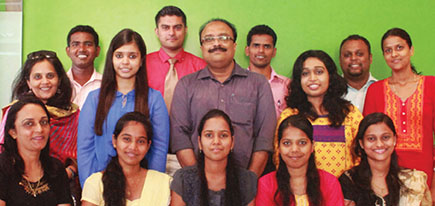

Dr P. Jayarajan (standing center) with the Palcare team
A major challenge, admits Pheroza, lies in finding the right medical team, those blessed with compassion, for these patients need "a certain kind of handling.” Generally doctors expect that they will "cure patients. Here they have to unlearn that, to accept that a patient will not live long, maybe a week to one year, but within that period to make the patient’s life as comfortable as possible. If there is proper pain and symptom management, patients are able to enjoy family and friends” until the end, observes Pheroza. The Palcare team is required to not only manage the patient but frequently the family too. "Most often the patient is prepared for death,” and counselling is geared more for the family. In their first year of operations, 59% of the patients were females and 82% from the lower and middle income groups. For those who cannot afford, Palcare arranges to give them free medicine.
A core team of volunteers is also required, realizes Pheroza, "the right kind of volunteers who would be willing to go to the slums if need be and not only those who want to have a cup of tea.” Companionship could be offered to patients by reading to them or playing games with them, or under the respite program, to spend several hours with them so that the caregiver can have some time off. Currently 80% of the Palcare patients are referrals from TMC, the rest come through word of mouth recommendations. The mortality rate of cancer being 70-80%, Pheroza explains that in India, in the absence of proactive or preemptive screening, diagnosis often comes too late.
The current corpus of Palcare stands at Rs 50 lakhs but Pheroza would like it to cross Rs 10 crores so that the interest can supplement the initial funds raised. As per the financial highlights for the period April 1, 2015 to August 31, 2016, carried in the Palcare brochure, Tata Trusts have sanctioned a grant of Rs 299.76 lakhs (of which the first instalment of Rs 131.72 lakhs has been received), Mahindra Foundation donated Rs 50 lakhs, individual trustees contributed Rs 51.42 lakhs, other trusts Rs 41.46 lakhs, corporations Rs 28.50 lakhs and patients Rs 3.06 lakhs. "Very few donations are given for the corpus; most are for operating costs,” states Pheroza, mentioning that their expenditure in the first year was nearly Rs120 lakhs.
Until Palcare completes three years it is neither eligible to receive donations under the Corporate Social Responsibility initiative nor permitted to get funds from abroad under the Foreign Contributions Regulation Act. "Every drop of funding counts and each drop is invaluable to Palcare,” notes their appeal for funds soliciting donations that are tax exempt, in the name of "The Jimmy S. Bilimoria Foundation.” They may be forwarded to 7C, Trust House, Next to Global Hospital, Dr E. Borges Road, 35, Hospital Avenue, Parel, Bombay 400012; tel: 022-65512551; email:
palcareindia@gmail.com Introduced on the Palcare website as the first woman president of the Advertising Club Mumbai, the Advertising Standards Council of India and the India Chapter of the International Advertising Association, Pheroza says that her marketing skills "are a little jaded now.”
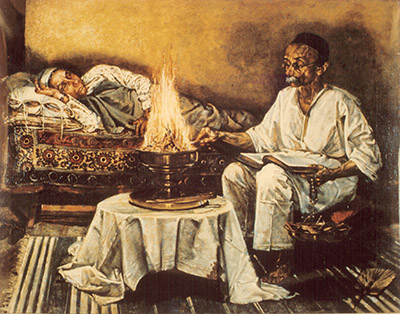
Pestonji Bomanjee’s oil painting Praying for the Sick
Jimmy was more religious than she and said his Zoroastrian prayers with regularity as also one Christian prayer that was shared with him by a nurse at the Breach Candy Hospital when he suffered from a major setback due to his G6PD deficiency. Pheroza reveals that she knows her basic Zoroastrian prayers and visits the agiaries for muktads and other prayers but is more drawn to Meher Baba whom she respects as "a prophet of God, having helped me through certain crises and put me in the right direction.” When her mother Nargis passed away in 2015, hers was the first prayer meeting that was held at the newly opened Prayer Hall at Worli, Pheroza reminds us. She appreciates that her father Fali K. F. Nariman, a well-known banker, taught the family "to value principles like honesty, integrity and to treat all individuals equally.”
For Palcare, "our values originate in the belief that every individual, rich or poor, irrespective of gender, religion, caste or creed, has the right to have a dignified existence — not only in health but in sickness too, and to the very end.”